Vicksburg, Mississippi, is familiar to history buffs because it was the turning point of the Civil War. From May 18 to July 4, 1863, Union forces led by Gen. Ulysses S. Grant besieged Vicksburg. Photographs of that time period show hundreds of caves dug into the hillside between the town and the Mississippi River; residents sheltered in the caves because Union gunboats lobbed over 20,000 shells into the town.
Conspicuous atop Vicksburg’s main hill in old photographs is the grand, white, columned courthouse with expansive pediments and a towering cupola. While it can no longer be seen from the Mississippi River because it’s obscured by 163 years of tree growth and development, it has been preserved as the Old Court House Museum and is packed with treasured artifacts. And one, in particular, has a story that resonates to this day.

The Vicksburg courthouse is an architectural feast for the eyes. Deena Bouknight
Couldn’t Bear to Take the Shot
Approximately 39 years later, America’s 32nd president, Theodore Roosevelt, traipsed in the woods about 30 miles outside of Vicksburg. An adept hunter, he was on a hunting trip at the invitation of then-Mississippi governor Andrew H. Longino. Famously, as the story goes, Roosevelt’s hunt was a failure. However, so as not to disappoint the president, some hunting assistants overwhelmed an old black bear, tied it to a tree, and summoned Roosevelt to shoot it.

A cartoon sympathetically depicting Theodore Roosevelt refusing to shoot a bear. Public Domain
Roosevelt refused, citing unsportsmanlike conduct. Newspaper articles and political cartoons lampooned the president’s hunt, but his refusal to shoot the tied-up bear resonated with Americans. About a year later, the story so motivated a Brooklyn, New York shop owner that she created a stuffed toy bear and obtained permission from the White House to call it the “Teddy Bear.”
The Teddy Bear became a toy that continues to appeal to children more than a century later.
In fact, when Roosevelt returned to Vicksburg in 1907, he gave a young boy named Homer Smith a Teddy Bear because Smith presented him with flowers. That 119-year-old Teddy Bear is now in in the historic courthouse as part of a special exhibit focusing on the Roosevelt’s bear hunt and the origins of the Teddy Bear.
Vicksburg Courthouse
Related Stories


An antique teddy bear graces the case at the museum. Deena Bouknight
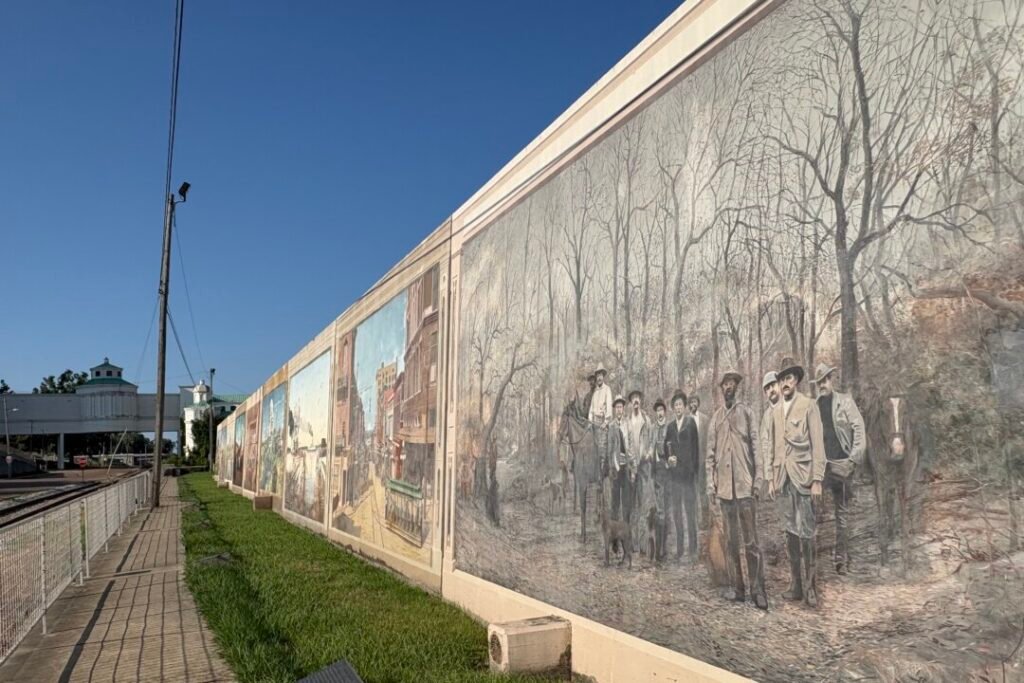
Many visitors to and residents of Vicksburg are familiar with its Civil War history, but they don’t know the story of the bear. That is, until they peruse the Vicksburg Riverfront Murals. These visually convey the town’s history through detailed paintings on flood-wall panels. Among the 32 panels is an almost realistic depiction of that November hunt in 1902. The trees are bare of leaves, Roosevelt sits astride a horse, and hunting dogs are at the feet of the guides assisting him.
A few blocks up the hill from the murals, past antebellum homes, is the courthouse. Just up the first flight of decorative, cast-iron stairs inside the massive, two-story structure is the “Teddy: A Bear and a President” display.

An exhibit explains the history of Roosevelt’s visit and the origin of the Teddy bear. Deena Bouknight
Visitors can learn all about Roosevelt’s hunting trip and the Teddy Bear’s roots through the exhibit’s historic photographs, political cartoons, famous quotes, and more. Along with the Teddy Bear that Roosevelt presented to the Smith boy, the exhibit also displays a black and white photograph of Roosevelt speaking in Vicksburg when he returned in 1907, as well as an original copy of the 1906 ‘The Roosevelt Bears: Their Travels and Adventures” by Seymour Eaton.