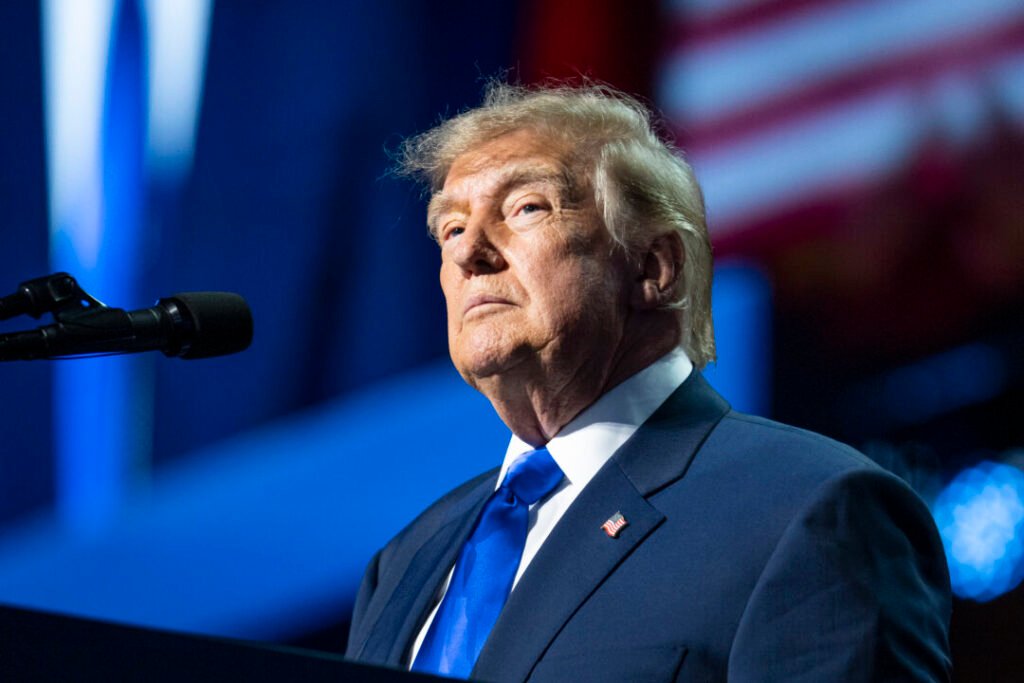

President Donald Trump speaks during the 2026 Republican Midterm Convention in Dallas on Sept. 9, 2026. Madalina Kilroy/The Epoch Times
President Donald Trump suggested on Sept. 11 that he would consider allowing Chinese automakers to build cars in the United States.
In an interview with Fox News, Trump dismissed the possibility of allowing imports of Chinese cars into the United States, saying the U.S. market would be overrun if such imports were allowed.
“We don’t allow his cars into the United States, and I never did,” he said, referring to Chinese leader Xi Jinping, adding that President Joe Biden had kept his policies on Chinese cars.
Trump suggested that he may be open to Chinese automakers building factories in the United States, but they would have to hire American workers.
“If China wanted to come in and open a plant to build their cars here, I’d be okay with that. Japan does it, but they hire our people. The big thing is they hire our people,” Trump said.
“What I don’t want is them to build in Mexico and just … build it inexpensively and ship it across the border.”
Related Stories


A regulation imposed by the Biden administration in early 2025 effectively bans all Chinese automakers from selling or building passenger vehicles in the United States. Washington also maintains more than 100 percent tariffs on Chinese electric vehicles.
The Alliance for Automotive Innovation, a Washington-based group representing major U.S. automakers, on Sept. 3 urged Congress to permanently ban the sale, import, and manufacture of Chinese connected vehicles, hardware, and software before the current congressional session ends.
“Right now, Chinese automakers are dumping subsidized vehicles with connected software and hardware around the world,” John Bozzella, the group’s president and CEO, said in a letter to the congressional leadership.
Bozzella warned that China is gaining market share in Europe, Australia, Southeast Asia, Mexico, and South America with vehicles that can collect, process, and transmit “sensitive vehicle and consumer data to the Chinese Communist Party.”
It hasn’t happened yet inside the United States, he said. He urged lawmakers to act quickly, given the scale and urgency of the threat.
Reuters contributed to this report.