UP Ration Card List 2026: The Complete, No-Nonsense Guide to Checking Your Name Online
If you live in Uttar Pradesh and depend on the Public Distribution System for your monthly wheat, rice, or sugar, there is one website you cannot afford to ignore: fcs.up.gov.in.
Every year, millions of families in UP check the Ration Card List UP to confirm whether their name is still on the government’s radar for subsidised food grains. But 2026 has brought a new twist. The rules have tightened, e-KYC has become mandatory, and thousands of ineligible names have been removed from the system. If you haven’t checked your status recently, now is the time.
This guide is written for real people—not bureaucrats. Whether you are a smartphone user in Lucknow, a farmer in a remote village, or a family member trying to help an elderly parent, this article will walk you through exactly how to check the UP Ration Card List, what your entitlements are, and what to do if your name has vanished from the list.
What Exactly Is the “Ration Card List UP”?
Before we dive into the clicks and taps, let’s clear the confusion. When people search for “Ration Card List UP,” they are usually looking for one of two things. The first is the NFSA Eligibility List—a public document that shows every household in a particular fair price shop’s area that is legally entitled to receive subsidised grain. The second is the beneficiary status—a personal check to see if your specific family is on that list.
Under the National Food Security Act (NFSA), the Uttar Pradesh Food and Civil Supplies Department publishes this data online. The list is organised by a hierarchy that feels very familiar to anyone in UP: District → Block/Town → Gram Panchayat/Ward → Fair Price Shop (Kotedar). This means you don’t need a password or a login to see the list. It is a public record. However, seeing the list and understanding what it means for your kitchen are two different things.
In 2026, the UP government has been aggressively cleaning up this list. Reports from districts like Hapur show that tens of thousands of names have been struck off because they were found to be income-tax payers, government employees, or owners of four-wheelers. The logic is simple: the state wants to ensure that the heavily subsidised—and currently free—grain goes only to the genuinely needy.
How to Check Your Name in the UP Ration Card List (Step-by-Step)
The official portal, fcs.up.gov.in, is the only reliable source. Ignore WhatsApp forwards that promise direct links; they often lead to phishing sites. Here is the exact process you need to follow, whether you are on a mobile phone or a desktop.
Method 1: The Standard Drill-Down (Best for Finding Neighbours & Yourself)
This is the most common way to check the list. It does not require your ration card number, which makes it perfect if you have lost your card or forgotten the number.
Step 1: Open your browser and go to fcs.up.gov.in.
Step 2: Look for the link that says “NFSA Eligibility List” or “राशन कार्ड की पात्रता सूची” under the “Important Links” section.
Step 3: A table of all 75 districts in UP will appear. Click on your district (for example, Lucknow, Kanpur, or Varanasi).
Step 4: You will now be asked to choose between Urban (नगरीय क्षेत्र) and Rural (ग्रामीण क्षेत्र). If you live in a city municipality, pick Urban. If you live in a village, pick Rural.
Step 5: Select your specific Town/Ward (if urban) or Block/Gram Panchayat (if rural).
Step 6: A list of Fair Price Shops (Kotedar) will appear. Click on the name of the shop that serves your area.
Step 7: The full list of cardholders for that shop will open as a PDF or a web table. Use Ctrl+F (on a computer) or the “Find in Page” option on your mobile browser to search for your surname or the head of the family’s name.
If your name appears here with a valid card number, you are in the system. However, do not stop there. Scroll down to the section on e-KYC because being on the list is not enough anymore.
Method 2: The Direct Search (Best If You Have Your Card)
If you have your 12-digit ration card number handy, you can skip the drill-down.
On the same fcs.up.gov.in portal, look for the option to search by Ration Card Number. You will be asked to enter the number, a captcha code, and then an OTP that will be sent to your registered mobile number. This method is faster but requires that your mobile number is linked to your Aadhaar and your ration card. If you have never updated your mobile number with the dealer, this method might fail, and you will have to use Method 1.
The Elephant in the Room: Why Your Name Might Be Missing
This is the part of the Ration Card List UP story that is causing anxiety across the state. In 2025 and 2026, the UP government used data from the Rightful Targeting Dashboard 2.0 (RT V-2) to identify and remove ineligible beneficiaries.
If you checked the list and your name is gone, it is likely because the system flagged you under one of these categories:
-
Income Tax Payers: If any family member files ITR, the system assumes the household is financially stable enough not to need free grain.
-
Government Employees: Central and state government employees (including postal and railway staff) were found to be holding ration cards in large numbers. These have been systematically removed.
-
Vehicle Owners: Ownership of a four-wheeler (car/SUV) or a heavy commercial vehicle is a common exclusion criterion. Even a light motor vehicle (LMV) can trigger a flag.
-
High Income: In rural areas, families with an annual income above ₹2 lakh, and in urban areas above ₹3 lakh, are being scrutinized. Additionally, business owners with GST turnover above a certain threshold (often ₹25 lakh) are being removed.
-
Death or Inactivity: The list is also being cleaned of deceased beneficiaries and those who have not lifted ration for over 6–12 months. The government assumes that if you haven’t taken ration in a year, you probably don’t need it.
A Word of Caution: Being removed from the list does not always mean you are permanently banned. If you believe you were removed by mistake (for example, you sold your car years ago, or your income has dropped), you have the right to appeal. You must visit your District Supply Office (DSO) or Tehsil Supply Office with proof (like a surrender certificate for the vehicle, or a new income certificate) and apply for reinstatement.
e-KYC: The New Normal for Ration Card Holders in UP
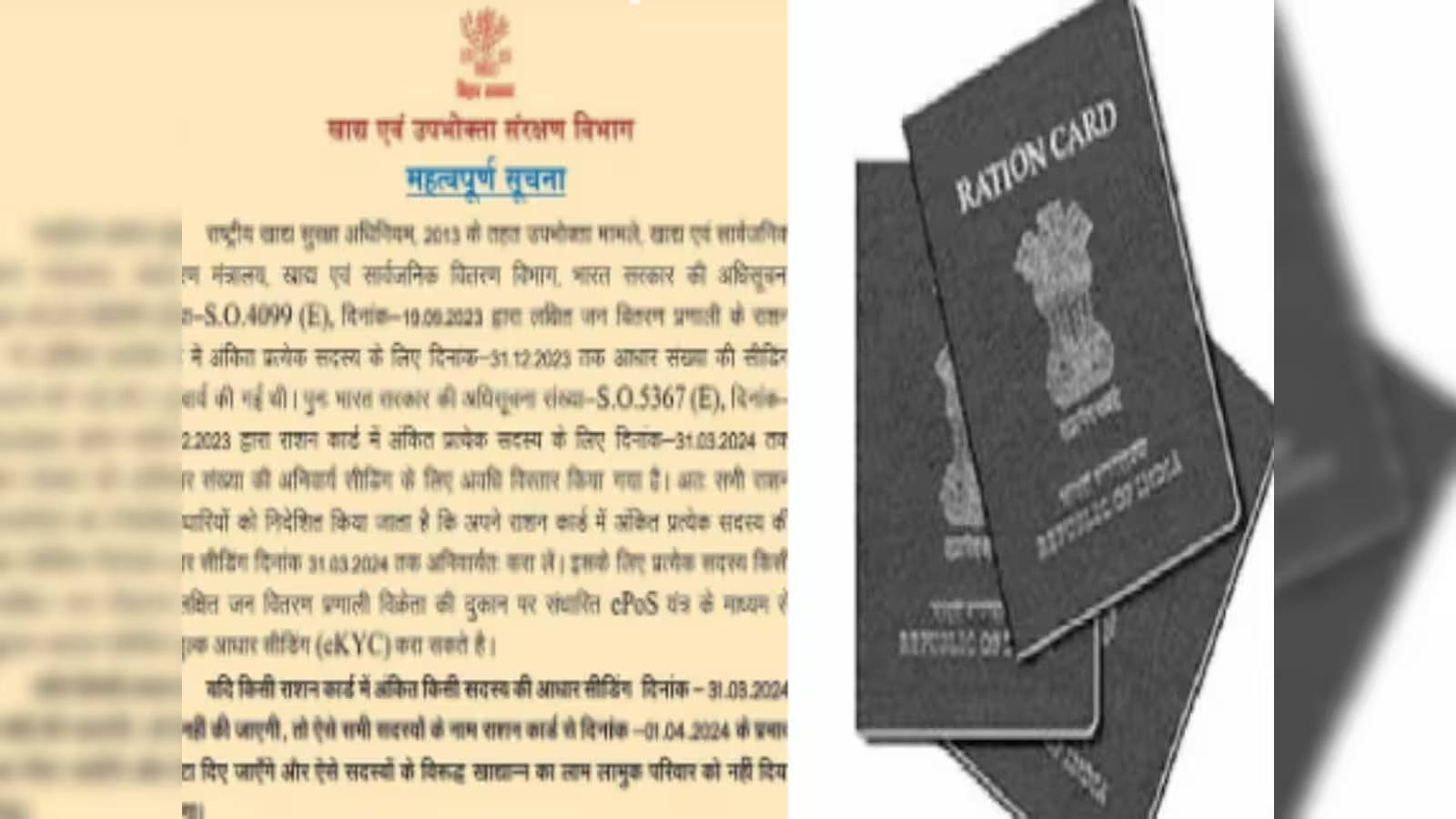
If you are on the list, congratulations. Now, the real work begins. The UP government has made e-KYC (Electronic Know Your Customer) mandatory for all ration card holders.
You might ask, “Didn’t I already link my Aadhaar years ago?” Linking Aadhaar is not the same as e-KYC. e-KYC involves biometric authentication—specifically, your fingerprint or iris scan—at the Fair Price Shop or a designated Common Service Centre (CSC/Jan Seva Kendra).
Why Is e-KYC So Important Right Now?
Because without it, your name will be suspended from the list. The deadline for e-KYC was extended multiple times in 2025, but as of 2026, the government is strictly enforcing it. If you go to the shop and the ePoS (electronic Point of Sale) machine cannot authenticate your fingerprint, the dealer is legally not allowed to give you grain.
How to Complete e-KYC
Step 1: Go to your Fair Price Shop (Kotedar) with your original Aadhaar card and your ration card.
Step 2: Tell the dealer you want to complete e-KYC. (This service is supposed to be free, though some Jan Seva Kendras may charge a small service fee for convenience).
Step 3: The dealer will place your finger on the biometric scanner. The system will match it with your Aadhaar database.
Step 4: Once verified, a confirmation will be sent to your registered mobile number.
Pro Tip: If your fingerprint is worn out (common among the elderly and manual laborers), ask for Iris authentication. The ePoS machines are equipped with iris scanners for this exact reason. If the dealer refuses, contact the District Supply Office immediately.
New Ration Card Application: How to Get on the List
What if you are not on the list at all? Maybe you just turned 18, got married, or moved to a new city in UP. You need to apply for a new ration card.
The process has moved mostly online, though the final verification is still physical.
Eligibility for a New Card
You are eligible if:
-
You are a permanent resident of Uttar Pradesh.
-
Your family does not already have a ration card in UP or any other state (duplicate cards are strictly banned).
-
Your annual family income is below the prescribed limit (typically ₹2 lakh for rural, ₹3 lakh for urban, though this can vary based on category).
-
You are not a government employee or an income tax payer.
Documents You Will Need
-
Aadhaar Card of the head of the family and all members.
-
Residence Proof: Voter ID, electricity bill, or rent agreement.
-
Income Certificate: Issued by the Tehsildar (should be recent).
-
Passport-size Photographs of the head of the family.
-
Bank Passbook: Aadhaar-seeded, in the name of the applicant.
-
Mobile Number: Linked with Aadhaar for OTP verification.
The Application Process
-
Visit the e-District UP portal or the fcs.up.gov.in portal.
-
Look for the “New Ration Card Application” link.
-
Register with your mobile number and Aadhaar.
-
Fill in the family details: names, ages, relationships, and Aadhaar numbers of every member.
-
Upload the scanned documents.
-
Submit the application. You will receive a Reference ID/Application Number. Save this number.
-
The Supply Inspector will conduct a field verification. They will visit your home to confirm that you actually live there and that your family size matches the application.
-
Once approved, your card will be generated, and your name will be added to the Ration Card List UP for your local shop.
Warning: Be wary of agents who promise to get your card made quickly for a large sum of money. The application is free, and the process is designed to be transparent. If someone asks for a bribe, report them to the anti-corruption helpline.
Understanding Your Entitlements: What Do You Actually Get?
Once you are on the list and your e-KYC is done, what do you get? The Ration Card List UP is not just a list; it is a promise of food security. The entitlements are divided into two main categories under the NFSA.
1. Antyodaya Anna Yojana (AAY) – The Yellow Card
This is for the poorest of the poor. To qualify, a family typically has no stable income, or is headed by a widow, a disabled person, or an elderly person with no support.
-
Monthly Entitlement: 35 kg of food grain per card, per month.
-
Cost: Under the current PMGKAY extension (valid till December 2028), this grain is completely free for AAY families. Previously, it was ₹2/kg for wheat and ₹3/kg for rice, but the government is currently waiving even that nominal cost.
2. Priority Household (PHH) – The Blue/Pink Card
This is the standard BPL (Below Poverty Line) card for families that are poor but not destitute.
-
Monthly Entitlement: 5 kg of food grain per family member. So, a family of 5 gets 25 kg per month.
-
Cost: Like AAY, this is currently free under the PMGKAY scheme. The split between wheat and rice depends on the district’s allocation, but you will receive the total quantity in a mix that the shop has in stock.
What about APL (Above Poverty Line) cards?
The APL (Orange) card is largely defunct for subsidised grain under NFSA. It now serves primarily as an identity and address proof document for school admissions, bank accounts, and other government schemes. If you have an APL card, you likely will not receive free grain unless the government announces a special scheme.
The “Home Delivery” Scheme for the Vulnerable
One of the most humane updates to the UP ration system in 2026 is the push for home delivery of ration for the elderly, disabled, and infirm.
The UP Food and Civil Supplies Department has instructed all District Supply Officers to identify beneficiaries who are physically unable to visit the Fair Price Shop. This includes senior citizens, people with disabilities (divyang), and those who are bedridden.
If you have such a person in your family, you should inform your local Kotedar or the DSO. Once verified, the dealer is responsible for delivering the monthly quota to the beneficiary’s doorstep. This is a major relief for families who previously had to struggle to transport a wheelchair-bound family member to the shop just to get their fingerprints scanned.
Common Problems and Solutions (FAQ)
Even with the best systems, glitches happen. Here are the most common issues people face with the Ration Card List UP and how to fix them.
Q1: My name is on the list, but the dealer says my fingerprint doesn’t match.
Solution: This is a biometric failure. Ask for Iris authentication. If that also fails, the dealer should manually enter your Aadhaar number and take a photo of you for verification. If the dealer refuses, call the toll-free number 1967 and file a complaint against the shop.
Q2: I applied for a new card 3 months ago. The status still says “Pending.”
Solution: A “Pending” status usually means the field verification has not been done. Go to your Tehsil Supply Office and ask for the Supply Inspector. They may need a gentle reminder to visit your home. Take your application reference number with you.
Q3: My father passed away. His name is still on the list. How do I remove it?
Solution: You need to apply for a member deletion. Go to the e-District portal or the DSO office with your father’s death certificate and your ration card. Do not just ignore it; keeping a deceased person on the card is considered a violation and can lead to the entire card being cancelled.
Q4: Can I use my UP Ration Card in another state?
Solution: Yes. Under the One Nation One Ration Card (ONORC) scheme, you can use your UP card at any Fair Price Shop in India. You will need to do biometric authentication there, and the system will deduct the grain from UP’s quota and add it to the other state’s transaction log. This is a lifesaver for migrant workers.
Q5: Is there a toll-free number for help?
Solution: Yes. The primary helpline for the UP Food and Civil Supplies Department is 1967. You can also use the 1800-1800-150 number listed on some government portals. Keep your ration card number handy when you call.
The Future of PDS in UP: What to Expect in 2027 and Beyond
The Ration Card List UP is no longer just a static PDF. It is becoming a dynamic, data-driven tool for social welfare.
The integration of Aadhaar, RT V-2 dashboard, and ePoS machines means that the government knows almost in real-time who is taking ration and who is not. In the coming years, we can expect to see more automated removal of ineligible beneficiaries—for example, if a family member buys a car, the system might automatically trigger a warning flag.
We may also see the merger of ration cards with other welfare schemes. Already, the ration card is being used as a proxy for income verification for scholarships and housing schemes. This makes it even more critical that your details on the ration card are 100% accurate.
For the common citizen, the message is clear: Stay informed, keep your e-KYC updated, and check the list periodically. The government is using technology to eliminate leakages, and the only way to protect your family’s food security is to play by the new rules.
Final Checklist: Your Ration Card Action Plan for 2026
Before you close this tab, run through this quick checklist to make sure your family is protected:
- □
Did you check the fcs.up.gov.in list this month? If not, do it today.
- □
Is your e-KYC complete? If not, go to your Kotedar with your Aadhaar card.
- □
Is your mobile number linked to your Aadhaar? You need this for OTPs.
- □
Is your family size updated? If a child turned 18, or an elderly parent passed away, update the card.
- □
Do you know your card type? (AAY vs. PHH). Know what you are entitled to.
- □
Is your address correct? If you moved, you need to transfer your card to the new shop.
The Ration Card List UP is more than a bureaucratic formality. It is the difference between a full stomach and an empty one for crores of families. Treat it with the importance it deserves, and don’t let a technical glitch or a missed deadline take away your family’s right to food.
External Links (SEO Authority References)
To help you cross-verify information and stay updated on national policies, here are three authoritative external resources:
-
National Food Security Act (NFSA) – Official Portal: For national-level guidelines, beneficiary lists across all states, and information on the PMGKAY extension, visit the official NFSA website at nfsa.gov.in.
-
One Nation One Ration Card (ONORC) – PIB: To understand how the portability of ration cards works for migrants, read the official Press Information Bureau release at pib.gov.in. Search for “ONORC” or “One Nation One Ration Card.”
-
UP e-District Portal: For applying for a new ration card, income certificates, and other linked services, the official Uttar Pradesh e-District portal is your starting point: edistrict.up.gov.in.