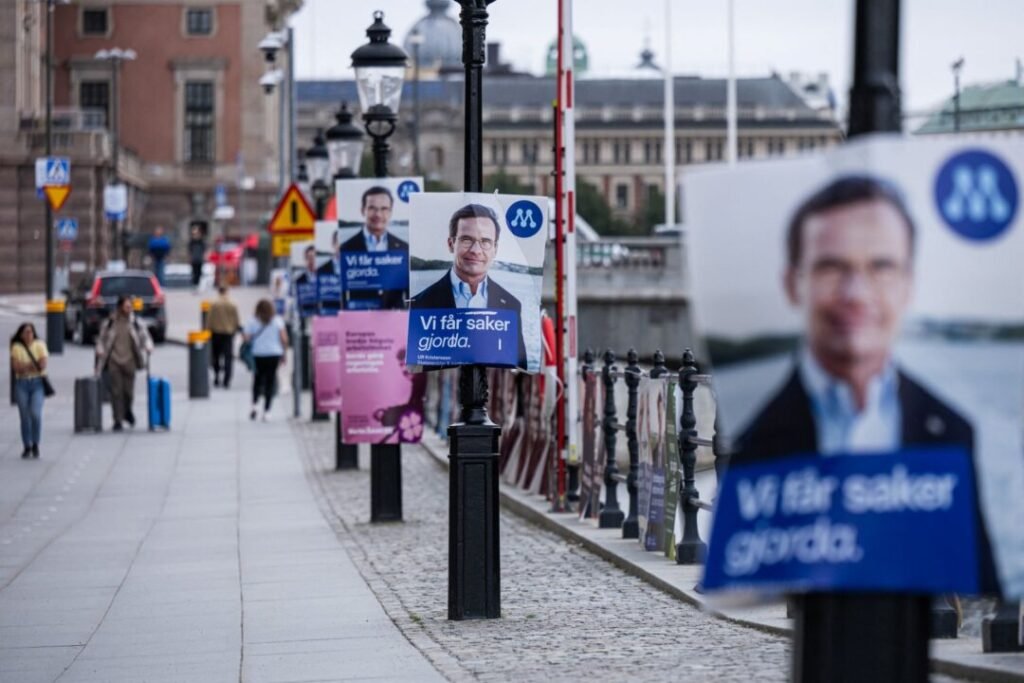
STOCKHOLM—Swedes head to the polls on Sunday in a parliamentary election that will determine whether Prime Minister Ulf Kristersson’s center-right coalition secures a second term and brings the right-wing Sweden Democrats into government for the first time, or whether former Prime Minister Magdalena Andersson’s Social Democrats return to power.
The race remains exceptionally close. Three polls published Friday put the four center-left parties at between 49.3 and 50.8 percent, compared with 47.6 to 49 percent for the governing parties and their Sweden Democrat allies. One survey projected a margin of just one seat in the 349-member Riksdag.
A Shift Years in the Making
Kristersson’s coalition of Moderates, Christian Democrats, and Liberals took office in 2022 on pledges to curb gang violence and sharply reduce immigration, after years in which Sweden’s rate of gun violence had risen from among the lowest in Europe to among the highest.
The Sweden Democrats, which emerged as the largest party on the right with 20.5 percent of the vote, remained outside the cabinet but signed the Tidö Agreement with the three governing parties. The deal gave the minority government the parliamentary support needed to advance its agenda while granting the Sweden Democrats significant influence over policy, particularly on crime and immigration.
The political shift had been building for years, particularly since 2015, when Sweden received roughly 163,000 asylum seekers, more per capita than any other EU destination country. The subsequent turn manifested in the 2022 election has attracted attention far beyond Sweden’s borders.
Related Stories


According to official statistics, the number of shootings fell to 147 in 2025, down 63 percent from 2022, and declined further to 53 during the first eight months of this year. The homicide and manslaughter rate also fell in 2025 to its lowest level in more than a decade.
Asylum applications, meanwhile, dropped by 30 percent in 2025, while asylum-related immigration fell to its lowest level since 1985, according to the government.
Johan Hakelius, political editor-in-chief of the Swedish news magazine Fokus, told The Epoch Times that the polls illustrate one of the paradoxes of electoral politics.
“By succeeding, you’re effectively digging your own grave: once voters feel that the issue they elected you to address has been resolved, they stop focusing on it and start thinking about other concerns,” he said. “It’s ungrateful, but that’s politics.”
Arvid Hallén, a policy analyst and co-founder of the conservative think tank Oikos, offered a similar assessment, saying the government “may have succeeded a bit too much” because voters “don’t reward politicians for what they’ve done; they’re interested in what they’re going to do.”
Hallén said many opponents of the Sweden Democrats object more to the party itself than to some of the policies it has championed. As a result, he argued, centrist voters who support tougher immigration policies but remain wary of the Sweden Democrats may be comfortable seeing those same measures pursued by the Social Democrats or another centrist-led government.
From Parliamentary Backers to Cabinet Ministers
On April 1, Kristersson and Sweden Democrats leader Jimmie Åkesson announced that the four parties would form a majority government if they prevail in the election, with Kristersson remaining prime minister and the Sweden Democrats taking key cabinet posts, including in areas such as migration and integration.

Magdalena Andersson, the Social Democrats, arrives for the parties’ leadership final debate on Swedish state television in Gaevle, Sweden, on Sept. 11, 2026. Anders Wiklund/TT News Agency/AFP via Getty Images
Andersson has made keeping the Sweden Democrats out of government a central theme of her campaign, arguing that the election will determine whether the party gains direct influence over areas including defense, education, culture, and public finances.
“That would be a very different Sweden,” she said.
Russia Affair in Final Stretch
The campaign was shaken in its final days by allegations involving Russia.
On Sept. 3, anti-racism magazine Expo published an investigation alleging that a Sweden Democrats parliamentary staffer had promoted Russian state narratives on social media. Her partner, Gustav Gellerbrant, who heads the party office responsible for coordinating with the government, said the posts had been taken out of context. He subsequently went on parental leave.
Hallén rejected broader attempts to portray the Sweden Democrats as sympathetic to Moscow.
“The left tries to brand them as pro-Russian, but they are not,” he said. “I would even argue that the Sweden Democrats are probably the most anti-Russian party in Sweden.”
Hallén, who said he knows members of the party leadership, argued that the Sweden Democrats have warned about Russian President Vladimir Putin and advocated higher defense spending for more than two decades.
Part of a European Pattern?
The vote comes against the backdrop of a broader rightward shift across the West.
Just a week earlier, the Alternative for Germany (AfD) secured a record 43.8 percent of the vote in the eastern state of Saxony-Anhalt. In France, Marine Le Pen leads polls ahead of the 2027 presidential election, while U.S. President Donald Trump has returned to the White House. In Italy, Giorgia Meloni has become the country’s longest-serving prime minister in decades, and in Britain, Reform UK leader Nigel Farage has emerged as a serious contender for prime minister.

Nigel Farage, leader of Britain’s Reform UK party (R), and Zia Yusuf, Reform UK’s spokesperson for home affairs, attend a press conference in London on Aug. 10, 2026. Kin Cheung/AP Photo
Hakelius, however, cautioned against reading too much into a right-wing victory or defeat on Sunday as evidence of this broader political trend.
“I’m not sure you can generalize from the result of the Swedish election to the rest of Europe,” he said, adding that even a change of government would not necessarily amount to a dramatic reversal of course.
“If the left wins, we’ll be taxed a little harder, there will probably be a little more migration, and there will be some differences in foreign policy,” Hakelius said. “But it’s not a momentous event.”
Hallén similarly suggested that many of the center-right government’s signature reforms may prove more durable than the election campaign would suggest.
“The heavier political players in the Social Democratic Party are probably discreetly quite happy that these reforms are in place, because they know they could never have introduced them themselves, given their own left wing and the parties they have to work with,” he said. “It was a job only the right could do, and now it’s done.”
For Hallén, the Swedish election therefore raises a different question for the right: not whether tougher policies on immigration and crime can win elections, but whether a government can remain popular after implementing them, once some voters come to believe that the problems they elected it to address have largely been solved.