

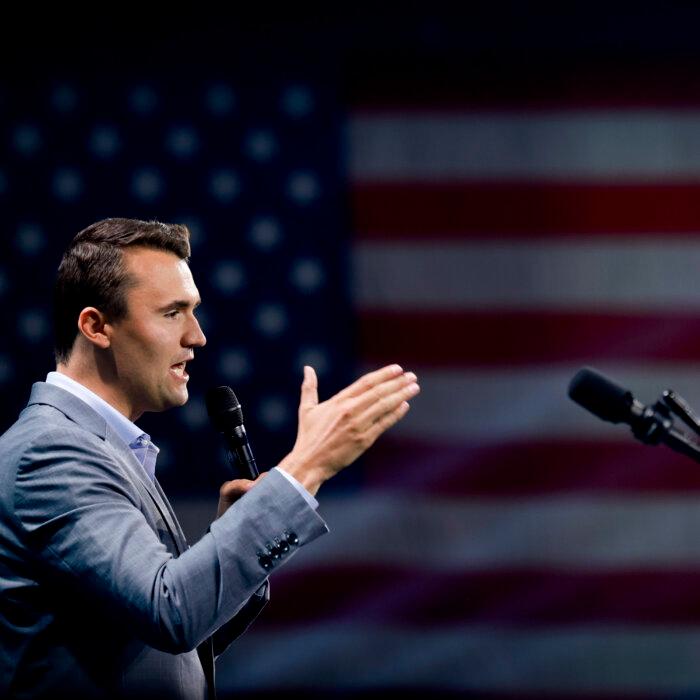
Charlie Kirk, founder and executive director of Turning Point USA, speaks at the High School Leadership Summit, at George Washington University in Washington on July 26, 2018. Samira Bouaou/The Epoch Times
The Washington Post must reinstate a columnist it fired because of posts she made on social media after the assassination of conservative commentator Charlie Kirk, according to a decision released on Aug. 24.
“The Washington Post did not have good and sufficient cause to terminate the employment of the Grievant, Karen Attiah,” the arbitrator said. “Therefore, the termination of the Grievant’s employment violated” the collective bargaining agreement.
In addition to reinstating Attiah, The Washington Post has to give her back pay and lost benefits, Espinosa said.
The ruling was based partly on the fact that Attiah had no prior disciplinary record.
“This decision confirms what we’ve said from the start: I was doing my job as an opinion journalist, and doing that job is not misconduct,” Attiah said in a statement.
Related Stories

“After spending over a decade of my career at the Post as an editor and an opinion columnist focusing on race, gender and global human rights, I’m relieved to finally have that record set straight.”
A Washington Post spokesperson told The Epoch Times in an email that the paper respects the arbitration process and would not be commenting further.
In the wake of Kirk’s assassination in 2025, Attiah took to social media to offer thoughts about political violence.
“Part of what keeps America so violent is the insistence that people perform care, empty goodness and absolution for white men who espouse hatred and violence,” one post said.
“If anything, the rush to coddle violent white men is self-protective—that we know they are not used to feeling vulnerable and mortal—and will react violently out of fear,” Attiah wrote on another. “And we will all suffer.”
Washington Post leaders said that the posts were “beyond the pale” and violated social media guidelines. One said during arbitration that the posts also undermined the paper’s journalistic integrity and values and created a safety issue.
“I don’t think it’s a big leap to say that this is not collegial behavior when you’re making these shocking and irresponsible posts continually and continually at such a heightened moment,” said Adam O’Neal, the paper’s opinion editor. “And that led to security concerns.”
The posts constituted gross misconduct, for which terminations can occur, according to The Washington Post. The paper’s union disagreed, saying that the posts were in line with Attiah’s columns and that she was “commenting on society’s response to violence, not commenting on the attacks themselves.”
The arbitrator said that the threats that resulted from the post could not be a factor in determining gross misconduct. The arbitrator also said that the record did not establish that Attiah disparaged white men, but that she was only referring to white men who espouse violence. The arbitrator also concluded that Attiah’s actions did not rise to gross misconduct.
“The penalty of termination imposed on the Grievant was absolutely disproportional,” the arbitrator said.
“The Grievant was an 11-year employee with no prior discipline. The Post had several other paths it could have taken, including conducting a thorough investigation that included an interview of the Grievant to gain a better understanding of the Grievant’s posts, asking the Grievant to remove the posts, and/or having a conversation with the Grievant about her social media activity and the inadvisability of posting during that fraught period.”