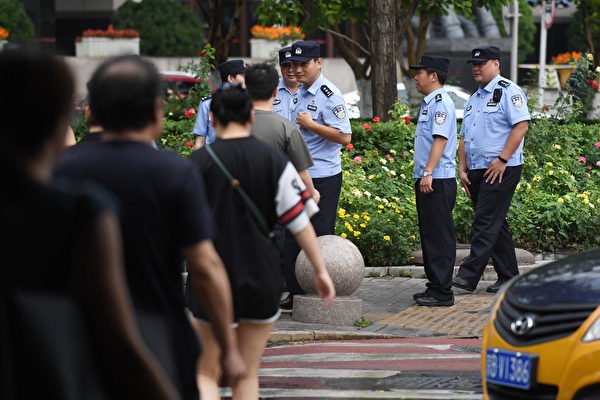
Chinese petitioners are alleging that Beijing police have been detaining them and handing them back to local authorities in exchange for cash payments.
The allegations concern China’s petitioning system, which in theory allows citizens to submit complaints and grievances to government authorities, including higher-level authorities in Beijing. Petitioners who believe local officials have failed to resolve their grievances may travel to the capital to seek intervention from central authorities.
However, in practice, petitioners rarely obtain redress for alleged injustices partly because of difficulties in even getting their complaints submitted. Local governments have been preventing many petitioners from reaching Beijing, particularly when their complaints could embarrass or implicate local officials. The Chinese regime has also long sought to intercept petitioners in Beijing and return them to their home regions.
The broader system is often referred to as “stability maintenance,” a term used for the regime’s efforts to prevent social unrest and suppress challenges to the authority of the Chinese Communist Party (CCP).
According to two petitioners interviewed by The Epoch Times, interception of petitioners has also become a source of revenue for officials and others involved.
Zhao Shuang, a petitioner from China’s Shandong Province, told The Epoch Times that she has repeatedly been intercepted by Beijing police and transferred to authorities in her home city of Jinan. She said many other petitioners she has encountered have had similar experiences.
Related Stories


“Beijing police ‘sell’ petitioners very commonly,” Zhao said. “Whenever there is a major meeting, or when they are clearing out petitioners, it is their harvest season.”
Zhao alleged that the transactions work by having local authorities pay Beijing police or other personnel to take petitioners back to their home regions. The amount, she said, depends on how much a petitioner’s case could potentially affect local officials.
“For example, if he or she is making a complaint about a certain official, or has strong evidence that could really affect that official, then the local authorities will spend money to ‘buy’ the petitioner back,” she said.
She said local officials often bring cash to Beijing and pay it before taking custody of the petitioner. Local officials can therefore demonstrate that they have stopped the petitioners from submitting their complaints in Beijing, while Beijing police receive cash incentives.
The allegations could not be independently verified by The Epoch Times.
Zhao’s experience with Chinese authorities began after she accused Liu Haitao, a police officer with the Shizhong District branch of the Jinan Public Security Bureau, of abusing his authority and allegedly using threats, inducements, and deception against her.
After Zhao continued to pursue complaints against the authorities, Jinan police transferred her case to prosecutors on suspicion of “picking quarrels and provoking trouble,” “extortion,” and “illegal use of information networks,” according to Zhao. She was ultimately released on bail pending further proceedings after the case was found to have unclear facts and insufficient evidence, she said.
Zhao said her repeated encounters with police in Beijing have reinforced her belief that intercepting petitioners has become a source of revenue for officials involved in the system.
Turning System Into Business
Wu Lixin, a Chinese military veteran who fled to the United States, told The Epoch Times that he has also witnessed what he described as an entrenched system surrounding the authorities’ efforts to control petitioners.
Wu said he was monitored and harassed by Chinese authorities for five years because of his involvement in a house church. Beginning in August 2019, he was taken to a police station for questioning or reprimanding almost every month, during which he said police also beat and mistreated him.
Wu said officials at different levels involved in “stability maintenance” can benefit from funds allocated by the central government for such activities. He alleged that, in this way, some of the money can ultimately return to the officials involved, creating a financial incentive to continue the system.
“Local public security bureaus, subdistrict offices, and others—the entire system has turned it into a business,” he said. “Officials treat petitioners as a cash cow.”
Wu said he has met large numbers of petitioners whose grievances remained unresolved for years or even decades.
“Why are the CCP’s stability maintenance expenses so large?” Wu said. “They exceed military spending.”
He said despite the spending, the CCP hasn’t solved the problems. “I know several petitioners who have petitioned for more than 10 or 20 years.”
Hong Ning contributed to this report.