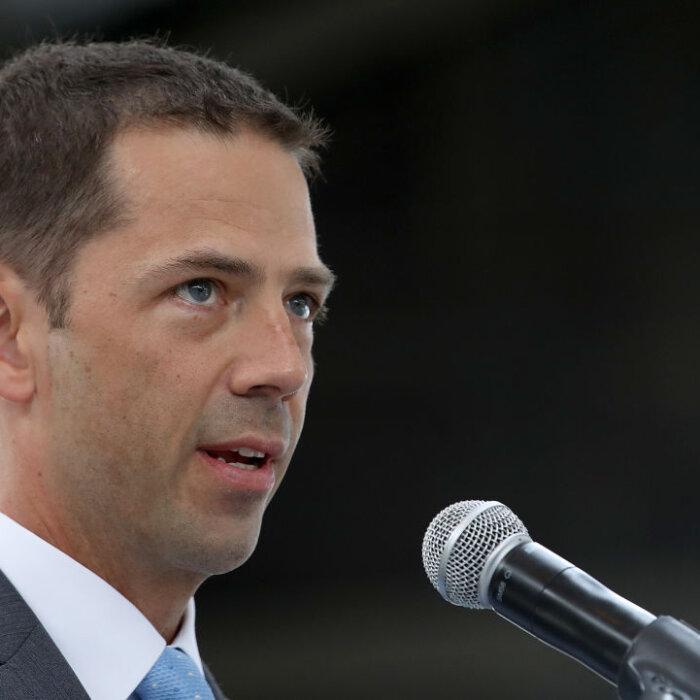
Interior Secretary Doug Burgum said that the Trump administration is getting close to approving permits to mine the deep ocean for critical minerals.
Burgum told a gathering of G20 energy ministers on Sept. 14 in Houston that companies could hear more about deep-sea mining “in the weeks and months ahead.”
“Those nodules that we just have to go out and vacuum up off the (sea) floor are filled with these critical minerals that we need,” Burgum said at the G20 Ministerial Meeting on Energy Abundance that is taking place this week.
“And of course, part of that is assuring that we’ve got diverse, secure, affordable supply of critical minerals.”
When asked when the federal government could issue deep-sea permits, Burgum said, “Those discussions are going on right now.”
Related Stories

“You’ll be hearing more in the weeks and months ahead because there’s some exciting developments that are coming on that front,” he added.
In addition to reshoring efforts, the United States is exploring seabed minerals, which are critical for developing modern technology.
China has a near-monopoly on the global rare earths market, essential for the production of many new technologies such as electric vehicles, wind turbines, and smartphones.
In April 2025, President Donald Trump issued an executive order to secure reliable supplies of critical minerals, which called for the acceleration of deep-sea mining.
The move was followed by the first permit application to the U.S. government by The Metals Company (TMC), which said it is developing the world’s largest source of battery metals on the Pacific seabed. On May 1, the Trump administration approved its first deep-sea critical minerals exploration application to TMC.
“Together, the resource is estimated to contain approximately 15.5 million tonnes of nickel, 12.8 million tonnes of copper, 2.0 million tonnes of cobalt, and 345 million tonnes of manganese,” TMC said in a January statement.
On Sept. 14, in its newsletter, TMC said that the “regulatory and strategic picture for deep seabed minerals in the United States continues to sharpen.”
It said that the National Oceanic and Atmospheric Administration (NOAA) had, in 18 months, received and is now processing more than a dozen applications, including three consolidated applications for an exploration license and a commercial recovery permit, with TMC’s the “first to be submitted.”
It said that this means that the U.S. government continues to “make clear that responsible seabed mineral development is a national security and economic priority” and that it “intends to pursue these resources.”
Polymetallic manganese nodules, found at depths of 2.5 to 3.7 miles in the abyssal zone, contain high concentrations of nickel, cobalt, copper, and manganese.
While seafloor massive sulfides, rich in copper, zinc, silver, and gold, are found 0.9 miles to 1.9 miles down, cobalt- and manganese-rich crusts are found along underwater mountain ridges.
The explored areas are in the Clarion-Clipperton Zone, a geological submarine fracture zone located in the north Pacific Ocean between Mexico and Hawaii, as well as in the Indian Ocean and the Mid-Atlantic Ridge.
China holds five active exploration contracts under the United Nations’ Jamaica-based International Seabed Authority (ISA), more than any other country. It is also ISA’s main funder.
Countries such as Japan, Germany, and the UK also have licenses.
The United States is not a signatory of the U.N. Convention on the Law of the Sea (UNCLOS), which established the ISA in 1982 and says that international waters and their resources are “the common heritage of humankind.”
The people of the Cook Islands, a self-governing country, are historically and culturally aligned with New Zealand and possess New Zealand passports.
Reuters contributed to this report.