Five major U.S. companies developing frontier artificial intelligence (AI) are being pressed to disclose whether Chinese actors have tried to obtain the closely guarded model weights behind their most advanced systems.
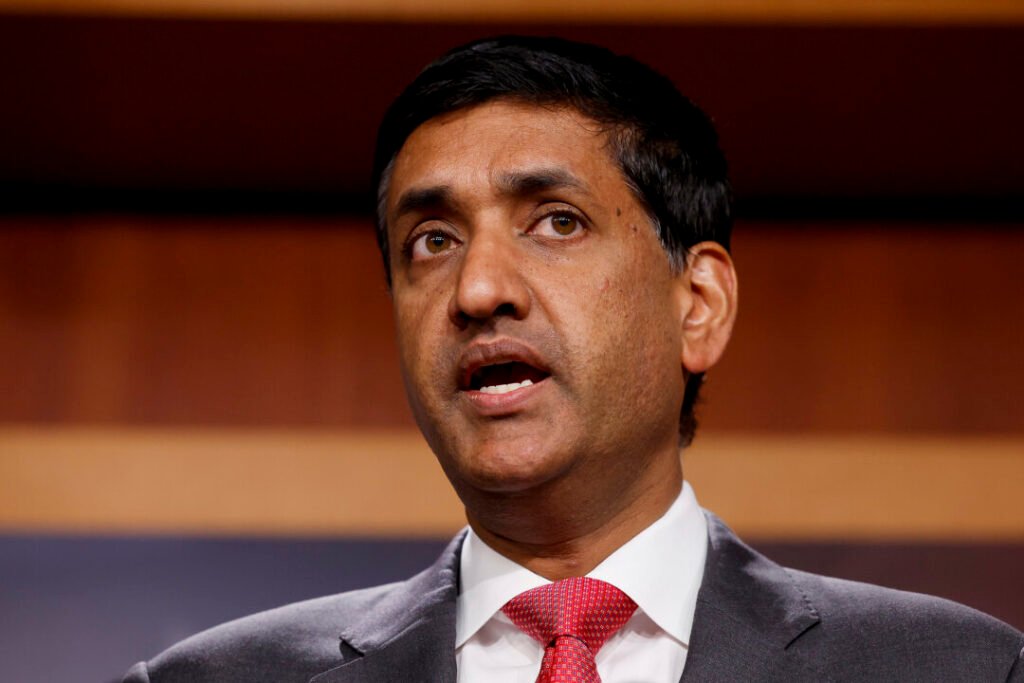
Rep. Ro Khanna (D-Calif.), the ranking Democrat on the House Select Committee on the Chinese Communist Party, sent letters on Sept. 30 to Alphabet, Anthropic, Meta, OpenAI, and SpaceXAI seeking details on attempted intrusions, successful breaches, cybersecurity safeguards, and cooperation with the U.S. government.
Khanna’s inquiry goes beyond asking whether any theft succeeded. He asks the companies to identify unsuccessful attempts to obtain model weights, attempted intrusions into frontier AI labs, cybersecurity spending and staffing, and whether independent third parties have tested the safeguards protecting their technology.
Model weights are the numerical parameters created during training that largely determine how an AI system processes information and generates responses. They are different from source code, but obtaining proprietary weights could give an outside actor access to capabilities that required substantial computing resources, research, and training to develop.
Khanna wrote that theft of such weights by the People’s Republic of China could allow Beijing to bypass years of expensive development.
“China is the most sophisticated cyber threat America has ever faced,” Khanna said in the letters.
Related Stories

He also asked the companies to identify any known instances during the past two years in which the Chinese regime, or an entity believed to be acting for it, sought through technical means to obtain intellectual property or other information from their frontier AI labs.
For any responsive incident, Khanna asked the companies to describe what happened, how they responded, and the outcome. Where a breach succeeded, he requested copies of incident reports.
The letters do not establish that China has successfully stolen frontier model weights from any of the five companies.
From Distillation to Possible Intrusion
The inquiry follows public accusations by U.S. AI companies that several Chinese developers have tried to extract capabilities from American models through a different technique known as distillation.
Distillation itself is commonly used in AI development. A smaller model can be trained using outputs from a larger one, often to make it cheaper or more efficient.
OpenAI and Anthropic have accused Chinese AI developers of using large numbers of unauthorized accounts and other methods to extract capabilities from their models without permission.
In a Feb. 12 submission to the House China Committee, OpenAI said most adversarial distillation activity it had observed appeared to originate from China. The company alleged that accounts associated with DeepSeek employees had developed methods to circumvent its access restrictions, including through third-party routers that obscured their origin. It also said DeepSeek employees developed code to obtain outputs from U.S. AI models programmatically for distillation.
Anthropic alleged on Feb. 23 that DeepSeek, Moonshot, and MiniMax had generated more than 16 million exchanges with Claude through roughly 24,000 fraudulent accounts as part of what the company described as industrial-scale distillation campaigns. Anthropic said the activity violated its terms of service and regional access restrictions.
In a September threat report, Anthropic said it had identified and disrupted additional distillation attacks against Claude from seven AI labs based in China. The company alleged the operations used increasingly sophisticated methods to circumvent its defenses and harvest capabilities from U.S. frontier models.
DeepSeek, Moonshot AI, and MiniMax have not publicly provided substantive responses to Anthropic’s findings and allegations.
Those cases involved attempts to extract capabilities through model outputs. They are distinct from stealing the underlying model weights.
Washington Expands Protection of American AI
The inquiry comes as the federal government has expanded efforts to protect advanced U.S. AI systems from foreign acquisition.
In an April 23 National Science and Technology Memorandum, the White House said the U.S. government had information indicating that foreign entities, principally based in China, were conducting “deliberate, industrial-scale campaigns” to distill American frontier AI systems.
The memorandum said those campaigns used tens of thousands of proxy accounts and other techniques to evade detection and extract capabilities from U.S. models.
The administration distinguished legitimate distillation from industrial-scale efforts aimed at extracting proprietary information or capabilities from U.S. developers. It also directed federal agencies to strengthen information sharing and cooperation with American AI companies against adversarial distillation and related threats.
Khanna is also asking the companies to account for their own defenses.
He wants to know how much they have spent on AI cybersecurity during the past two years, how many employees are assigned to it, whether the companies consider their defenses adequate, and whether an independent third party has audited or assessed the safeguards protecting their model weights.
The Epoch Times contacted Alphabet, Anthropic, Meta, OpenAI, and SpaceXAI for comment. None responded by publication time.
The companies have until Oct. 19 to respond to Khanna’s requests.