A new report to the United Nations has alleged there are reasonable grounds to believe U.S. forces are responsible for two different strikes in Iran on Feb. 28 that could constitute war crimes.
The report also assessed Iranian authorities committed crimes against humanity as they worked to stifle protests throughout the country in January.
These findings come from an independent international fact-finding mission conducted for the UN’s Human Rights Council. The mission published its report on Sept. 14.
The UN mission was initially established to investigate allegations of human rights violations during economic protests in Iran that began on Dec. 28, 2025, and intensified through early January. The mission’s scope expanded as U.S. and Israeli forces launched strikes on Iran on Feb. 28, setting off an ongoing armed standoff.
“People in Iran are caught between intensified repression and violence by their government and renewed armed conflict and insecurity resulting from the hostilities between Iran and the U.S. and Israel,” the report’s conclusion reads.
Related Stories


“The Trump Administration formally withdrew from the UN Human Rights Council following the Council’s consistent failures to uphold its own ‘values’ as it pushes anti-American rhetoric and antisemitism, all while it appeases repressive regimes, thus making a mockery of the very ‘rights’ it claims to protect,” a U.S. State Department official told The Epoch Times on Sept. 17. “As such, we do not give credibility to findings in this report.”
Minab and Lamerd Strikes
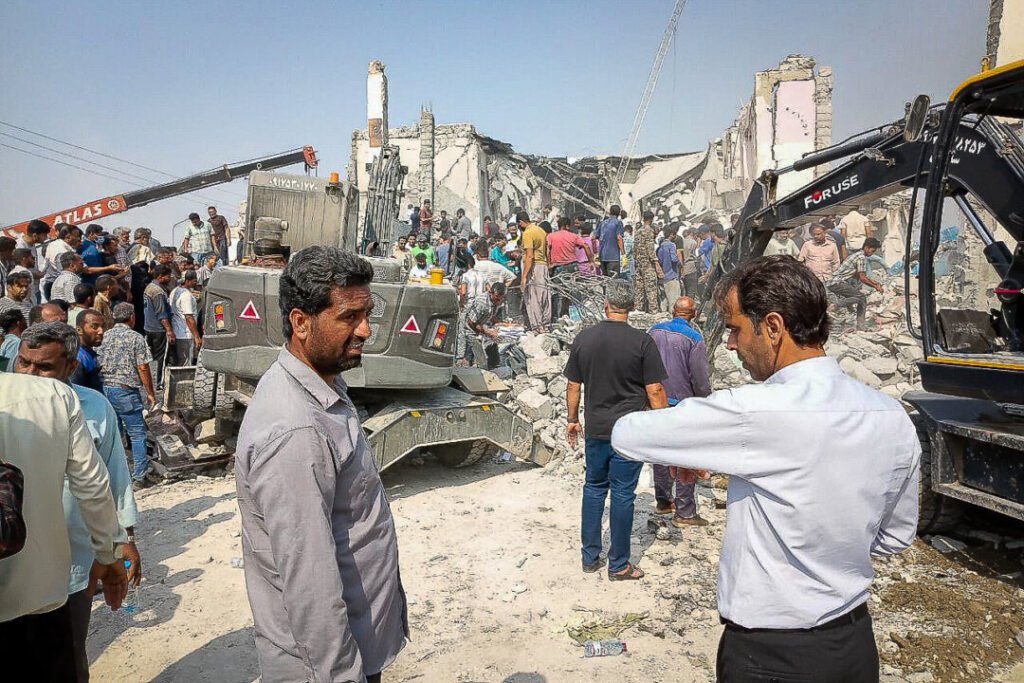
War crimes allegations against U.S. forces stem from a series of strikes that hit the Shajareh Tayyebeh Primary School in the Iranian city of Minab on Feb. 28, and the Shahid Haj Khalil Naimi Cultural and Sports Complex in the city of Lamerd the same day.
Local authorities assessed that 156 people, including more than 100 children, were killed in the strikes on the Minab primary school.
In May, after various media reports indicated U.S. forces were behind the strikes on the Minab school, U.S. Central Command (CENTCOM) Commander Adm. Brad Cooper told Congress that his team’s preliminary review found that a strike on the school was “correlated” with a U.S. military action, but offered few additional details.
Though they noted the Minab school is located around 72 meters from an Iranian military facility, UN reviewers said the school was clearly identifiable as a non-military object and was separated from the adjacent military facility by a wall.
“Satellite imagery of the school before the strike also appears to show human figures, readily identifiable as children, gathered in its courtyard,” the UN report said.
During his Congressional testimony in May, Cooper said the U.S. military’s review of the Minab school strike was coming to an end but could not specify a timeline for its release. The Pentagon has yet to finalize the review.
“Our investigation remains ongoing, and we have nothing to announce at the moment,” Pentagon spokesman Joel Valdez told The Epoch Times on Sept. 17.
Valdez declined to comment on the findings of the UN report.
Local authorities assessed 22 people were killed in separate strikes on the Lamerd athletic complex on Feb. 28, including five children.
Assessing the strikes on the Lamerd athletic complex, the UN reviewers noted footage indicating two separate missiles exploded in the air over the facility. The report said the behavior of the missiles is consistent with that of U.S.-made Precision Strike Missiles, which are designed to detonate above their target and release a shower of metal pellets.
CENTCOM previously denied culpability for the Lamerd strikes and said the weapons visible in the available footage more closely resemble Iranian Hoveyzeh cruise missiles. The new UN report notes analyses challenging this U.S. military assessment.
The UN review team said the strikes on the Minab and Lamerd sites could both amount to the war crime of launching indiscriminate attacks harming civilians.
Responding to a request for comment, White House spokeswoman Anna Kelly said the UN Human Rights Council “has accomplished nothing for human rights while spouting unserious nonsense for decades.”
“The only party in this conflict that has committed war crimes is the Iranian regime, which has murdered thousands of its own people, killed Americans overseas, executed acts of terrorism in the Strait of Hormuz, and launched indiscriminate attacks against its neighbors in the region.”
Iranian Protest Response
What began as economic protests across Iran in late December devolved into violence by early January.
The UN report noted that while Iranian authorities initially took a conciliatory approach to the economic grievances of demonstrators, they eventually cast such demonstrations as riots and asserted U.S., Israeli, and other foreign actors were working to exacerbate the unrest and instigate violence.
Though the UN review team said most of the footage and witness accounts they reviewed indicated the protests were peaceful, they did collect independent and credible reports “that some protesters behaved violently in some locations.” The review team described reports of individuals burning a police kiosk, another individual using a homemade flamethrower against security forces, and other instances in which individuals appeared to throw objects at or kick security force members.
Amid these protests, Iranian authorities imposed a nationwide shutdown of internet and telecommunications services and employed increasingly violent tactics.
The report described reviewing multiple videos of individuals located on or around police stations firing rifles from elevated positions down toward people in the streets below. In other cases, security forces were described as raiding hospitals and detaining individuals seeking medical treatment amid the intensifying protest crackdown.
Iranian authorities have officially assessed that 3,038 people were killed and around 25,000 more were injured during these protests. The UN review team acknowledged it could not independently verify the casualty figures but “has strong grounds to believe that the true figures for deaths and injuries are significantly higher.”
Further, the UN report also raises concerns about the use of the death penalty against dozens of individuals connected to the protests. In several instances, the corresponding court cases and executions were carried out within the course of a few weeks.
“By following summary death penalty proceedings that violated due process guarantees and fair trial rights or executing individuals for crimes not amounting to ‘the most serious crimes,’ or both, Iran unlawfully and arbitrarily deprived at least 58 men of their right to life,” the report states.