The sudden death of Alexander the Great in 323 B.C. left his kingdom divided among his generals who soon became rivals.
By 305 B.C., most of what is today southern Greece, Turkey, and all of the eastern Mediterranean coast down to Gaza belonged to Antigonus, one of Alexander’s former generals. Much to his chagrin, Egypt still belonged to Ptolemy, another of Alexander’s generals, while a single island in the Aegean Sea remained independent. That island was Rhodes, and it was the site of one of the Hellenistic age’s longest and most famous and longest battles.
The Rhodians prevailed, commemorating their victory with the spoils of war by constructing the tallest statue ever conceived—the Colossus of Rhodes. But before the island could celebrate its triumph, it had to survive the wrath of Antigonus’s heir.

A depiction of the siege of Rhodes in 305 B.C., showing Demetrius’s forces using the Helepolis to attack the city’s walls. Public Domain
Underdogs and Outliers
Antigonus’s son, Demetrius, has been remembered throughout history as “Demetrius the Besieger” (337 B.C.–283 B.C.). Having recently taken Cyprus from Ptolemy, his sights were now set on Rhodes for its refusal to assist in the Cyprian campaign. Rhodes was a powerful policing force for traders passing through the Aegean, and its independence combined with its loyalty to Ptolemy made it an irresistible target.
Demetrius descended on the island with 200 warships, 170 cargo and transport ships, and an armada of 1,000 more pirates, privateers, and traders eager to cash in on what was expected to be an easy victory. Rhodes had an army of 7,000 troops bracing for an invasion by 40,000.

A coin featuring the portrait of Demetrius I of Macedon who created siege equipment to conquer Rhodes. Public Domain
Among Demetrius’s weapons of war was a monstrosity known as the “Helepolis.” A tower on wheels with as many as nine stories, it was filled with catapults and ballistae and manned by thousands of soldiers. Fortified with brass plating over its lumber, it stood nearly 150 feet tall and posed the greatest threat to Rhodes’s fortress walls. The siege lasted through the winter, with Demetrius suffering heavy losses due both to storms and the sheer willpower of the Rhodian defenders.
After a year had passed with little achieved, Antigonus ordered Demetrius to abandon the siege. The peace terms included the collection of much of Demetrius’s military weaponry, including the mighty Helepolis. The lumber was sold off, and the bronze melted down to supply the immense construction demands of the colossus.
The Rise
Rhodes averages 300 sunny days per year. It’s no surprise the island was believed to be under the protection of the sun god, Helios. The Rhodians intended to build a massive statue of their protector as a warning that no invading force should dare challenge them again.
Related Stories
The best architect on the island, Chares of Lindos, had been a student of Alexander the Great’s master sculptor, Lysippus (circa 390 B.C–300 B.C.), whose genius gave rise to a tradition of more lifelike, animated features remembered today as the “Lysippian gaze.” Given the tutelage of its sculptor, it’s no surprise that the Colossus, though a statue of Helios, would be fashioned in Alexander’s image.
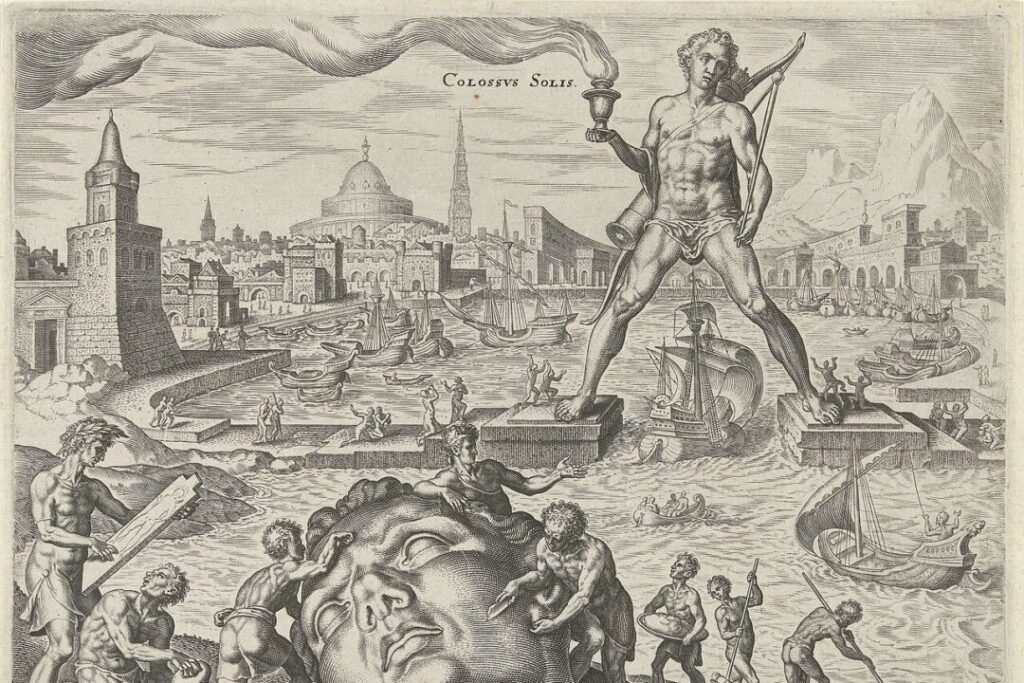
The Colossus has long been depicted as straddling the Rhodes harbor, standing tall enough for ships to sail between its legs. As ubiquitous and influential as this image has become, it is only the fanciful creation of the 15th-century Dutch artist, Maarten van Heemskerck. While the exact pose and location of the statue remain a mystery, there are descriptions of Chares’s building process, interior design, structure, and the finished result.
Starting with a marble foundation, the feet and ankles were sized slightly above proportion and anchored deep into the marble to support the tremendous weight of the standing figure. The frame consisted of a trellis of iron tie-bars filled with stone pillars and rock to brace against the wind. Over the iron was a layer of bronze skin panels, 1/4 inch to 1 inch thick. From out of the lush, curly hair jutted a crown of sun rays. Each new section was built up from the completed section below by piling a massive mound of earth around the entire statue. This mountain of dirt doubled as a ramp and platform, alleviating the need for what would have been a forest’s worth of scaffolding.

Map of ancient Rhodes illustrating the layout of the city and its fortified walls. University of Edinburgh Heritage Collections/CC BY-SA 3.0
The Colossus was built on a scale far greater than any statue before it. For comparison, the statue of Zeus at Olympia in its seated position reached only about 40 feet. Estimates of the Colossus’s total height, including its marble pedestal, range between 105 and 120 feet. After 12 years of constant labor, the Colossus’s completion around 282 B.C. marked the singular moment in history when all seven ancient wonders of the world were displayed simultaneously.
The Fall
While Chares had taken into consideration every aspect of the statue’s height, proportions, balance, and resilience to the elements, he could not have foreseen the complications that would result from the chemical reactions between iron and bronze. It would be millennia before chemists and architects completely understood the process of galvanic corrosion. The meeting points between the iron frame and bronze skin created a gradual transfer of electrons from the iron to the bronze, hastening the iron’s deterioration.
The massive earthquake that struck Rhodes around 226 B.C. is well documented as the event that snapped the statue at its knees, but by that point, as engineers know today, those most vulnerable joints had been slowly rusting for 56 years. The additional strain of the stone and different metals all expanding and contracting at different rates as temperatures rose and fell by more than 30 degrees each day and night ensured the earthquake merely advanced an encroaching fate.

“The Oracle of Delphi Entranced,” by Heinrich Leutemann. The oracle is shown here entering a trance before issuing a prophetic decree. Public Domain
To Rebuild or Not to Rebuild?
With the Colossus now in a heap of twisted metal, the Rhodians were faced with the daunting challenge of whether to salvage or abandon their masterpiece. A question of such spiritual, political, and financial weight merited divine counsel, which throughout the Hellenistic age meant consulting the Oracle at Delphi.
Legend has it that, in search for the very center point of the earth, Zeus dispatched two eagles to circle the globe. Their flight paths met at Delphi. Its divine placement as the navel of the earth made it a neutral spiritual center among the warring factions of the Mediterranean. The oracle decreed that the collapse was a sign of Helios’s disfavor with the statue, and that it should not be reconstructed.
Byzantine accounts claim that either Vespasian or Hadrian, both Roman emperors in the 1st or 2nd century A.D., may have financed the restoration of the Colossus, only for it to fall again. Modern scholars disagree as to whether this was possible. The accounts generally agree that the gnarled ruins of the statue have remained a tourist attraction for centuries. According to Theophanes (circa 759–818), Arab invaders eventually sold off the remnants in A.D. 653 to a Jewish merchant who transported them away on a caravan of 900 camels.
Originally, the Greek word “kolossos” did not imply a statue of enormous size but one that contained a godly or mortal essence. It was only after the collapse of the Colossus of Rhodes that the word became synonymous with epic size. Centuries later, the Romans would build a statue of comparable height for Nero and name the massive arena next to it the Coliseum.
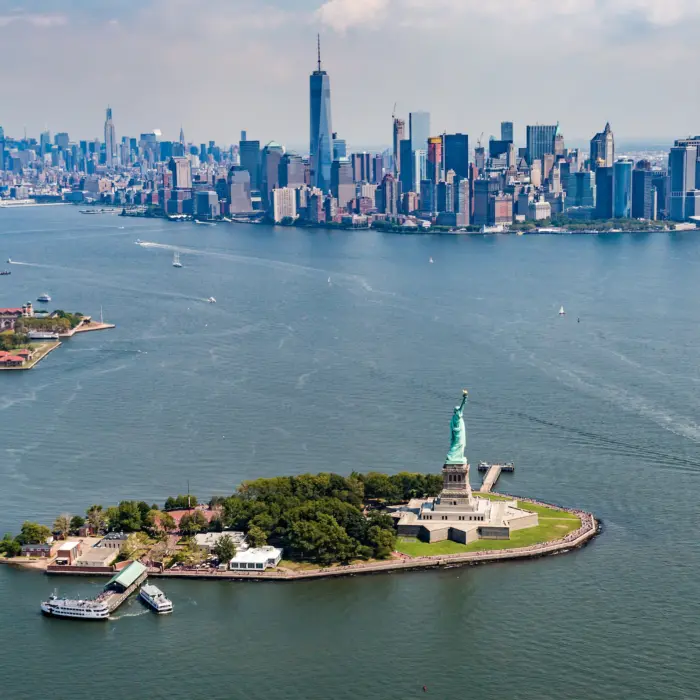
In 1883, poet Emma Lazarus wrote her famous dedication for the Statue of Liberty. She titled her poem, “The New Colossus.”