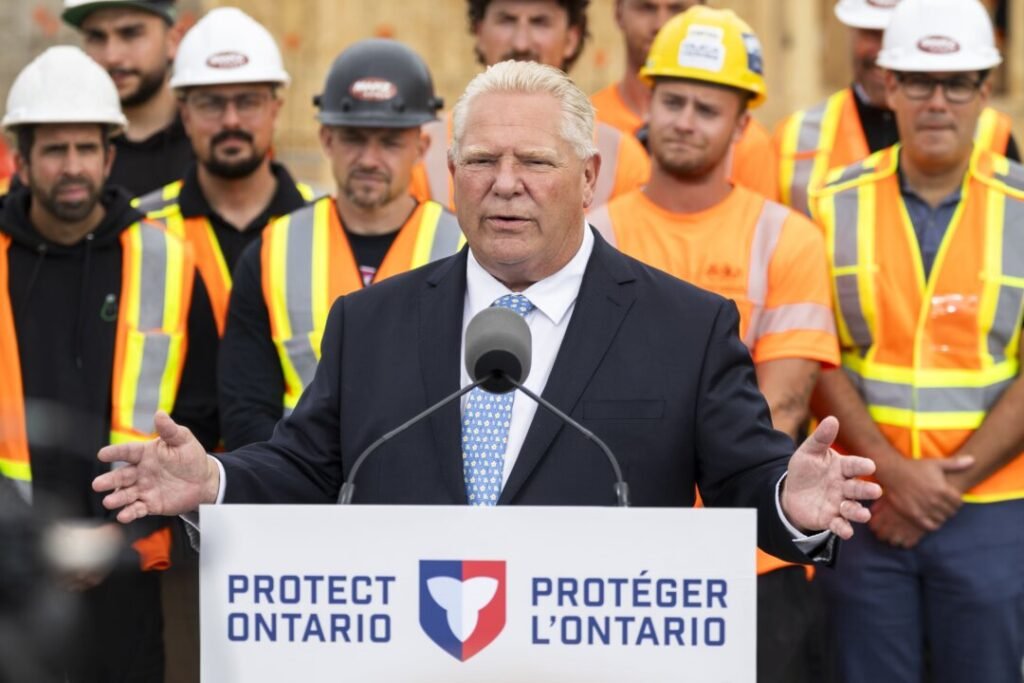
Ontario Premier Doug Ford speaks to media at a housing development in Hamilton on Aug. 24, 2026. The Canadian Press/Nick Iwanyshyn
Ontario is expanding eligibility for two tariff-relief programs in a bid to support businesses affected by new U.S. tariffs and import bans set to take effect this week and later this month.
The province announced on Sept. 10 that it is broadening access to the Protect Ontario Financing Program (POFP) and the Ontario Together Trade Fund (OTTF), so that businesses impacted by the latest wave of American tariffs and import bans can apply for relief.
The $1 billion POFP will provide immediate relief to impacted businesses through loans that can be used for costs such as payroll, lease payments, and utilities, according to the province’s news release. The $150million OTTF will provide grants or loans to small and medium-sized businesses to help them expand interprovincial trade and reshore supply chains away from the United States.
The announcement comes two days after U.S. President Donald Trump intensified his retaliatory measures following Canada’s implementation of a new series of tariffs on American products.
On Sept. 8, Trump signed five executive orders imposing new 50 percent tariffs on certain Canadian exports to the United States, including steel and aluminum products, select dairy and specialty cheeses, mattresses, furniture, and paper products, effective Sept. 15, the Ontario government noted.
Related Stories
Speaking at an event organized by the Toronto Region Board of Trade on Sept. 10, Ontario Premier Doug Ford told the audience that expanding eligibility for the province’s tariff support programs will help businesses in hard-hit sectors stay afloat.
“I’ll be clear: Our government is going to do whatever it takes to protect workers and businesses from President Trump,” he said.
In a statement on Sept. 10, Minister of Economic Development Vic Fedeli said the province’s financial support through the two programs will help affected businesses retain their employees amid economic uncertainty. And he said the provincial government promises to help businesses build an economy resilient to challenges “for decades to come.”
Businesses must meet several criteria to be eligible for the POFP. The requirements include having operations in Ontario, earning a minimum annual revenue of $2 million, and employing at least 10 full-time staff in the province. In addition, businesses must belong to sectors affected by the tariffs under Section 232 of the U.S. Trade Expansion Act of 1962 or under Section 338 of the Tariff Act of 1930.
The OTTF similarly requires businesses to operate within the province. Applicants must also provide proof that they belong to sectors such as steel, auto, and aluminum that are “extensively targeted” by U.S. tariffs. As well, they must provide three years of operations/financial statements and employ at least five full-time workers, among other criteria.
Canada-U.S. Trade Tension
Trump originally announced the new 50 percent tariffs on July 20, citing what his administration described as “discriminatory” trade practices involving Canada’s supply-managed dairy sector, Canadian tariffs on U.S. automobiles, and provincial restrictions on the sale of American alcohol.
The new 50 percent tariffs on Canadian imports were initially set to take effect on Aug. 19, but the president postponed them for three days to allow for further trade negotiations. Trade talks between the two countries, however, broke down on Aug. 21, resulting in U.S. levies on CA$28 billion of Canadian products taking effect on Aug. 22. Ottawa responded by imposing counter-tariffs on a matching value of U.S goods, which came into force on Sept. 8.
Prime Minister Mark Carney had announced Ottawa’s intention to introduce counter-tariffs on Aug. 22.
Two days later, Trump said Washington would impose new 50 percent tariffs on Canadian vehicles and auto parts starting in 2027. On Sept. 7, Trump added that he would ban aircraft produced by Montreal-based Bombardier to be sold in the United States unless they began manufacturing in that country.
The following day, he proceeded to sign the five new executive orders to ban imports of certain Canadian goods into the United States, and to impose additional 50 percent percent tariffs on some Canadian products.
The two sides have been exchanging barbs since the collapse of the Aug. 21 trade talks. Ottawa says Washington wanted to infringe on Canada’s sovereignty with its proposed trade deal. Washington dismisses this, saying it’s Ottawa that walked away from the deal to gain domestic political advantage.
Meanwhile, Carney said on Sept. 10 that he has been in contact with Trump to discuss other issues, such as the war in Ukraine. On Sept. 11, Canada-U.S. Trade Minister Dominic LeBlanc said officials in Washington and Ottawa remain in contact following the failed negotiations, though he emphasized that no formal trade talks have taken place.
Trump suggested on Sept. 12 that a trade deal with Canada could be reached “fairly soon,” provided Canada “treats our farmers better” and stops imposing large tariffs.
Omid Ghoreishi, Paul Rowan Brian, and The Canadian Press contributed to this report.
We had a problem loading this article. Please enable javascript or use a different browser. If the issue persists, please visit our help center.