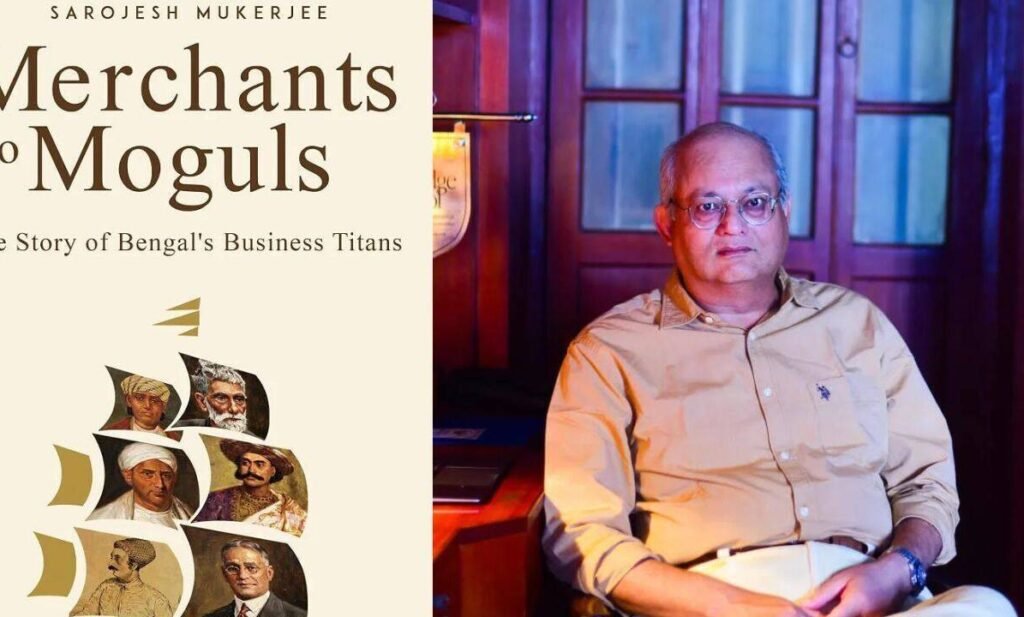
Bengal’s Forgotten Business History: How Six Entrepreneurs Helped Shape India’s Economic Legacy
Bengal has long been celebrated for its literature, art, culture and social reform movements. However, its contribution to India’s business and industrial development is equally remarkable. A new historical book, Merchants to Moguls: The Story of Bengal’s Business Titans, by author and academician Sarojesh Mukerjee, brings this lesser-known economic history into focus.
Published by Readomania in 2026, the book explores the lives of six influential entrepreneurs whose businesses, innovations and philanthropic activities helped shape Bengal’s economic landscape during the eighteenth, nineteenth and twentieth centuries.
The book has also attracted attention for its effort to highlight a side of Bengal’s history that is often overlooked: the rise of Indian entrepreneurs who built successful commercial enterprises despite the challenges of colonial rule.
Merchants to Moguls: A New Perspective on Bengal’s Business Legacy
Rather than focusing exclusively on political leaders, writers and social reformers, Sarojesh Mukerjee explores the people who helped establish Bengal as an important centre of trade, commerce and industrial activity.
The book follows six remarkable personalities:
- Ramdulal Dey: A prominent merchant known for his maritime trade and commercial connections between India and America.
- Mutty Lal Seal: An entrepreneur who expanded his business interests into shipping, insurance, property and philanthropy.
- Rustomji Cawasji Banaji: A Parsi businessman who played an important role in Calcutta’s commercial and civic development.
- Dwarakanath Tagore: An ambitious businessman who invested in coal, shipping, banking and other industries.
- Acharya Prafulla Chandra Ray: A renowned scientist and entrepreneur associated with the development of India’s chemical and pharmaceutical industry.
- Sir Rajendra Nath Mookerjee: An influential industrialist whose contributions helped advance engineering, manufacturing and heavy industry.
Through these individual journeys, the author examines how business ambition and innovation contributed to the economic development of Bengal.
How Colonial Rule Challenged Indian Entrepreneurs
One of the central themes of Merchants to Moguls is the difficult business environment under British colonial rule.
Indian entrepreneurs frequently faced unequal competition, racial discrimination, financial uncertainty and limited institutional support. Despite these obstacles, several business pioneers managed to establish influential enterprises and create lasting commercial institutions.
Dwarakanath Tagore’s business ventures, particularly his involvement in coal mining and the establishment of Carr, Tagore & Co, illustrate the scale of ambition among nineteenth-century Indian entrepreneurs.
Similarly, Ramdulal Dey’s commercial connections demonstrate how Indian merchants participated in international trade networks long before modern globalisation.
The book presents these achievements within their historical context, showing that entrepreneurship in colonial Bengal required considerable financial judgement, resilience and innovation.
Business Success Beyond Wealth and Profits
Another important aspect of the book is its focus on philanthropy and social responsibility.
Several of the entrepreneurs featured in the book supported educational institutions, hospitals, charitable organisations and social development initiatives.
Their stories highlight how business success could contribute to wider social progress.
The book also raises an important question for modern entrepreneurs: should business success be measured only through profits, or should its contribution to society also matter?
By connecting commercial achievements with public service, Mukerjee offers lessons that remain relevant to business leaders and young entrepreneurs today.
Who Is Sarojesh Mukerjee?
Sarojesh Mukerjee is an author, historian and academician who founded The Cambridge School, where he has taught advanced economics since the institution’s inception.
His interest in the colonial history of Calcutta has influenced his writing and historical research.
His earlier book, The Life & Times of David Hare: First Secular Educationist of India, was published in 2024 and explored the contribution of Scottish reformer David Hare to education in Bengal.
Merchants to Moguls is his second major historical work, examining Bengal’s forgotten business pioneers and their contribution to India’s economic development.
His upcoming historical work, In Justice or Injustice: Early Law Trials at Calcutta, is expected to be published in 2027.
Book Launch and Availability
The launch of Merchants to Moguls: The Story of Bengal’s Business Titans was listed for October 28, 2026, at the Calcutta Club in Kolkata.
The book is published by Readomania and is listed in the publisher’s online shop at a price of ₹499.
Readers interested in Indian business history, colonial Bengal, entrepreneurship and industrial development can explore the book through the publisher’s official website.
Why This Book Matters for India’s Business History
India’s economic history is not simply a story of colonial policies, foreign companies and political developments. It is also a story of Indian entrepreneurs who took risks, established businesses, developed industries and created institutions under challenging circumstances.
Merchants to Moguls brings these overlooked contributions into public discussion.
By highlighting six influential personalities, Sarojesh Mukerjee encourages readers to reconsider Bengal’s historical identity and recognise its contribution to India’s commercial and industrial development.
The book is particularly relevant for students, researchers, business professionals and young entrepreneurs who want to understand the historical foundations of Indian enterprise.
Ultimately, the message is clear: Bengal’s legacy extends far beyond literature and culture. Its forgotten business pioneers also played an important role in shaping India’s economic journey.