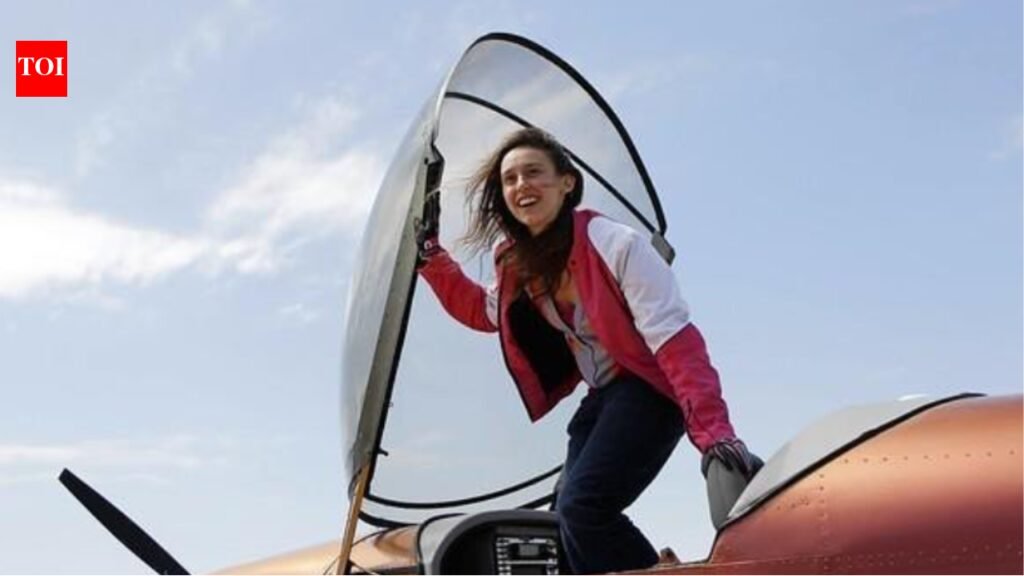
At an age when most teenagers are still figuring out what they want to become, Sabrina Gonzalez Pasterski was already building something that could leave the ground. Born in Chicago in 1993, Pasterski developed an early fascination with aircraft and began flying lessons at nine. By her early teens, that interest had turned into a serious engineering project.
A childhood fascination took shape
Pasterski did not simply dream about flying. She learned how aircraft worked and began working on a kit-built plane with help from her family. Perimeter Institute records that she built an aircraft as a teenager and logged hundreds of hours building and flying it.The story is repeated with different ages, so one detail needs care: she built the aircraft by about 14 and later completed her first US solo flight at 16. Her own account also describes the long regulatory process surrounding that flight.
Building a plane was only half the challenge
Her aircraft was not something she could simply take onto a runway. It went through an airworthiness inspection, and Pasterski worked through the requirements needed for it to be flown by a student pilot. Her own account says she made more than 300 modifications to the original kit design.The US Federal Aviation Administration (FAA) maintains records for her aircraft. One registered aircraft lists Sabrina Aircraft Manufacturing as the manufacturer and identifies it as a fixed-wing, single-engine experimental aircraft.
Then came the flight
The difficult part was not simply getting airborne. Pasterski had to wait because US rules generally required a person to be at least 16 to fly a powered aircraft solo. Her own account says she received her student pilot permit on her 16th birthday.That makes the popular version of the story slightly misleading. She did not suddenly build a plane at 16 and fly it. Years of lessons, construction, testing and regulatory work came first.
From aircraft to theoretical physics
The plane was only the beginning. Pasterski entered MIT at 17 and graduated at the top of its physics programme with a perfect 5.00 GPA, according to Perimeter Institute. She later earned her PhD from Harvard in 2019.Today, her work has moved far beyond aircraft. She studies quantum gravity and high-energy physics and leads the Celestial Holography Initiative at Perimeter Institute, exploring how gravity, quantum theory and spacetime might fit together.
What makes Sabrina’s story different
The striking part is not simply that a teenager flew an aircraft. It is that she treated curiosity as something that could be tested with real work.Her journey also offers a useful lesson about science. Big achievements rarely appear as one dramatic moment. They often begin with a child asking how something works, followed by years of mistakes, measurements, repairs and persistence.