[ad_1]

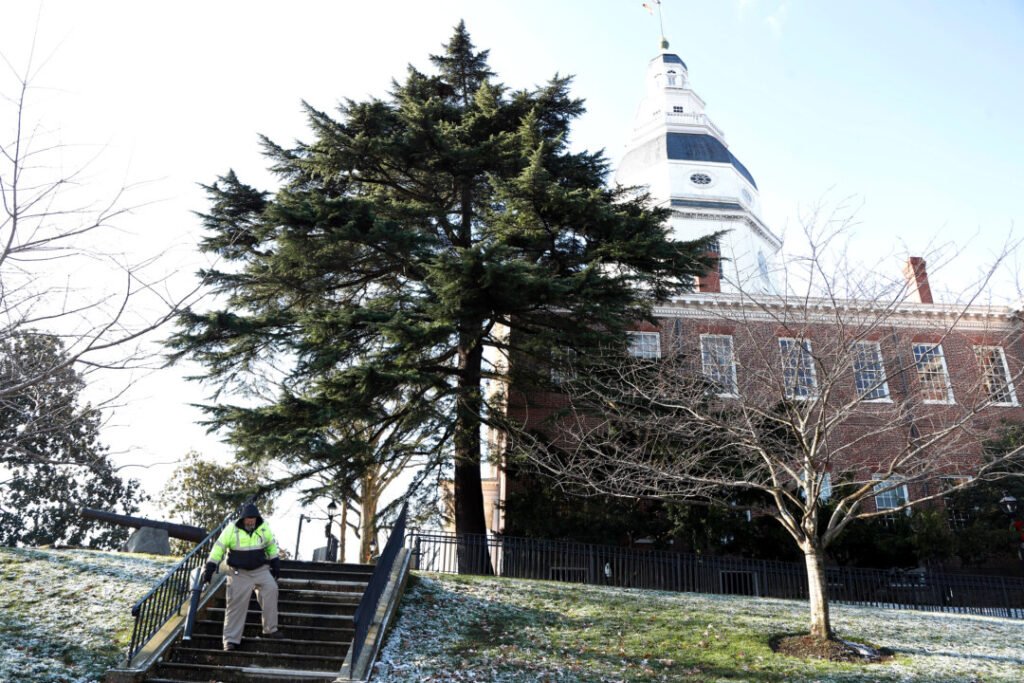
A worker blows leaves and snow off steps outside of the Maryland Statehouse in Annapolis, Md., on, Jan. 8, 2020. Julio Cortez/AP Photo
Maryland voters will get to decide on a congressional redistricting amendment backed by Democrats after the state’s highest court ruled it must be placed on the November ballot.
The Maryland Supreme Court on Thursday reversed two lower court rulings that had blocked it from going to voters, but directed that the ballot summary be rewritten to state more plainly that the amendment would limit Maryland’s map-drawing rules to state legislative districts and that the state constitution would no longer provide any standards for congressional districts.
The high court told the board to substitute the purpose paragraph from the legislation for the original ballot text. Chapter 881, the legislation in question, was enacted during a special session of the General Assembly that ran from Aug. 3 to 5.
The amendment seeks to clarify that the requirements for compactness, contiguity, due regard for natural boundaries, and equal population standards in the state constitution apply only to legislative districts for the state Senate and the House of Delegates.
It also would authorize the General Assembly to grant the Supreme Court original jurisdiction to review any congressional districting plan. And it states that nothing in the state constitution supplies criteria for congressional district boundaries.
Related Stories


Ned Miller, chief strategist for Fight Back MD, which supports the ballot measure, said, “We are building the statewide campaign to educate voters, organize supporters and build the coalition necessary to stand up to Donald Trump and pass Question 3 in November.”
Democrats already hold seven of Maryland’s eight U.S. House seats. The proposed amendment would not change voting districts for this year’s midterm elections. If approved by voters, it could free Democratic lawmakers to draw new congressional districts.
The court ordered the circuit courts to enter new orders by Friday directing the substitution.
State Senate Minority Leader Steve Hershey, one of several Republican lawmakers who sued, said he appreciated the court’s finding that the ballot wording was unfair but said it wasn’t the role of the judiciary to rewrite what lawmakers had done.
“The Court ultimately provided political cover for the General Assembly by allowing this misleading constitutional amendment to remain on the ballot,” Hershey said in a statement.
The Associated Press contributed to this report.
[ad_2]
Source link