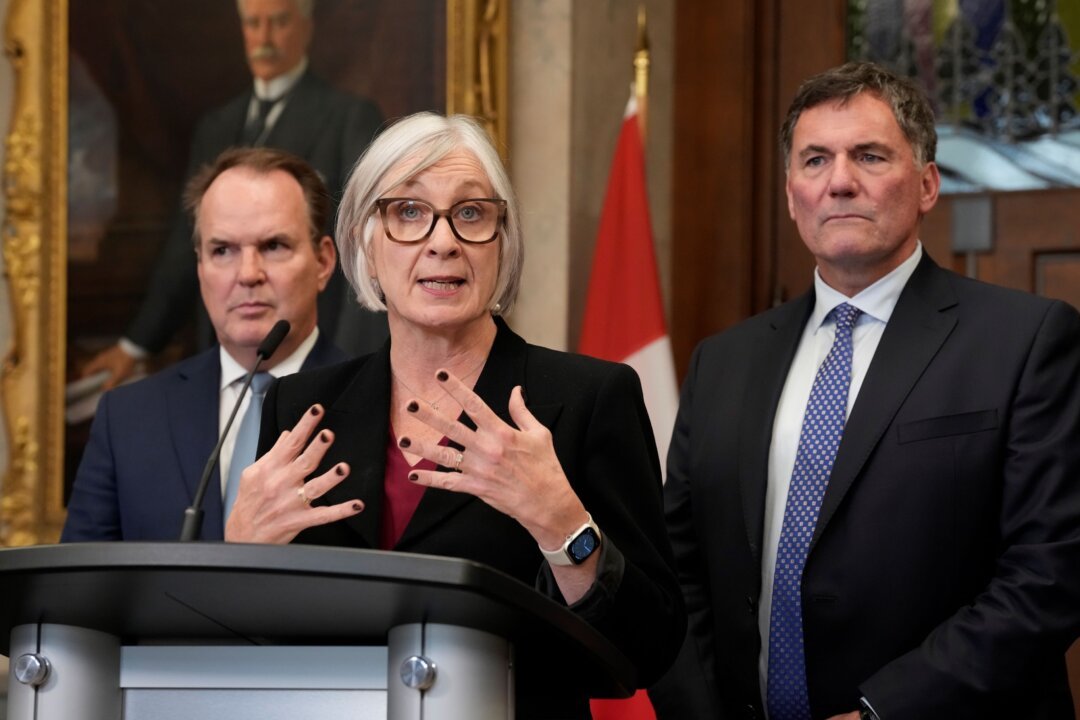
The federal government has introduced legislation aimed at speeding up project approvals while making significant changes to collective bargaining and work-stoppage rules in federally regulated industries.
The government introduced Bill C-39, the Building Canada Strong Act, on Sept. 21, saying it would streamline federal approvals, strengthen transportation and trade infrastructure, and create new tools for resolving labour disputes.
Project Approvals
Dominic LeBlanc, minister responsible for One Canadian Economy, said the government is applying the approach used by its Major Projects Office to projects of all sizes.
The office was created a year ago to coordinate and accelerate approval processes for major projects deemed by the federal government to be in national interest.
“Today, we are applying the same urgency and efficiency to projects of all sizes across the economy,” LeBlanc said.
LeBlanc said the new process would establish clearer federal review timelines, reduce delays and duplication, and coordinate permitting and assessment processes.
“One project, one review, and one year to a decision,” he said.
Related Stories


LeBlanc added that the government consulted with indigenous peoples, provinces and territories, investors, municipal leaders, and Canadians while developing the legislation.
Steven MacKinnon, minister of transport and government House leader, said the proposed legislation would establish a Transportation Projects Office to coordinate federal permitting processes and help move priority projects forward within one year.
It would also formally designate strategic trade corridors and identify ways to eliminate bottlenecks, he said.
MacKinnon said the proposed project-review changes would not eliminate environmental assessments or the government’s obligations to indigenous rights holders.
The Conservatives are calling on the government to remove regulations such as the Impact Assessment Act and the industrial carbon tax altogether, saying this way businesses can thrive without government intervention.
“What we need to do is reduce the governmental cost for our industries so that they can actually compete, while bringing home investment and jobs for our people,” Conservative Leader Pierre Poilievre said recently.
Labour Code Changes
The legislation also proposes changes to Canada’s federal labour system.
Patty Hajdu, minister of jobs and families, said the proposed legislation is introduced because federally regulated sectors—including ports, rail, air transportation, telecommunications, banking, and marine transportation—depend on stable relationships between employers and workers.
Hajdu said the proposed Canada Strong for All Act would expand mediation tools and facilitate earlier intervention when disputes could have significant consequences.
The legislation would also establish clearer rules around Section 107 of the Canada Labour Code, which allows the labour minister to intervene in certain disputes, the government says.
Hajdu said under the proposed changes, the minister would have to explain why arbitration or another dispute-resolution mechanism is necessary.
She said the changes would establish “clear guardrails” around Section 107 and reinforce it as a last-resort tool.
“Section 107 is meant to be a measure of last resort, and it will remain that when all other alternatives have been exhausted by the parties,” Hajdu said.
Hajdu said that before Section 107 could be considered, a special mediator would be appointed in high-conflict negotiations to help the parties resolve sticking points and examine the causes of the dispute. She noted that the mediator could then report publicly on the state of negotiations.
The minister added that the proposed legislation would also strengthen certain worker protections.
Hajdu said the government would clarify paid medical leave provisions to ensure they work coherently with employer-provided benefits and protect workers’ union benefits and memberships when contracts change hands.
She said the government also plans to develop a strategy to substantially increase penalties for worker misclassification and wage theft, including stronger penalties for repeat offenders.
During question period on Monday, NDP MP Don Davies accused the Liberals of siding with wealthy investors instead of standing with workers who want fair and safe workplaces.
“New Democrats know that to truly build Canada strong, we need a healthy and respected working class. It’s workers who build this country and keep it moving,” he said.
Green Party Leader Elizabeth May said she doesn’t like how the Liberals intervene in collective bargaining, and she doesn’t think changes to the code benefit Canada’s economy.
Bloc Québécois Leader Yves-François Blanchet said the bill is “one more token placed on the table in order to attract huge foreign businesses in Canada, telling them that there will be no more environmental regulations, much less work regulations, and that things will be easy.”
Conservative House Leader Andrew Scheer declined to comment on the bill, saying he would wait to see the legislation before offering remarks.
The Canadian Press contributed to this report.