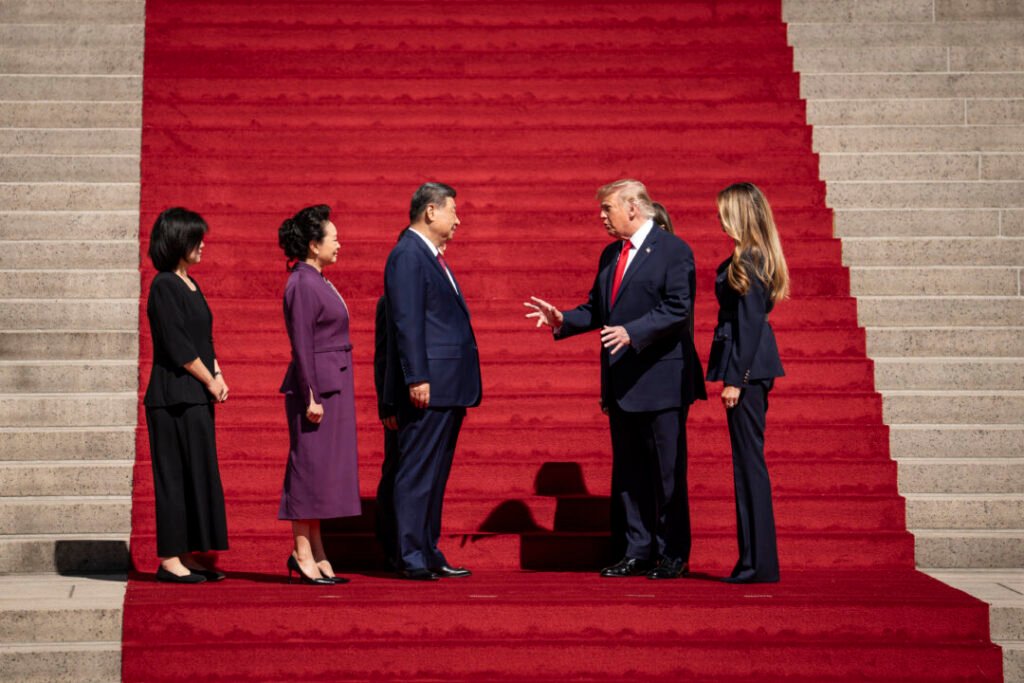
WASHINGTON—President Donald Trump and Chinese leader Xi Jinping wrapped up their summit on Sept. 25 in Washington with a tea meeting at the White House, followed by a tour of the National Archives to view historic documents marking America’s 250th anniversary.
After three days of diplomatic engagements, the Chinese Communist Party leader and his wife, Peng Liyuan, departed from Joint Base Andrews, concluding their first state visit to the United States in over a decade.
Here are the key takeaways from the Trump–Xi summit:
Trump Warns Xi About Iran
As tensions with Iran continue, China has faced criticism for providing the Islamic regime vital support, including sustained oil exports despite U.S. sanctions.
During the visit to the National Archives, Trump confirmed that he discussed Iran with the Chinese leader.
Related Stories


“I think we’re going to do great,” he told reporters, without elaborating further.
Earlier in the day, U.S. Ambassador to China David Perdue told CNBC that Trump warned Xi during their White House meeting on Sept. 24 that any Chinese support for Iran—whether direct or indirect, including intelligence, parts, or military equipment—is “unacceptable.”
“President Trump made that very clear again yesterday,” Perdue said, noting that recent talks have shown progress.
“We’ve seen evidence that they have listened to us. They pulled some things down, and we have evidence that they pay attention when President Trump talks about this particular issue.”
Tight Media Control, Surprise Protest Song
During the two-day summit, Trump and Xi did not hold a joint press conference. Journalists were also not allowed into the Oval Office to question Xi directly, which contrasts with Trump’s meetings with other world leaders.
Throughout the summit, Chinese Communist Party officials tightly limited the media’s access to Xi, protecting him from tough questions about human rights, Taiwan, Hong Kong, and other topics considered sensitive by the Chinese regime.
On the first day of the summit, Trump gave Xi a tour of recent White House renovations, including the new helipad and ballroom. During the tour, Xi unexpectedly encountered reporters. Members of the American press, standing just three feet away, asked him about sensitive topics, including the possible release of Hong Kong political prisoner Jimmy Lai.
Xi did not respond. Trump intervened and said that the two leaders “had a great meeting.”
Xi kept smiling and remained silent.
Another notable event happened during the state dinner honoring Xi on Sept. 24. At the White House dinner, military musicians performed “Do You Hear the People Sing?” from the famous musical “Les Misérables.” The performance drew a lot of attention after a White House official shared a clip on social media. That particular song is banned in China, as it was popular during the 2019 pro-democracy protests in Hong Kong.
‘Our Farmers Are Going to Be Very Happy’
During the White House tea meeting with Xi, Trump appeared positive, telling reporters that both sides have “made great strides.”
“I think our farmers are going to be very happy. A lot of very positive things happened,” he added.
At the previous Trump–Xi summit in May in Beijing, China committed to purchasing $17 billion in agricultural products annually for three years. It also agreed to buy 25 million metric tons of U.S. soybeans, as announced in October 2025. It remains unclear whether Beijing is meeting these targets or has made additional purchase commitments during the Washington summit.
U.S. Trade Representative Jamieson Greer said on Sept. 25 that details of trade discussions will be announced on Monday.
“We’re in a managed trade situation,” he told CNBC. “We’ve had progress, and we will release on Monday, I think, a lot more details about what we’ve accomplished over the past few weeks in negotiating with the Chinese.”
Before the summit, both Greer and Treasury Secretary Scott Bessent held meetings in New York City with their counterparts on trade issues on the sidelines of the U.N. General Assembly.
Greer said that the U.S. export controls on advanced chips and other strategic goods will remain in place. However, he indicated that the United States is considering a preferential trade agreement with China for non-sensitive goods, including farm products, medical devices, and consumer goods.
He noted that both sides have agreed to protect these specific goods from future trade disputes and tariff measures.
Rare Earths Remain a Choke Point
In recent years, Beijing has used its monopoly on rare earth processing as a major trade lever against the United States.
Perdue said that Washington is concerned about China weaponizing its dominance in this sector.
Until the United States reduces its reliance on China for rare earths and critical minerals, he said, “it’s going to be a bumpy road.”
“President Trump is working feverishly right now to regain that independence, and I can tell you we have a Manhattan Project-level effort underway right now in pharmaceuticals and in rare earth elements,” he said, referring to the top-secret U.S. government program during World War II that built the world’s first atomic bomb.
This extension includes Beijing’s suspension of rare earth export controls and the broader U.S.–China tariff truce.
No Change in US Policy Toward Taiwan
Perdue reiterated that U.S. policy toward Taiwan remains unchanged despite pressure from Xi.
“Of course, China has tried to coerce change in that regard, [but] we’re not changing the language,” he said. “We’re not changing our position there. We want peace across the strait. We don’t want coercion. We don’t support independence.”
“Xi has gotten that message,” he added.
The United States has long maintained a “one-China policy” without recognizing Beijing’s sovereignty over Taiwan. It has also been Taipei’s main arms supplier under the Taiwan Relations Act.
“President Trump has shown respect and listened to their side of that argument,” Perdue said. “But we are more stable on that issue today than we have been in the last decade.”