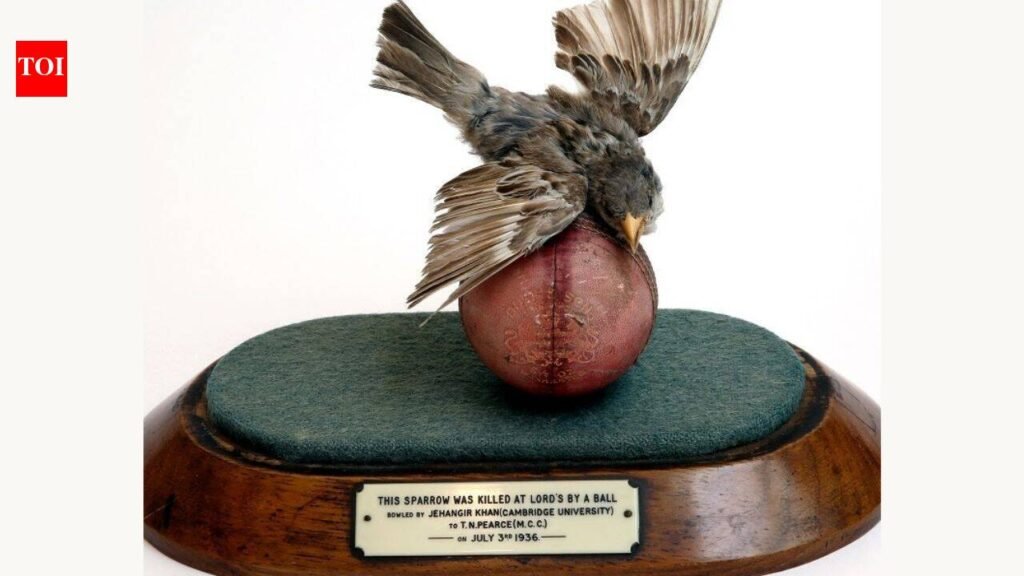
Every corner of Lord’s Cricket Ground has a story. Since opening in 1814, the venue in London’s St John’s Wood has become one of cricket’s most iconic grounds. Generations of cricketers have played here, and many of the game’s most memorable moments have unfolded on its field.Away from the pitch, Lord’s is also home to one of cricket’s biggest collections of history. Inside the ground sits the Marylebone Cricket Club (MCC) Museum, which was inaugurated in 1953 by HRH, The Duke of Edinburgh. It is one of the oldest sporting museums in the world and houses some of the game’s most famous artefacts.Visitors can see Kapil Dev’s 1983 World Cup-winning memorabilia, the Ashes urn, bats used by WG Grace, and many other pieces of history from different eras of cricket. But among all those exhibits, one display continues to stand out for its unusual story — a cricket ball mounted with a stuffed sparrow.
The day a cricket ball hit a sparrow
The incident happened on July 3, 1936, during a match between Cambridge University and the MCC at Lord’s.Indian fast bowler Jahangir Khan was representing Cambridge University. He was bowling to Tom Pearce when one of his deliveries struck a sparrow in mid-air. The bird died instantly after being hit by the ball.What made the incident even stranger was what happened next. Pearce still managed to play the delivery, and the sparrow fell near the stumps.As recorded by Wisden Almanack: “TN Pearce, the batsman, managed to play the ball and the bird fell against the stumps without dislodging a bail.”The unusual moment immediately became part of cricket folklore., and instead of discarding the bird, it was preserved.
How the sparrow became a museum exhibit
The sparrow was stuffed and mounted on the very cricket ball that hit it.The display was later placed in the Memorial Gallery at Lord’s and has remained one of the museum’s most recognised exhibits ever since.The museum describes it as one of its “best-loved artefacts”.“The unfortunate bird was stuffed and mounted upon the ball that killed it and subsequently displayed in the Memorial Gallery at Lord’s. It has since become one of the most curious and best-loved artefacts ever displayed at the Ground.”For decades, thousands of visitors have stopped to look at the sparrow and the ball, making it one of the museum’s most talked-about exhibits despite having nothing to do with a famous innings or a major trophy.
What scientists discovered 84 years later
The sparrow remained on display at Lord’s for decades before experts carried out conservation work in 2020.It was sent to London’s Natural History Museum, where specialists examined and restored it.The conservation work revealed something that had not been known since 1936. The bird was identified as a young adult male sparrow.The museum also repaired damage that had appeared over time. According to the MCC Museum, “Conservation work at the Natural History Museum in early 2020 revealed for the first time that the sparrow had been a young adult male.”The restoration included repairs to skin splits across the abdomen, a loose wing, and cleaning away dust and dirt collected over many years inside the museum.The work was carried out to ensure the exhibit could continue to be displayed for future visitors.
The bird has left Lord’s only twice
The conservation trip in 2020 was only the second time the sparrow had left Lord’s since becoming part of the museum.Its first trip came in 2006, when it travelled to the Netherlands.The sparrow became part of the Grand House Sparrow exhibition at the Natural History Museum of Rotterdam, where it was displayed. After returning to Lord’s, it continued to occupy its place inside the MCC Museum.The museum noted that the conservation work in London should help preserve the exhibit for years to come.“Its more recent trip should guarantee that it remains fit to delight visitors to the MCC Museum for many years to come.”