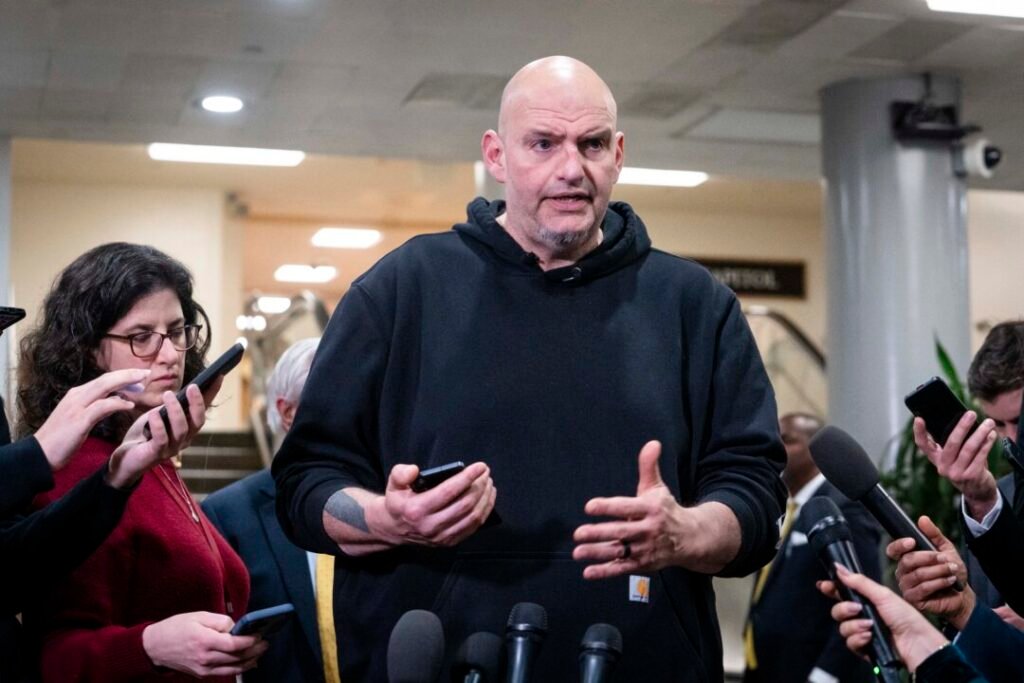
Sen. John Fetterman (D-Pa.) is rejecting what he calls overreaction to artificial intelligence (AI) and data centers, saying U.S. leadership in AI and energy is tied to national security and competition with China.
“AI supremacy and energy dominance underpins our national security,” Fetterman wrote on X on Aug. 22.
“China continues to fuel and benefit from our overreaction,” he wrote. “I reject the political pandering and hyperbole over data centers or AI doomsdaying.”
His comments came four days after Pennsylvania Gov. Josh Shapiro, also a Democrat, signed an executive order changing the state’s permitting and other requirements for large data centers.
Fetterman did not name Shapiro or say whether his criticism included the governor’s order.
The Pennsylvania senator has also opposed Sen. Bernie Sanders’ (I-Vt.) call to pause AI development.
Related Stories


On Aug. 10, Sanders urged Anthropic, Meta, and OpenAI to “immediately pause” AI development, citing incidents that he said raised the risk of humans losing control of the increasingly capable systems. Sanders said senators could act if the companies did not pause voluntarily.
Responding to reporting on Sanders’s call, Fetterman wrote on X, “China ❤️’s to hear this.”
“America must lead in the development of AI, otherwise we live under China’s rules,” he wrote. “That must not happen.”
Sanders has separately proposed a federal moratorium on new AI data centers. He and Rep. Alexandria Ocasio-Cortez (D-N.Y.) announced the Artificial Intelligence Data Center Moratorium Act in March, which would halt construction of new AI data centers until Congress enacts broader AI safeguards.
US, China Race on AI Infrastructure
The Trump administration’s America’s AI Action Plan calls for faster permitting of data centers, semiconductor plants, power projects, and other infrastructure needed for AI, along with expansion of the electric grid and greater use of federal land for data center and energy projects.
The plan says the United States needs “vast AI infrastructure and the energy to power it.”

An Amazon Web Services data center in Boardman, Ore., on Aug. 22, 2024. Jenny Kane/AP Photo
Beijing’s national planning documents likewise connect AI development with computing and energy infrastructure.
China’s 15th Five-Year Plan calls for more high performance computing resources, large intelligent computing clusters, and closer coordination between computing facilities and electricity supplies.
The Chinese government’s 2026 work report calls for “ultra large scale intelligent computing clusters,” coordination between computing and electricity infrastructure, nationwide allocation of computing resources, expanded public cloud capacity, and larger high quality datasets.
Stanford University’s 2026 AI Index said leading U.S. and Chinese models had traded the top position several times since early 2025.
As of March, Stanford said the top U.S. model led the top Chinese model by 2.7 percent on an evaluation that includes human comparisons of model responses.
The index also said the United States continued to produce more top-tier AI models and higher impact patents, while China led in the volume of AI publications, citations, and patent grants.
Fetterman’s reference to China also comes amid documented attempts by China-linked actors to exploit U.S. disputes over AI infrastructure.
In June, three Republican House Energy and Commerce Committee leaders asked the FBI and the White House Office of Science and Technology Policy for briefings on allegations that foreign adversaries were seeking to slow U.S. data center development.
OpenAI separately reported in June that accounts likely originating in China had posed as Americans and generated material criticizing data centers and electricity costs. OpenAI said the operation sought to exploit existing concerns but found no evidence that it gained meaningful traction beyond its own activity.
Power Costs Draw Federal Action
Concerns about who pays for the electricity and grid infrastructure required by large data centers have produced federal action alongside the push to build more AI capacity.
On March 4, Amazon, Google, Meta, Microsoft, OpenAI, Oracle, and xAI signed the White House’s Ratepayer Protection Pledge.
The companies agreed to build, bring, or buy the additional electricity needed for their data centers and pay for new power delivery infrastructure required to serve them. They also agreed to negotiate separate rate structures and pay those costs even if they ultimately use less electricity than requested.
The White House expanded the pledge in July to additional utilities, developers, cooperatives, and states.

President Donald Trump speaks during a roundtable meeting on the administration’s “ratepayer protection pledge” in the Indian Treaty Room at the White House on March 4, 2026. The pledge is a policy designed to shift rising energy costs from artificial intelligence data centers away from consumers. Win McNamee/Getty Images
Congress is considering a related approach.
The bipartisan Ratepayer Protection Act, H.R. 9340, advanced from the House Energy and Commerce Committee in a 52–0 vote on July 21.
The bill would require state utility regulators to consider standards intended to make data centers and other large new electricity users bear the additional generation, transmission, distribution, and other grid costs associated with serving them.
Pennsylvania Changes Data Center Rules
Shapiro’s Aug. 18 executive order establishes a new state permitting process for data centers with peak electricity demand above 25 megawatts—the maximum amount of electricity a project expects to draw at one time.
Developers seeking the order’s more favorable permit-review process must sign a project-specific agreement with the Pennsylvania Department of Environmental Protection (DEP). This makes the Governor’s Responsible Infrastructure Development, or GRID, requirements legally enforceable.
Under the agreement, developers must obtain enough new electricity capacity to meet the project’s peak demand and enough additional energy to cover its annual use.
They must also offer local and county governments a community benefit agreement covering issues such as noise, traffic, air quality, visual impacts, emergency planning, and financial contributions toward local priorities.
Environmental requirements include plans addressing water demand, water efficiency, and possible effects on other users.
The agreement allows civil penalties for violations and allows DEP to remove a developer from the preferred review process for noncompliance.
For developers that sign the GRID agreement, DEP can review qualifying permit applications as they arrive rather than waiting for every application to be filed. The department cannot issue the permits until the project is consistent with the local comprehensive plan and has obtained required municipal approvals, including applicable zoning and subdivision approvals.
Developers that do not sign the agreement face a slower process. DEP cannot begin reviewing their applications until local approvals and any required water withdrawal or wastewater authorizations are in place, and the department cannot issue permits on a rolling basis.
The order also removes data center projects from Pennsylvania’s Permit Fast Track program, which coordinates agency reviews for major economic development projects.
It directs the Department of Revenue to revise the rules for the state’s Computer Data Center Equipment Exemption Program so new applicants must comply with GRID requirements.
The order prohibits agencies under Shapiro’s authority from using nondisclosure agreements in connection with data center projects and requires DEP to create a public map showing permitting information.
Beginning July 1, 2027, operating data centers in Pennsylvania must report their energy and water use, peak electricity demand, energy and water sources, and measures taken to improve efficiency and limit environmental impacts, according to the order.
Pennsylvania’s utility regulator had already acted separately on large electricity users before Shapiro signed the order. On May 13, the Pennsylvania Public Utility Commission issued a final model tariff framework for large electricity customers, including data centers.
The framework addresses which customers bear responsibility for infrastructure costs, financial guarantees, interconnection studies, contract terms, and other issues that arise when large new electricity loads connect to the grid.
Shapiro’s order directs his special counsel for energy affordability to seek additional commission rules, procedures, and orders.
Those include measures that would require qualifying data centers to reduce electricity use before other customers during certain grid emergencies unless they have secured enough additional generating capacity, and measures assigning certain reliability and interconnection costs to data center customers rather than other ratepayers. The additional utility measures would require further action by the commission.