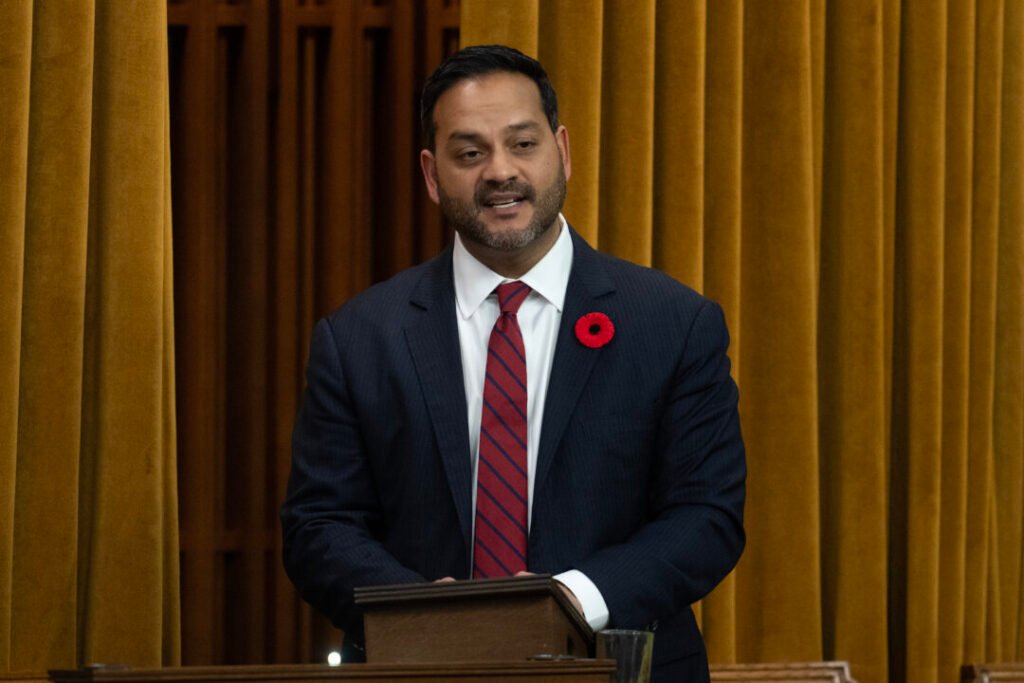
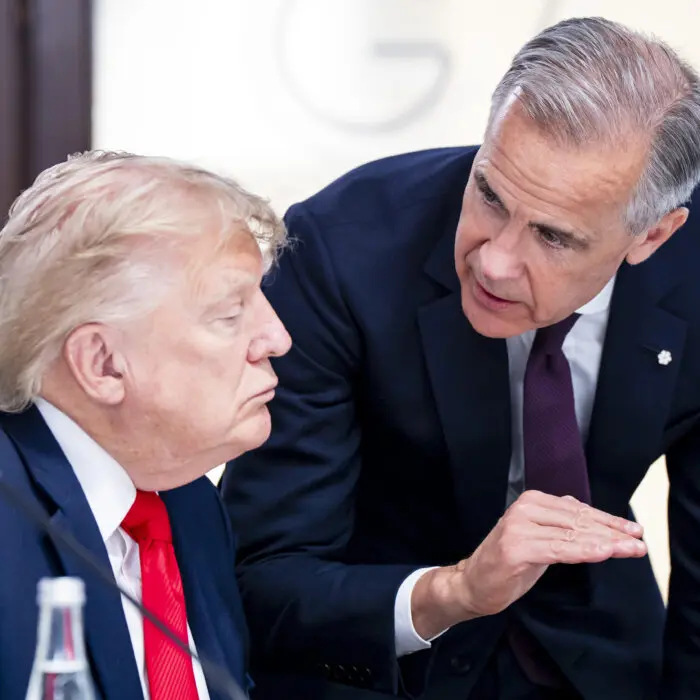
Conservative MP Shuvaloy Majumdar rises during question period in Ottawa on Nov. 3, 2023. The Canadian Press/Adrian Wyld
The Conservatives are urging the federal government to release full details of the trade deal proposed by the United States before talks between the two countries collapsed late on Aug. 21.
“Canadians deserve to know all the facts, to judge and hold accountable all of the decisions that are made which affect their lives,” said MP Shuvaloy Majumdar, shadow minister for Canada-United States relations.
In an Aug. 23 letter to Dominic LeBlanc, minister responsible for Canada-U.S. Trade, Majumdar said the Conservative Party agrees that Canadians should stand united in the fight for tariff-free trade with the United States, and that “Canada cannot accept a bad deal.”
However, given that the new tariffs would have serious consequences for the Canadian economy, Ottawa should release the draft text of any proposed agreement that both governments have seen, if one exists, he wrote.
“Even after addressing Canadians and the media, the public and Members of Parliament still remain in the dark on your government’s demands in negotiations with the Trump administration,” Majumdar wrote.
Since negotiations have now ended, there is no need to maintain secrecy for the benefit of Canada’s position in talks, he said, adding that the Conservative Party is not asking for negotiating secrets or anything not already known to Washington.
Related Stories
“This information will allow all Canadians to debate and discuss the way forward as a country,” he wrote.
Majumdar said that U.S. tariffs on Canada are far higher than when Prime Minister Mark Carney took office, and that Carney made “roughly a half-dozen major concessions” before the talks began, but instead of getting Canada wins, “It did the opposite.”
Shortly before Carney was sworn in as prime minister on March 14, 2025, Washington had already on March 4 imposed a 25 percent tariff on imports from Canada under the International Emergency Economic Powers Act, with 10 percent on energy products including critical minerals and potash. The 25 percent tariff was paused on March 7 for Canadian goods that qualify for preferential treatment under the Canada-United States-Mexico Agreement (CUSMA).
Then on March 12, 2025, the United States imposed global 25 percent tariffs under Section 232 on steel and aluminum, without exemption for CUSMA-compliant goods in those sectors.
Later in 2025, Canadian cars and light trucks faced a global 25 percent tariff imposed by the United States on April 3, followed by 25 percent tariffs under Section 232 on non-CUSMA auto parts on May 3. The United States then imposed 50 percent global tariffs under Section 232 on semi-finished copperproducts and derivatives on Aug. 1, followed by a tariff increase from 25 percent to 35 percent on non-CUSMA goods starting on Aug. 7.
On Aug. 29, 2025, the United States ended the “de minimis” exemption that for decades had allowed parcels valued at less than US$800 to enter the country duty-free, disrupting Canadian small and medium-sized businesses that rely on low-value cross-border delivery.
In terms of concessions, Canada rescinded its 3 percent digital services tax on June 29, 2025, after Trump halted trade negotiations over the tax. O also removed its 25 percent counter-tariffs on U.S. goods effective Sept. 1, 2025, while retaining counter-tariffs on steel, aluminum and automobiles.
In addition, Canada backed away from new obligations on U.S. streaming companies in June and July this year, which would have required foreign streaming services such as Netflix and Spotify to make additional contributions to Canadian-content funding. Instead, Ottawa opted to replace the streaming contribution requirements with $600 million per year in Canadian federal funding.
Regarding the Gordie Howe International Bridge, Ottawa agreed to share 50 percent of the bridge’s net revenue during its first 15 years of operation with an economic development fund that is “solely controlled” by Washington. Canada also agreed to require consultation with the United States concerning certain toll changes.
We had a problem loading this article. Please enable javascript or use a different browser. If the issue persists, please visit our help center.