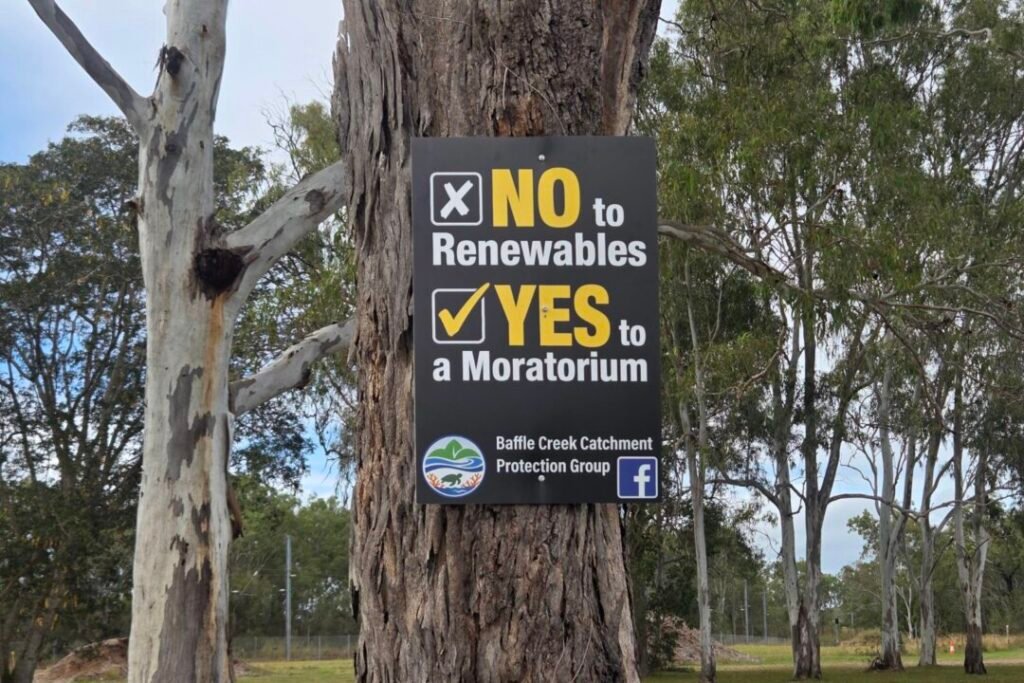
A community collective in the small Queensland township of Baffle Creek says residents fear the growing number of proposed renewables projects could endanger waterways, wildlife, and rural communities.
The Baffle Creek Catchment Protection Group has lodged a petition with the Queensland government calling for an immediate moratorium on all large-scale industrial and renewables approvals in the area until a full independent review is conducted.
The group has expressed concern about downstream ecosystems and the Great Barrier Reef, citing erosion and chemical risk, as well as fears large renewables projects could impact the health and tranquility of the local environment.

Members of the Baffle Creek community hold a gathering against renewables in their area in Queensland, Australia. Courtesy of Sean Hordern
At least three major renewable energy and storage projects are proposed around the Baffle Creek catchment, including two large battery developments and a pumped hydro project.
The region sits between the regional cities of Bundaberg in the south and Gladstone to the north, and is located around five hours’ north of Brisbane.
Baffle Creek is recognised as one of the few remaining undisturbed coastal rivers in the state and is known for its open waterways, wetlands, coastline and coral reefs.
Related Stories

Fire Risk Concerns
Baffle Creek Catchment Protection Group representative Sean Hordern said he had no issue with renewables in the right places, but said the township was not suitable.
“I got no problem with renewables in the right area,” he told The Epoch Times. “I think there’s at least one or two out near … North Gladstone, that’s in the right spot.

The Baffle Creek community protesting against renewable development in their area. Courtesy of Sean Hordern
“But in the middle of you know, five or six national parks and waterways, and everything down here, why are we risking our way our life?”
As a former rural firefighter, fire risk is one of Hordern’s biggest worries.
Hordern claims the development applications note rural fire brigades as an option to deal with blazes.
“I know from fact that the rural firefighters are not allowed to go to a renewables fire. You don’t have a hazmat suit or breathing apparatus.”
The closest fire stations are also around a 40-minute drive from Baffle Creek.
Hordern said fire could also impact people in the nearby townships of Agnes Water and Seventeen Seventy, some of whom only have one road in and out, and could be downwind of any blaze.
The local said the catchment was highly flood-prone and argued that contamination or sediment from development sites could move through interconnected creeks and waterways.
He was particularly concerned about projects near waterways feeding local water supplies, as well as the possibility of pollutants entering groundwater or streams and potentially travelling into the Great Barrier Reef.
“If something gets into it … we’re going to contaminate our water supply before we even get it out of the ground or out of the creeks,” Hordern said.
He also criticised the way environmental and social impacts were assessed, arguing some studies did not adequately consider flooding, wildlife or the broader catchment.
Hordern described parts of the consultation process as a “box-ticking exercise,” saying it did not always provide a true picture of community sentiment.
Concerns Renewables Treated Differently
Former James Cook University Professor Peter Ridd said he wasn’t concerned about run-off into the Great Barrier Reef, but was more worried that renewables projects were being treated differently.
“It is hypocritical to hit farmers with all sorts of regulation, but let renewables developers get away with minimal constraints,” he told The Epoch Times.
“There is one set of rules for farmers—and they are excessive—and virtually no rules at all for renewables developments,” Ridd claimed.
The Epoch Times contacted the Queensland LNP state government for additional comment.
Renewables Projects Must Follow Guidelines
The Epoch Times understands that the company behind one of the proposed projects, AMPYR, will soon lodge a development application for the Rutherglen Battery which will be assessed against the state’s new code for battery storage facility developments, introduced in December 2025.
The Queensland Renewable Energy Council (QREC) said the process for renewable applications in the state was stringent.
“This includes consideration of environmental values, water quality and stormwater, natural hazards and disasters including ecological values, transport impacts and other site-specific risks,” QREC CEO Katie-Anne Mulder told The Epoch Times.
“Applications are also publicly notified, giving local residents and other stakeholders the opportunity to make submissions, with third-party appeal rights available.”
All new wind farms and solar farms above one megawatt production capacity must undertake a social impact assessment and enter into a community benefit agreement with the relevant local council, at a minimum, before a development application can be properly lodged.
Furthermore, any projects that may have significant impacts on matters of national significance—such as the Great Barrier Reef—may also require federal oversight.