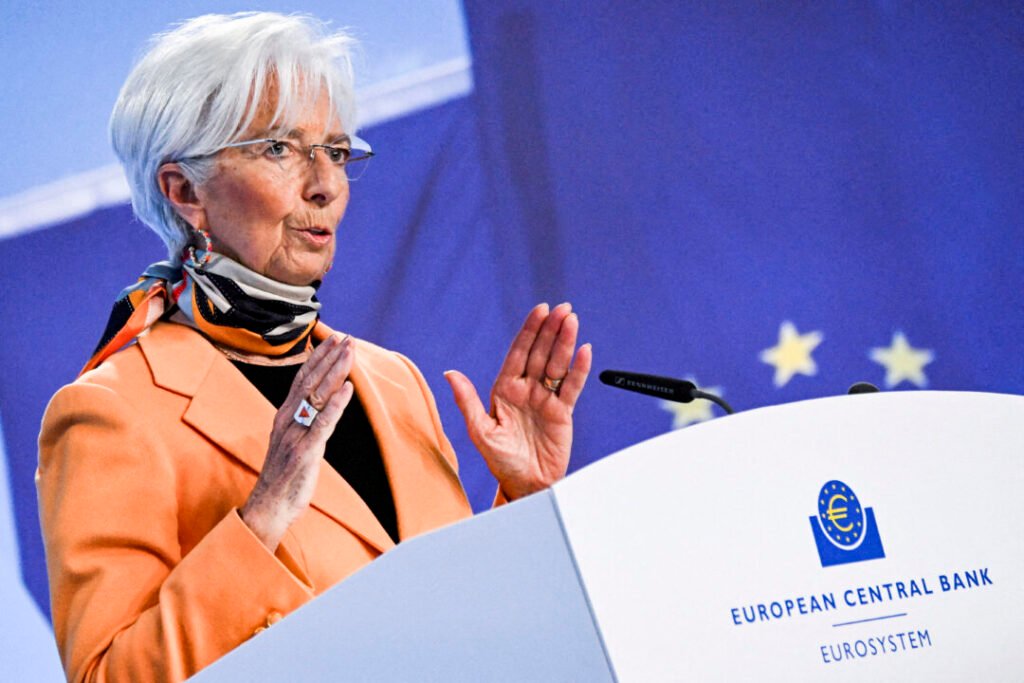
The European Central Bank—also known as the ECB—raised a trio of key interest rates by a quarter point as inflation remains above its 2 percent target.
Upside inflation risks and downside threats to economic growth drove the widely expected Sept. 10 policy decision.
It marked the second rate hike since June, when the institution followed through on its first increase in three years.
Global financial markets watched the ECB’s meeting closely as it could set the stage for other central banks—from the Federal Reserve to the Bank of Japan—to raise rates.
Here’s what to know about the ECB’s policy action.
‘Outlook Remains Highly Uncertain’
Related Stories

The ECB’s Governing Council voted to raise three key interest rates by 25 basis points.
Effective from Sept. 16, the deposit facility, the main refinancing operations, and the marginal lending facility will rise to 2.5 percent, 2.65 percent, and 2.9 percent, respectively.
“The conflict in the Middle East continues to generate inflation pressures, and inflation is set to remain well above target for an extended period,” the ECB said in a post-meeting statement.
Staff projections do not expect headline inflation to return to the 2 percent target for two more years.
Excluding food and energy prices, core inflation is still forecast to remain above 2 percent beyond 2028.
As for economic growth, the baseline projection for 2026, 2027, and 2028 is 0.9 percent, 1.4 percent, and 1.5 percent, respectively.
“This is an upward revision for both 2026 and 2027, mainly reflecting the greater-than-expected resilience of the euro area economy,” the ECB said.
“The outlook remains highly uncertain.”
Inflation in Europe
Inflation pressure in the euro zone has worsened due to the oil supply shock, as the bloc is a net energy importer.
Its 12-month inflation rate hit 3.3 percent in August, driven by a more than 14 percent spike in energy costs, the highest since January 2023.
Comparable to other advanced economies, the region’s inflation woes are driven almost entirely by global crude and gas prices.
Excluding energy and food, the annual core inflation rate came in at a lower-than-expected 2.4 percent.
Energy inflation could further intensify this month as global prices keep climbing.
A barrel of Brent—the global seaborne benchmark for oil prices that’s more sensitive to geopolitical tensions—topped $107 in overseas trading on Sept. 10.
Heading into the winter, conditions could deteriorate as natural gas storage levels are low, says Simon Lack, portfolio manager at Catalyst Energy Infrastructure.
“Europe looks like they’re going to be struggling to fill up their caverns before the winter,” Lack said in a note emailed to The Epoch Times.
“They’re going to have to either rely on other sources of energy and gas or start paying up more aggressively because shipments originally going to Europe were redirected towards Asia, where buyers themselves pay a bit more.”
European natural gas prices have rocketed 150 percent over the past year.
By comparison, U.S. natural gas prices are down more than 11 percent amid record domestic production and enormous inventories.
‘Insurance’ Rate Hike
Traders had priced in a 100 percent chance of a rate hike before the Sept. 10 policy meeting.

A worker rides his bicycle to the BP oil refinery Ruhr Oil in Gelsenkirchen, Germany, on March 28, 2022. Martin Meissner/AP Photo
The ECB’s decision falls into the category of an “insurance” rate increase, says Carsten Brzeski, global head of macro at Dutch bank ING.
“It is a hike to stay ahead of the curve, demonstrating the ECB’s high level of vigilance, and an attempt to prevent higher energy prices from feeding through to the broader economy,” Brzeski said in a note shortly after the meeting.
ECB officials did not forecast their next meeting, as they have insisted since the start of the Iranian conflict that they will take a meeting-by-meeting approach to monetary policy.
Investors have been pricing in at least one more rate hike at either the October or December policy meetings.
But it is hard to see the ECB willing to worsen surging government bond yields and deteriorating public finances by tightening policy further, Brzeski added.
“It’s difficult to envisage the ECB being willing to risk a recession to tackle what is still a textbook supply-side shock. Admittedly, though, the ECB has made policy mistakes before,” he said.
Like the United States and Japan, European countries have seen bond yields soar.
The German 10-year bund yield reached 3.5 percent for the first time since 2008.
France’s 10-year bond yield also hit an 18-year high of 4.3 percent.
The Italian 10-year yield cracked 4.3 percent for the first time in three years.
Federal Reserve, Next Stop
The Federal Reserve will be the next major central bank to meet in September.
Ahead of the Sept. 15 and Sept. 16 Federal Open Market Committee meeting, investors have priced in a 72 percent chance of a quarter-point rate hike.
Futures markets amplified their bets after elevated producer inflation data.
“Combined with elevated oil prices and a live Fed meeting next week, investors perceived this print as inflationary rather than disinflationary; hence yields moved higher, equities moved lower, and rate-hike odds firmed,” Chris Osmond, CIO for Fifth Third Wealth Advisors, told The Epoch Times in an emailed note.
The entire Treasury yield curve advanced throughout the Sept. 10 trading session.
The benchmark 10-year yield hit 4.93 percent for the first time since April 2007. The 30-year Treasury bond yield climbed to a 26-year high of 5.34 percent.
The 2-year yield—typically sensitive to Fed policy expectations—rocketed to 4.55 percent. This suggests investors expect three rate hikes.
Wall Street will focus on the August Consumer Price Index at the end of the week.
Economists do not expect much change in the consumer inflation data, as the annual inflation rate is forecast to be unchanged at 3.4 percent.
The 12-month core inflation rate is predicted to slow to 2.4 percent.