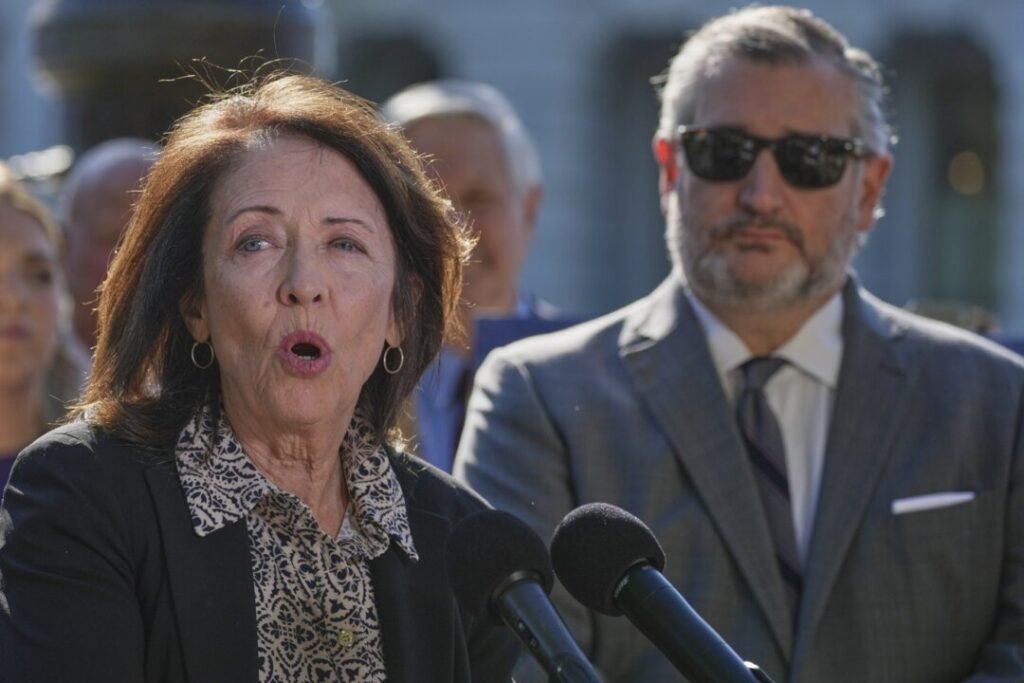
A bipartisan bill that aims to fix spiraling spending, frequent lawsuits, and a string of other issues affecting college sports cleared a major hurdle after a Senate vote on Tuesday.
The Senate voted 74–24 to stop the filibuster, moving the Protect College Sports Act one step closer to a final up-or-down vote.
Last month, the Trump administration gave its support to the bill, which is co-sponsored by Sens. Ted Cruz (R-Texas) and Maria Cantwell (D-Wash.).
Cantwell said the size of the margin in the Senate vote left her “cautiously optimistic” the legislation could get through the House, which has repeatedly failed to pass different versions of a college sports bill.
The vote came a week after college presidents in the Southeastern Conference threatened to sue Louisiana State University over its now-canceled plans to allow players who had participated in NFL training camps to be placed on its roster.
“That was probably like a big lamp for some people who saw it and said, ‘Oh my God, this is so out of control,’” Cantwell said. “You can see how out-of-hand the situation was getting.”
Related Stories

The bill’s supporters say it “will restore order to college sports, support student athletes, and preserve and strengthen our uniquely American system of collegiate athletics.”
But among those who voted against it were all four black Democrats in the Senate—Sens. Cory Booker (D-N.J.), Lisa Blunt Rochester (D-Del.), Raphael Warnock (D-Ga.), and Angela Alsobrooks (D-Md.).
Opposition From NAACP
Advocacy group the National Association for the Advancement of Colored People wrote a letter last month setting out its reasons for opposing it.
“We recognize that the bill contains provisions concerning scholarships, health care, athlete agents, safety standards, and student athlete representation,” the letter states. “College athletes deserve those protections. They should not, however, be used as political cover for provisions that insulate institutions and conferences from legal and economic accountability.”
“What this bill does at its core is to protect a system of exploitation,” Sen. Chris Murphy (D-Conn.) said.
Cantwell and Cruz introduced the bill in May, but since then, they have won the support of the Southeastern and Big Ten conferences.
Earlier this year, Cantwell produced a report about the spiraling costs since name-image-likeness (NIL) payments began.
“Escalating costs of the college football arms race are creating massive debts for athletics departments, consuming colleges’ general funds, drawing down their endowments, reaching into the wallets of non-athlete undergrads, and even luring direct contributions from state taxpayers,” the report stated.

Sen. Shelley Moore Capito (R-W.Va.) (2nd R), joins college athletes listening during a news conference on Capitol Hill, Washington, on Sept. 14, 2026. Mariam Zuhaib/AP
The order, called “Saving College Sports,” highlighted a 2021 antitrust ruling from the Supreme Court that struck down restrictions on the National Collegiate Athletic Association’s (NCAA’s) transfer and recruiting rules.
Afterward, it updated its rules to allow players to be paid for their NIL rights from third parties.
Backing From Coaches
The proposed legislation has got the backing of football coaches Deion Sanders of Colorado and Nick Saban, formerly of Alabama, and basketball coaches John Calipari of Arkansas and Mark Few of Gonzaga.
“This clears up about 75-80 percent of our issues,” Calipari said at a news conference in Washington on Monday, before the vote. “Nothing is perfect. This is a bite out of the apple.”
But critics of the Protect College Sports Act say the NCAA should not be getting more power.
“Over and over again, courts have determined that colleges and the NCAA and conferences are violating the law,” Murphy said.
The Associated Press contributed to this report.