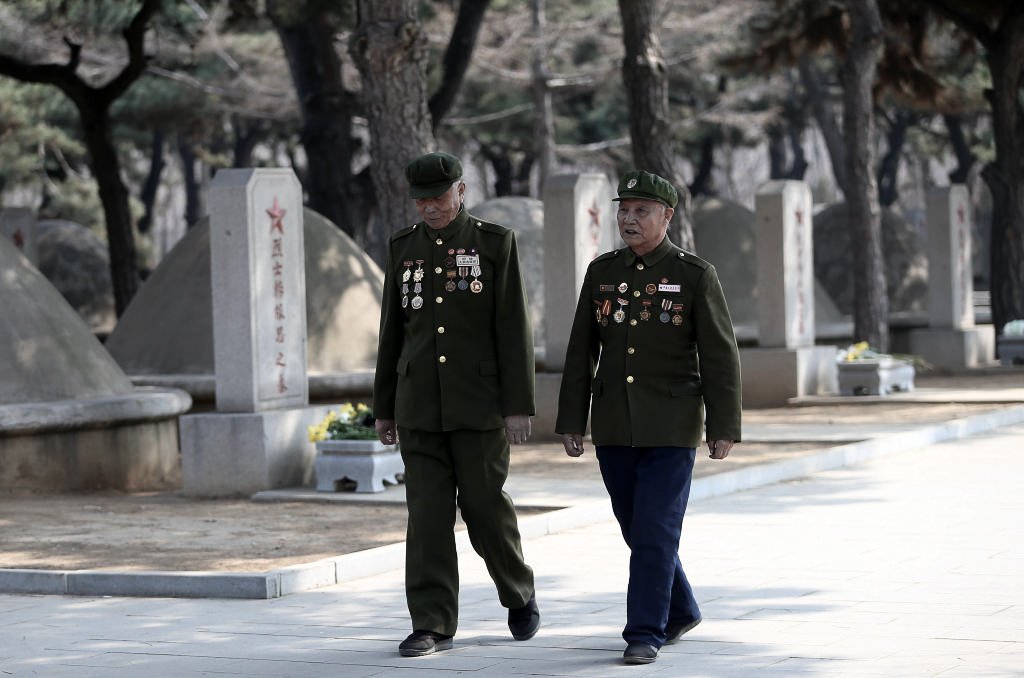

Elderly People’s Liberation Army (PLA) veterans walk at Shenyang Martyrs’ Cemetery in Shenyang, northeast China’s Liaoning Province, on March 29, 2017. STR/AFP/Getty Images
A 71-year-old Chinese military veteran who fought in the Sino-Vietnamese War in 1979 has been detained for nearly two months on suspicion of operating an illegal gambling venue, prompting Chinese veterans to appeal to authorities for his release and question whether he is being targeted for his activism on behalf of veterans and other retirees.
Ye Baizao, of Guangdong Province, was arrested by police on Aug. 13 at a mahjong and card games venue in Jiangmen, according to Chinese civil rights group Civil Rights and Livelihood Watch, citing Ye Baizao’s younger brother, Ye Baishi. Ye Baizao is currently being held at the Jiangmen Detention Center.
Ye’s family and other veterans dispute the allegation that he operated the venue. They say he had no role in running the establishment and merely spent time there playing cards, socializing, and doing odd jobs.
His younger brother submitted a written statement to the local procuratorate on Sept. 10 asking authorities to release him.
Ye Baishi said his brother, who is widowed and whose only son works in Africa, is effectively living alone in China. He said Ye Baizao has suffered from psychological and neurological issues stemming from his military service and lacks legal capacity, which prevented him from signing a power of attorney to allow his brother to hire a lawyer on his behalf.
As a result, Ye Baizao has remained in detention without a lawyer representing him, while his relatives have been unable to obtain information about the case, his brother said.
Related Stories

Ye’s Activism
A Chinese veteran surnamed Teng told The Epoch Times that he believes the gambling charge is retaliation for Ye Baizao’s longstanding involvement in efforts to defend the rights of Chinese veterans. Teng requested that only his surname be published out of fear of reprisal.
“The trigger for Ye Baizao’s arrest this time was that he always participated in veteran rights activism. The charge imposed on him by the authorities was retaliation against him,” Teng said.
Ye had frequently participated in activities and petitions organized by veterans, according to Teng, and had previously served a two-year prison sentence in connection with his activism.
His advocacy also extended beyond military veterans, he said. Ye had helped elderly people in Guangdong Province who sought better access to medical care, pensions, and other social protections.
“He could not stand seeing injustice,” Teng said. “He was kind and friendly in his dealings with people around him, but he detested [China’s] public security authorities.”
Teng said other veterans have also been trying to intervene since Ye’s detention, including traveling to Jiangmen and calling local police and procuratorial authorities.
“If he really committed a crime, we would not want to shield him,” he said. “But he did not run a gambling venue.”
Lack of Legal Representation
The case has also raised concerns among Ye’s relatives about his access to legal representation and the length of his detention.
Under China’s criminal procedure rules, a suspect who is initially criminally detained can generally be held for up to 30 days by police before the case is submitted to prosecutors for a decision on whether to approve an arrest, with prosecutors generally having up to seven additional days for that decision. The 37-day period is therefore commonly cited as the maximum period for the initial criminal detention and arrest process in ordinary cases.
Ye has now been detained for nearly two months, according to his brother.
Ye’s family have not been given information on where the case currently stands or whether prosecutors have approved Ye’s arrest.
Li Xi contributed to this report.