

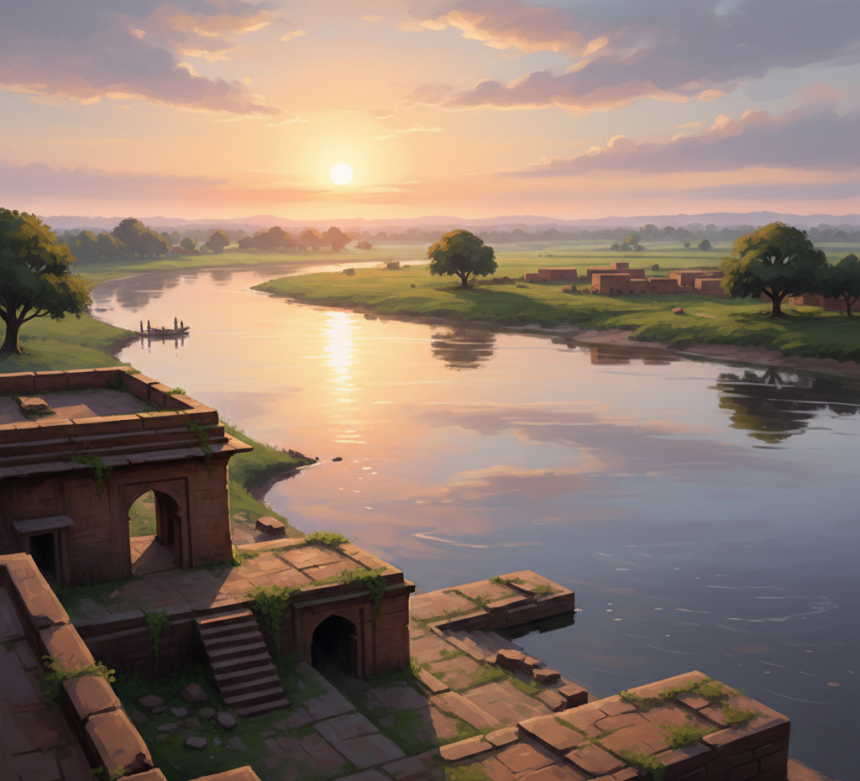
Azamgarh History : Nestled in the verdant plains of Eastern Uttar Pradesh, Azamgarh is often perceived through a modern lens—either as a administrative district or through its contemporary demographics. However, to limit Azamgarh to just a dot on the map is to ignore the symphonies of history that have played out on its soil.
As we delve into azamgarh-history, we discover that this land was not merely a passive spectator to the rise and fall of empires; it was an active participant. From being a sacred part of Lord Buddha’s Kosala to becoming the thorn in the side of the British East India Company, Azamgarh’s past is rich with valor, culture, and syncretism.
This comprehensive guide takes you beyond the cursory mention on the official portal. We will excavate the layers of antiquity, navigate the medieval maze of tribal chieftains, relive the horrors and heroism of 1857, and stroll through the literary lanes that produced Urdu’s finest poets.
1: The Ancient Bedrock – Kosala and Malla
The official record from the district administration correctly anchors azamgarh-history within the framework of the Kosala Kingdom. To understand the weight of this, one must visualize the 6th century BCE. This was the age of Mahajanapadas, and Kosala was the crown jewel of Northern India.
1.1 The Glory of Kosala
Unlike the Magadha empire, which relied on military expansion and vast bureaucracies, Kosala’s prosperity, as noted in Buddhist texts, came from its fertile lands. The district of Azamgarh, being the easternmost frontier, served as the granary of the kingdom. The “prosperity reaching its zenith” during the Buddha’s time, mentioned in the source, implies that the villages of modern-day Azamgarh were bustling with trade in rice, sugarcane, and textiles.
Archaeologically, while the official site laments the lack of “antiquarian value,” local historians argue that the very absence of grandiose stupas suggests a population that adhered to the simple agrarian lifestyle praised by the Buddha. The real wealth was the alluvial soil deposited by the Tons and Ghaghara rivers.
1.2 The Malla Identity
A unique facet of azamgarh-history is its connection to the Malla Republic. While the Mallas are historically associated with Kushinagar and Pava (where Buddha died), the official data specifies that the north-eastern part of Azamgarh was Malla territory. This indicates a cultural overlap. The Mallas were known as brave warriors and followers of the 24th Tirthankara, Mahavira. This explains the later distribution of Jain communities in Eastern UP.
The transition from this republican/clan-based system to the imperial Guptas remains a historical gray area, but the foundation of Azamgarh’s character—hardworking farmers and fierce warriors—was laid here.
2: The Medieval Interregnum and the Name “Azamgarh”
How did a land of Buddhist republics acquire an Islamic name? The answer lies in the 17th century. For almost a thousand years between the Gupta era and the Mughals, this region was a patchwork of petty chieftains and Bhumihar/Brahmin landlords.
2.1 The Arrival of the Meos and Rajputs
Before the Mughals solidified control, the region was administered by local Rajput clans, primarily the Meos and later the Gautam Rajputs. However, the pivotal moment came in 1665 AD.
Vikramajit Singh, a Meo Rajput, was a powerful landlord. His son, Azmat Khan, was not just a warrior but a visionary. When he received a grant from the Mughal emperor, he decided to consolidate his power base. He constructed a fortified garrison on the banks of the Tons River. He named it “Azamgarh” —literally the Fort (Garh) of Azam (in honor of his ancestor or possibly Prince Azam, son of Aurangzeb).
This was the turning point. The garrison grew into a qasba (town). This is why Azamgarh lacks the ancient ruins of Kannauj or Varanasi; it is a relatively “young” city in terms of its current urban identity, yet it sits on ancient soil.
2.2 The Suryavanshi Shift
A fascinating subchapter of azamgarh-history is the decline of the Meos and the rise of the Suryavanshi Rajputs. By the 18th century, as the Mughal empire decayed, the Narayan dynasty of Suryavanshi Rajputs seized control. They were known for their strict adherence to honor codes (izzat) and their patronage of Sanskrit learning.
3: The Volcano of 1857 – The True Heroism
If you google azamgarh-history, the search algorithms will heavily favor results related to the 1857 War of Independence. And rightfully so. While Delhi, Kanpur, and Lucknow get the limelight, Azamgarh was one of the last districts in India to be “pacified” by the British.
3.1 The Uprising Begins
On June 3, 1857, the sepoys of the 17th Regiment Native Infantry stationed at Azamgarh mutinied. Unlike the chaotic violence in Meerut, the mutiny here was organized. The sepoys liberated the treasury and released prisoners. Crucially, they didn’t just run away; they installed their own administration.
3.2 The “King” of Azamgarh
The British evacuated the district headquarters, fleeing to Ghazipur. The local Zamindars, who had chafed under Dalhousie’s Doctrine of Lapse, rallied to the rebel flag. The most prominent figure was Babu Amar Singh (of the Narayan dynasty). He was joined by Kunwar Singh, the legendary hero of Arrah (Bihar).
For months, Azamgarh remained a free territory. The British referred to the area as “extremely disturbed.” It was only in October 1858—after the formal declaration of peace in most of India—that Colonel Milman finally crushed the resistance. The retaliation was brutal: estates were confiscated, and the feudal aristocracy was decimated.
This period cemented the “rebel” identity of Azamgarh in the British colonial archives, a point of pride for local historians today.
4: The Archaeological Silence & Folk Memory
Returning to the official website’s lament: “possesses hardly any remains of much antiquarian value.” Why is this the case? Does this make Azamgarh historically irrelevant? Absolutely not.
4.1 The Ecology of History
Eastern UP is prone to severe flooding and seismic activity. Unlike the stone-heavy regions of Rajasthan or Central India, Azamgarh’s architecture was predominantly brick and clay. Over centuries, abandoned temples were cannibalized for new housing. The old Kosala stupas, likely made of mud, have simply melted back into the earth.
4.2 The Living Temples
However, the history survives in its living shrines. The Shitla Devi Temple and the Hariharnath Temple are not just places of worship; they are archaeological markers. The presence of black stone idols in the distinct Gupta-era style (discovered during local excavations) confirms that this was never a cultural wasteland. It was simply a land that prioritized function over preservation.
5: The Literary Renaissance – The Soul of Azamgarh
To truly understand azamgarh-history, one must leave the battlefield and enter the mushaira (poetic symposium). The 20th century transformed Azamgarh from a feudal backwater into a powerhouse of Urdu literature and progressive thought.
5.1 Kaifi Azmi: The Voice of the Century
Born in the village of Mijwan in 1919, Syed Athar Hussain Rizvi, known as Kaifi Azmi, is Azamgarh’s greatest export to the world. Kaifi was not just a poet; he was a revolutionary. His poetry gave voice to the starving peasant of the 1940s.
His famous line, “Aao phir se diya jalayein” (Come, let us light the lamp again), resonates deeply with the history of a district that saw its lamps extinguished by colonial revenge and communal partition. His daughter, Shabana Azmi, continues his legacy, and the Mijwan Welfare Society stands as a modern monument to this historical figure.
5.2 The Educational Movement
Simultaneously, the Al Jamiatul Ashrafia in Mubarakpur became a beacon of Islamic learning. This dual identity—revolutionary Marxist poet and orthodox Islamic scholar—coexisting in the same geography is the true “antiquarian value” of Azamgarh. It is the history of the Indian mind.
6: Geography as Destiny
We cannot separate azamgarh-history from its geography. The district is crisscrossed by the Tamsa (Tons) and the Ghaghara. These rivers are the arteries of its history.
6.1 The Tons River
Unlike the Ganga, which is deified, the Tons is a working river. It facilitated the trade of Azamgarhi Sarees and Biri (leaf cigarettes). Historically, the river acted as a defensive moat for the Azamgarh fort. Today, the bridges over the Tons are lifelines, but in history, controlling the Tons meant controlling the region.
6.2 The Saryupari Brahmin Identity
The geography also created the distinct Saryupari Brahmin sub-caste. Unlike the Kanyakubja Brahmins of Kanpur, the Brahmins of this region (between the Saryu and Tons rivers) developed unique rituals and a strong land-owning identity. Their history is intertwined with the Bhumihar community, often leading to complex social dynamics in the medieval period.
7: Azamgarh in the Modern Era
7.1 The Administrative Evolution
Post-independence, Azamgarh maintained its identity as a distinct district. However, in a significant administrative overhaul in 1989, history repeated itself. Just as the Malla territory was split in ancient times, the modern district was bifurcated. Mau was carved out as a separate district.
This was a controversial event. For the people of Mau, it was liberation from a distant headquarters; for Azamgarh, it was the loss of its industrial belt (Mau is famous for power looms and sarees).
7.2 The Political Landscape
In recent political history, Azamgarh gained attention as the parliamentary constituency of Mulayam Singh Yadav and later his grandson, Tej Pratap Yadav. However, the 2022 bypolls saw a massive shift when the BJP captured the seat for the first time in decades. This modern political churn is just the latest chapter in a long history of rulers—from Malla chieftains to Meo Rajputs to British Collectors—trying to control this land.
Conclusion: The Unbroken Thread
The history of Azamgarh is not written in stone; it is written in water—the flowing rivers, the tears of widows of 1857, and the sweat of farmers. It is a history that challenges the elitist notion that a place is only historic if it has a standing monument.
Azamgarh is the monument. It is a monument to survival, to syncretism, and to the quiet dignity of the millions who have called it home. From the Buddha’s monks walking its paths to Kaifi’s couplets recited in Bollywood, the thread remains unbroken.