The Ancient Roots: Azamgarh in the Age of Epics
Before the city was named, the region was a crucible of spiritual and intellectual activity. The history of Azamgarh is deeply intertwined with mythology, as the area along the banks of the Tamsa River (also known as the Tons) is said to have been a favored spot for sages and hermits.
According to local legend and historical texts, this land formed the eastern gateway to the ancient kingdom of Ayodhya. It is believed that the ashrams of three great sages—Maharshi Durvasa, Dattatreya, and Chandrama Rishi—were situated here, at the confluence of three sacred rivers. The legendary sage Durvasa, known for his fiery temper, is said to have arrived from Chitrakoot at the tender age of 12 and meditated here for years, making the site a center of devotion across the Satyug, Treta, and Dwapar yugas.
Even today, the Durvasa Rishi Ashram remains a place of deep spiritual significance. Every Kartik Purnima, thousands of devotees gather here for a holy dip at the river confluence during a three-day fair. The enduring presence of these ancient ashrams connects Azamgarh to a past that predates recorded history, establishing it as a land of culture and piety.
The Founding of a City: The Story of Azam and Vikramajit (1665)
The most definitive chapter in the history of the city began in the 17th century. The district is named after its headquarters town, Azamgarh, which was founded in 1665 by Azam, the son of a Rajput prince named Vikramajit.
Vikramajit was a descendant of the Gautam Rajputs of Mehnagar in pargana Nizamabad. In a significant turn of events that reflects the syncretic culture of the time, Vikramajit embraced Islam. He had a Muslim wife who bore him two sons, Azam and Azmat.
The story of the founding is one of ambition and familial conflict. Vikramajit had three sons: Vikramajit, Narayan, and Rudra. After a power struggle, Vikramajit emerged victorious, killing his brother Rudra. His two sons, Azam and Azmat, went on to establish their own strongholds. While Azam gave his name to the town of Azamgarh and built its fort, Azmat constructed the fort and settled the bazaar of Azmatgarh in the pargana of Sagri. The tombs of Raja Azam Shah and his queen can still be found in the Karbala Maidan, serving as a lasting reminder of the city’s founder.
Azamgarh Under the Nawabs and the British: A Region in Transition
Following its founding, the area’s history became intertwined with the larger political landscape of the region. In the 18th century, Azamgarh was included in the sirkars (administrative divisions) of Jaunpur and Ghazipur within the subah (province) of Allahabad. It was ruled by local chieftains, including Mohhabat Khan, who was popularly known as the Raja of Azamgarh.
The district of Azamgarh was officially formed on September 18, 1832, by the British East India Company. As British influence consolidated, the region became a part of the colonial administrative machinery. However, this period also sowed the seeds of rebellion that would culminate in the First War of Independence in 1857.
The 1857 Uprising and a Moment of Freedom
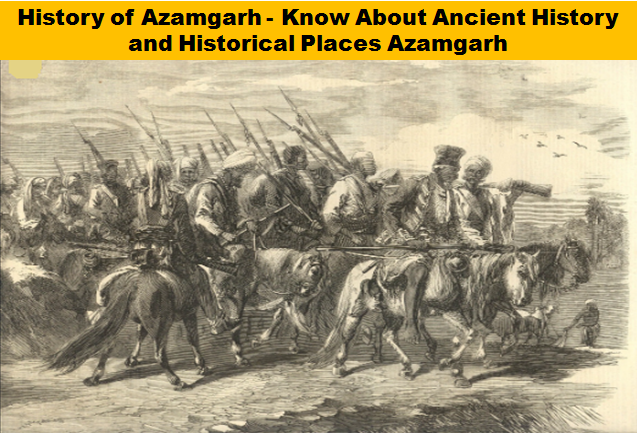
Azamgarh’s role in the 1857 uprising is one of the most heroic and significant chapters in its history. At a time when the British Empire seemed invincible, the people of Azamgarh rose up in defiance, and for a brief, shining moment, they tasted freedom.
In March 1858, the famous freedom fighter Kunwar Singh of Shahabad (in Bihar) marched towards Azamgarh, his very arrival causing anxiety among the British authorities. The military garrison at Azamgarh in May 1857 consisted of the 17th Native Infantry, some 500 strong. A pivotal event occurred on the night of June 3, 1857, when Indian sepoys, led by Bhondu Singh, broke open the jail and looted the collector’s treasury of Rs. 70,000 before escaping to Varanasi.
In another daring act, revolutionaries, including Rajjab Ali, attacked the old district jail, freeing imprisoned comrades and killing British officers. For approximately 81 days, the district of Azamgarh remained largely free from British rule, with revolutionaries controlling the jail and the British company garden. This period of independence was an unparalleled epoch of heroism and sacrifice, but it was short-lived. The British eventually recaptured the area, and the mutineers were brutally suppressed.
Sadly, the historic jail, a witness to this pivotal struggle for independence, now lies in ruins. Reports indicate that the site is crumbling, covered in garbage, and overgrown with bushes, a stark symbol of the neglect of our historical heritage.
The Rise of a Cultural and Educational Hub
The late 19th and early 20th centuries marked a transformation for Azamgarh, establishing it as a major center of education and culture in Eastern Uttar Pradesh. This period was dominated by the legacy of Allama Shibli Nomani, a renowned Islamic scholar.
In 1883, Allama Shibli Nomani started the Shibli School. After his death in 1914, the Azamgarh Muslim Education Society was formed to run the school, and in 1924, it was upgraded to a college. Under the influence of the freedom movement, it was named the National College. The Shibli National College, as it is known today, became an “oasis of learning” in a region hungry for education.
Leaders like Mahatma Gandhi, Abul Kalam Azad, and Motilal Nehru used to visit the college, and letters from Gandhiji are still preserved in its library. In 1946, the college received recognition as a degree college, and in 1970, postgraduate courses were started. Spread over 20 acres, the institution now has 10,000 students studying from Class I to postgraduate courses. It has produced several prominent personalities, including former Union ministers, former UP chief minister Ram Naresh Yadav, and even the first finance minister of Pakistan, Mohammad Shoaib.
The college also houses the Shibli Library, an absolute treasure trove of history, established in 1914. It holds 750 handwritten manuscripts, including Jahanara’s ‘Al-Arwah’ and Persian translations of the Upanishads and Mahabharata.
This intellectual heritage gave rise to a host of renowned Urdu poets, including Kaifi Azmi, Iqbal Suhail, and Khaleel-Ur-Rehman Azmi. The district also became home to other notable institutions like the Madrassa-tul-Falah and Madrassa-tul-Islahi, further solidifying its reputation as a center for Islamic and modern education.
Azamgarh and the Indian Independence Movement
The people of Azamgarh played an active and often sacrificial role in the final phase of the struggle for India’s independence. Following the Non-Cooperation Movement, the district emerged as a hotbed of resistance.
In 1930, freedom fighter Raghubar Dayal Srivastava participated in the Satyagrah movement at the Police Lines in Azamgarh under the leadership of veteran freedom fighter Sitaram Asthana. He was arrested, convicted, and tortured in prison, yet he refused to seek a pardon. Even after his release, he dedicated himself to reforming the oppressive ‘intermediary’ system in land revenue collection and supported the Quit India Movement in 1942, providing refuge to other revolutionaries at great personal risk.
The Quit India Movement was met with severe repression in Azamgarh. On August 11, 1942, shops observed a hartal, and government offices were picketed. A large crowd that came to hoist the tricolour at the collectorate was dispersed by police firing. The movement turned militant on August 14, with police stations being burnt down and railway lines being sabotaged. The British administration was handed over to the military, which carried out brutal crackdowns, resulting in numerous deaths and arrests. Despite the terror unleashed by the British, the spirit of the people of Azamgarh remained unbroken, contributing significantly to the freedom that was finally won on August 15, 1947.
A Glimpse of Modern Azamgarh: Culture, Heritage, and Development
Today, Azamgarh is a blend of its glorious past and its aspirations for the future. It is a city making its mark on the map of development.
Heritage Sites: The Pride of the Past
Azamgarh is dotted with numerous historical and heritage sites that tell the story of its rich past:
-
Durvasa Rishi Ashram: As mentioned, this ashram at the confluence of the Tamsa and Manjusha rivers is a major religious site. In a significant step for its preservation and promotion, the Uttar Pradesh government has sanctioned ₹1 crore for its integrated development under the Chief Minister’s Tourism Development Scheme. The project aims to beautify the site, install modern lighting, sanitation, and an information center, making it more welcoming for pilgrims and boosting regional tourism.
-
Shibli National College and Library: A living testament to the city’s educational heritage, it remains a premier institution and a must-visit for those interested in history and literature.
-
Shahi Pul (Sher Shah Suri’s Bridge): A significant Mughal-era architectural heritage, this bridge was built by Sher Shah Suri in 1530 using cold mortar.
-
The 200-Year-Old Church: Built in 1843 by the Bishop of Kolkata, this church in Civil Lines is a symbol of Azamgarh’s religious harmony.
-
Karbala Maidan: Home to the tombs of Raja Azam Shah, his queen, and soldiers from the 17th-18th centuries, this site offers a tangible connection to the city’s founder.
-
Mehnagar Fort: The fort of the Gautam Rajputs, located in the Nizamabad area, represents the lineage from which the city’s founder emerged.
Culture and Economy: The Living Tapestry
Azamgarh’s culture is a vibrant mix of its historical influences. It is famous for its handwoven Banarasi saris, particularly from towns like Mubarakpur, a craft that provides a livelihood to many weavers. The district also possesses a unique craft: the Nizamabad black pottery. This distinctive lustrous black pottery is made by rubbing a special oil and double-firing it. The silvery ornamentation is achieved by rubbing an amalgam of mercury and tin into the etched and baked patterns, creating a stunning silvery tracery that resembles bidri metal ware. Floral and geometric designs are etched onto the surface of these pots.
To celebrate its cultural and mythological heritage, the district administration organizes the five-day Azamgarh Mahotsav annually. The event showcases folk dances like Kaharwa and Rajasthani styles, and features performances by famous artists and singers, drawing large crowds. With Chief Minister Yogi Adityanath taking keen interest in restoring the cultural glory of the Hariharpur Sangeet Gharana, a music college is being built in Hariharpur village to revive this classical tradition.
The district’s economy is primarily dependent on agriculture, with over 80% of its workers engaged in the sector. However, its per capita income has historically been among the lowest in the state, leading to significant migration to other cities and even to Gulf countries for employment.
Notable Personalities: The Pride of Azamgarh
Azamgarh has produced an impressive array of personalities who have left their mark on politics, literature, spirituality, and sports. The toponymic surname “Azmi” is commonly associated with Indian Muslims hailing from this district. Some of the most notable figures include:
-
Kaifi Azmi: An iconic Urdu poet who left an indelible mark on Indian cinema and literature. He was born in the village of Mijwan in Azamgarh.
-
Allama Shibli Nomani: A towering Islamic scholar and the founder of the Shibli National College.
-
Rahul Sankrityayan: A prolific writer, essayist, and scholar who is considered the “Father of Hindi Travelogues.” He is known for his deep knowledge of Buddhism and Indian history.
-
Ayodhya Singh Upadhyay ‘Harioudh’: A celebrated Hindi poet and writer, known for his ‘Priya-Pravas’ and his work in ‘Khariboli’ literature.
-
Political Leaders: The district has produced several prominent political figures, including former Union Minister Kalpanath Rai, former UP Chief Minister Ram Naresh Yadav, and MLA Abu Asim Azmi from Maharashtra.
-
Sports Personalities: Indian cricketers Iqbal Abdulla and Praveen Dubey also hail from Azamgarh.
The City Today: Development and Connectivity
In recent years, Azamgarh has witnessed significant strides in development and infrastructure. It has established itself as an important city in Purvanchal.
-
Connectivity: The city has one of the biggest bus depots in eastern Uttar Pradesh and regular bus services to all district headquarters and Delhi. The Purvanchal Expressway, built in 2021, has further improved connectivity with Lucknow and other important cities. The city is also a key railway station on the network. In a major leap, the new Azamgarh Airport, located 9 km from the city center, was inaugurated by Prime Minister Narendra Modi in March 2024, connecting the city to Lucknow via regular flights.
-
Education: Azamgarh State University was established in 2019 to cater to the higher education needs of the district. A Government Medical College and Super Facility Hospital has also been established, improving access to healthcare.
-
Tourism: The district has seen a steady growth in tourism. In 2024, over 15.8 lakh visitors came to Azamgarh, and the first quarter of 2025 alone saw more than 3.25 lakh tourists. This growth has strengthened the local economy and provided employment opportunities.
The Complex Narrative: Challenges and a New Vision
Despite its rich history and recent development, Azamgarh has also faced complex challenges. In the past, it has been in the headlines for negative reasons, being labeled in connection with terrorism. This narrative, driven by a few incidents, created a “terror tag” for the district, often overlooking its intellectual and cultural heritage. An article in Outlook magazine highlighted this dichotomy, referring to it as “A Place And Its Negative”. The district has also struggled with poverty and malnutrition for decades, factors that contributed to migration and social issues.
However, the narrative around Azamgarh is changing. The focus is shifting from its negative image to its true identity as a district of scholars, saints, and artists. The efforts to promote its cultural heritage, like the Azamgarh Mahotsav and the development of the Durvasa Rishi Ashram, are part of a conscious effort to rebrand the city as a hub of tourism, spirituality, and historical importance. The state government’s push for infrastructure, connectivity, and education is paving the way for a more prosperous and positive future for this ancient land.
Conclusion: A Legacy Carved in Time
The history of Azamgarh is not just a chronicle of dates and events; it is a vibrant narrative of resilience, cultural fusion, intellectual pursuit, and heroic resistance. From the legendary ashrams of Durvasa to the powerful fort of Azam Shah, from its valiant stand in 1857 to its legacy as a seat of learning, Azamgarh has a story that deserves to be told and celebrated.
It is a city that has witnessed the rise and fall of kingdoms, the birth of literary giants, and the birth pangs of a nation’s freedom. Its journey from an ancient spiritual center to a modern district with an airport and a university is a testament to its enduring spirit.
For the traveler seeking to explore the heart of India’s historical tapestry, for the student of history, or for anyone simply curious about the stories that shape our world, Azamgarh stands as an open book, waiting to be read. Its historical treasures—from the crumbling jail to the manuscripts of Shibli Library, from the Shahi Pul to the black pottery—are waiting to be rediscovered and preserved for future generations.
External Links to Know More
-
For the official history and latest information on the district, you can visit the official website: Azamgarh District Website
FAQs on Azamgarh History
1. Who founded the city of Azamgarh and when?
The city of Azamgarh was founded in 1665 by Azam, the son of a Rajput prince named Vikramajit who had converted to Islam.
2. What is the historical significance of the Tamsa River in Azamgarh?
The Tamsa River is historically significant as it was home to the ashrams of legendary sages like Durvasa, Dattatreya, and Chandrama Rishi, making the region an important spiritual center since ancient times.
3. How did Azamgarh contribute to India’s independence movement?
Azamgarh played a crucial role in the 1857 uprising, with revolutionaries taking control of the district for 81 days. It was also active in the Quit India Movement of 1942, with its people participating in hartals, picketing, and suffering violent repression.
4. What are the major heritage sites in Azamgarh?
Key heritage sites include the Durvasa Rishi Ashram, Shibli National College and Library, Shahi Pul (Sher Shah Suri’s Bridge), the 200-year-old church in Civil Lines, Karbala Maidan (with the tombs of Raja Azam Shah), and the historic jail from the 1857 era.
5. Who are some famous personalities from Azamgarh?
Famous personalities include renowned Urdu poet Kaifi Azmi, Islamic scholar Allama Shibli Nomani, writer Rahul Sankrantyayan, poet Ayodhya Singh Upadhyay ‘Harioudh’, and political figures like former UP CM Ram Naresh Yadav and Abu Asim Azmi.
6. What is the famous black pottery of Azamgarh?
Nizamabad black pottery is a distinctive craft of the region. It involves creating a deep black color using local clay mixed with mustard oilseed cake, and the silvery ornamentation is done by rubbing an amalgam of mercury and tin onto the etched and baked patterns.
7. Is Azamgarh connected by air?
Yes, the new Azamgarh Airport was inaugurated in March 2024. It connects the city to Lucknow via regular flights operated by FlyBig.
8. Why is Azamgarh known as a center of education?
Azamgarh is home to the historic Shibli National College, established in 1883 by Allama Shibli Nomani, which has produced many notable alumni. It also has the newly established Azamgarh State University.