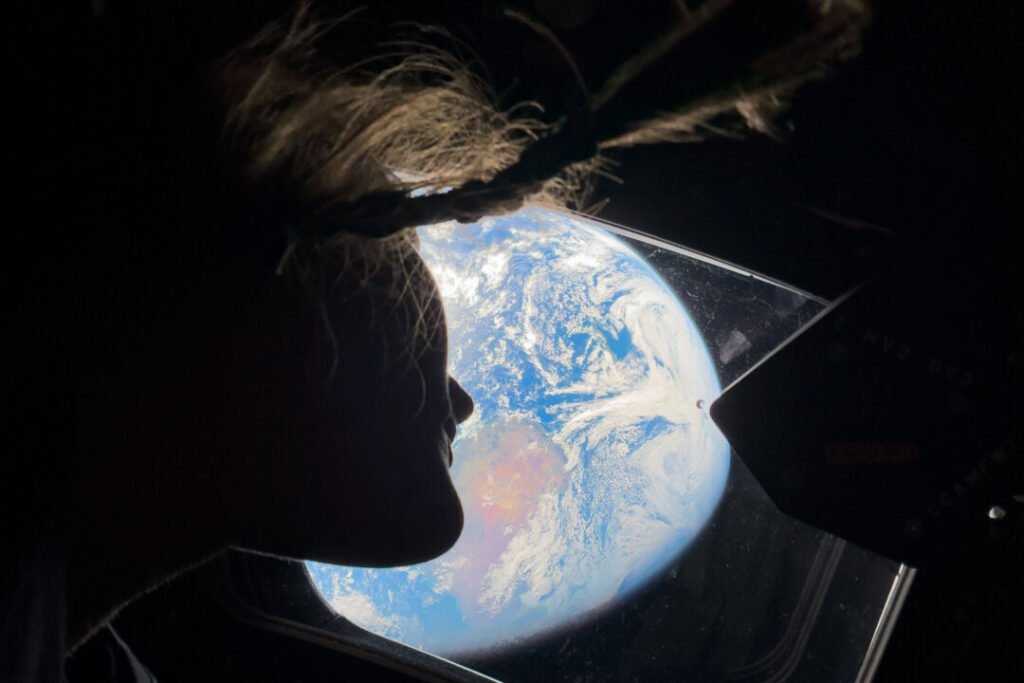

NASA astronaut and Artemis II mission specialist Christina Koch peers out of one of the Orion spacecraft’s main cabin windows, looking back at Earth, as the crew travels towards the Moon on April 4, 2026. NASA’s Artemis II mission will take Wiseman, Glover, Koch, and Hansen on a 10-day journey around the Moon and back aboard their Orion spacecraft. NASA via Getty Images
Australian government officials have told a federal parliamentary committee that a new space cooperation treaty with the United States would slash the time needed to approve joint missions from as long as two years to almost none.
Luke Phillips, director of international partnerships at the Australian Space Agency and the agreement’s lead negotiator, told the parliamentary committee that space activities currently require separate treaty-level agreements, a process that can take up to two years to conclude before work can begin.
The framework agreement instead establishes a single legal basis under which future projects can proceed through non-binding, project-specific arrangements that will not need to go through Australia’s treaty-making process each time, he explained.
Related Stories

Questioned by Claire Clutterham, the MP for Sturt, about sovereignty and “sensitive technology” referenced in the agreement’s national interest statement, Phillips said the term covers dual-use technologies with both civil and potential military applications, and that information-sharing on such technology would be handled under provisions in the agreement rather than excluded outright.
Alison Penfold, the member for Lyne, pressed officials on privacy safeguards for farmers, referencing concerns that satellites could be used for surveillance.
Phillips said all activity under the agreement would have to comply with existing Australian law and policy, and that the agreement contained no additional privacy safeguards specific to agricultural land beyond that requirement.
Committee members also asked about orbital debris.
Christopher De Luis, general manager of the Office of the Space Regulator, said Australia manages debris risk domestically through the Space (Launches and Returns) Act, a licensing scheme, and that international debris-mitigation standards are negotiated primarily through the United Nations Committee on the Peaceful Uses of Outer Space, of which Australia is a member.
The CSIRO’s Mark Cheung and the Bureau of Meteorology’s Kristin Reeson told the committee their agencies would use the framework to expand Earth observation, remote sensing and space-weather monitoring work, with the Bureau currently relying on data from 30 satellites operated by other countries to produce forecasts and warnings.
Phillips told the committee the agreement does not commit Australia to any specific programme and preserves the country’s “sovereignty and decision-making authority,” with each future project remaining subject to separate Australian government decisions.