UP Scholarship 2026: Apply, Check Status & Get Paid

Saroj kumar

November 22, 2026

If you are a student in Uttar Pradesh, or the parent of one, you have probably heard the phrase “UP Scholarship” whispered in school corridors, discussed in college canteens, or debated at home when fee deadlines loom. The UP Scholarship 2026 cycle is not just another government form. For lakhs of families across the state, it is the thin line between continuing education and dropping out. This guide is written to cut through the confusion. No jargon. No vague promises. Just what the official portal and recent notifications actually say, what you need to do, and where students usually slip up. Whether you are in Class 9 or finishing your post-graduation, the process has a rhythm. Once you understand it, the fear goes away. What Exactly Is the UP Scholarship 2026? The UP Scholarship is a umbrella of financial assistance schemes run by the Social Welfare Department of the Uttar Pradesh government. It is not a single scholarship. It is a system of pre-matric and post-matric scholarships designed to support students from General, OBC, SC, ST, and minority communities who meet specific income and academic criteria . The “2026” in UP Scholarship 2026 refers to the academic session 2026–27. The application windows opened in phases starting August 2026 for school students, and September 2026 for students in higher education . The scheme is administered entirely online through the official portal: scholarship.up.gov.in. What makes this year slightly different—and more serious—is the One Time Registration (OTR) requirement. Since the 2025–26 session, OTR has become mandatory. You cannot simply fill a form and hope for the best. Your Aadhaar and mobile number must be verified first . This single change has tripped up thousands of applicants who waited until the last day. The Three Categories: Know Where You Fit Before you touch the portal, you need to be honest with yourself about which category applies to you. The deadlines are different. The documentation is slightly different. And if you apply under the wrong category, verification will fail. Pre-Matric Scholarship This is for students in Classes 9 and 10. It is the foundation level of the scheme, aimed at keeping younger students in school. The application windows for this group closed earlier in the cycle—renewal applications were due by August 25, 2026, and fresh applications by September 21, 2026 . If you are reading this in October 2026, the pre-matric window for this session has already passed. Bookmark the portal for next year. Post-Matric Intermediate Scholarship This covers students in Classes 11 and 12. The timeline mirrors the pre-matric schedule: renewal by August 25, fresh by September 21, 2026 . Again, if you missed it, the portal will not reopen for this session. The government does not entertain late submissions for school-level scholarships. Post-Matric Other Than Intermediate (Dashmottar) This is the category that is currently active as of October 2026. “Dashmottar” simply means “beyond matriculation.” If you are pursuing graduation, post-graduation, diploma, ITI, or any professional course after Class 12, this is your category . The deadlines for Dashmottar are the ones you need to tattoo on your memory: Renewal applicants: October 15, 2026 Fresh applicants: October 31, 2026 A word of caution: the October 31 date is for online submission. The hard copy of your application, along with documents, must reach your college by November 4, 2026 . Missing the hard copy deadline is the same as not applying at all. Image Prompt 2: A split-screen style image. On the left, a calendar with October 15 and October 31 circled in red marker. On the right, a close-up of a student’s hand holding a printed application form, with a college stamp visible on the corner. The background is a blurred college corridor. The tone is urgent but calm. Eligibility: The Quiet Details That Disqualify People Most articles list the broad eligibility criteria and stop. That is not helpful. The real reasons applications get rejected are often small, avoidable details. Here is what actually matters for UP Scholarship 2026. Domicile and Institution You must meet the Uttar Pradesh domicile requirements for your specific category. Generally, this means you are a resident of UP. However, there are provisions for students studying outside UP under certain conditions. The safest approach is to check the specific instructions on the portal for your category before assuming you are eligible . Your institution must be recognized. If you are studying in a fly-by-night college that is not registered with the appropriate board or university, your application will not move forward. The institution’s master data must be verified by the district authorities. If your college has not updated its master data on the portal, your form will sit stuck regardless of how perfect your own details are . Family Income The income limit varies by category. For the post-matric scheme, the commonly applied limits are based on the previous financial year’s income certificate. You cannot use an old income certificate from three years ago. The certificate must be current and issued by the competent authority . Do not guess your income category. If your family income is borderline, get the certificate first and then apply. The portal will ask for the certificate number, and the verification team will cross-check it. Aadhaar and Bank Account Linkage This is where the majority of payment failures happen. The scholarship is disbursed through Direct Benefit Transfer (DBT). The bank account must be in the student’s own name. It must be linked to Aadhaar. And the name on the Aadhaar, the bank account, and the scholarship application must match exactly . If your name is “Riya Singh” on Aadhaar but “Riya Kumari Singh” on your bank passbook, you will have a problem. Fix these discrepancies before you apply, not after. The portal will not do it for you. The OTR Process: Your First Real Hurdle One Time Registration is not a suggestion. It is the gate. Here is how it works, stripped of bureaucratic language. Go to scholarship.up.gov.in. Look for the OTR section. You will need two things: an active mobile number and your Aadhaar number. Step 1: Mobile Authentication. You enter your mobile number. An OTP arrives. You verify it. This links the mobile number to your OTR profile. Use a number that will remain active for at least a year. If you lose access to this number, recovering your OTR becomes a nightmare. Step 2: Aadhaar e-KYC. The portal will redirect you to complete Aadhaar-based verification. This usually involves an OTP sent to your Aadhaar-linked mobile number. If your Aadhaar is not linked to a mobile number, you must visit an Aadhaar center to update it first. There is no workaround . Step 3: OTR Generation. Once the mobile and Aadhaar steps are complete, the portal generates your unique OTR number. It is displayed on screen and sent to your registered mobile. Save it. Write it down. Screenshot it. You will need it every time you log in . Students who try to bypass OTR or use someone else’s mobile number end up locked out. The system is designed to ensure one person, one identity, one scholarship record. Filling the Application: A Step-by-Step Walkthrough Once your OTR is ready, the actual application is relatively straightforward—if you have your documents ready before you start. What You Need in Front of You Aadhaar card Aadhaar-linked mobile number (for OTPs) Previous qualifying examination marksheet Current income certificate Caste certificate (if applicable) UP domicile certificate (if applicable) Current admission or enrolment proof Fee receipt for the current academic year Bank passbook (showing account number, IFSC, and student’s name) Passport-size photograph Previous scholarship registration number (for renewal applicants only) The Filling Process Log in with your OTR number. Select the correct scholarship category—Dashmottar, in this case. Select Fresh or Renewal. If you received a scholarship last year under the same category, you are a renewal applicant. If this is your first time under this category, you are fresh. Enter personal details exactly as they appear on your Aadhaar. Do not abbreviate your name. Do not use a different spelling. The system will verify against Aadhaar e-KYC data. Mismatches cause automatic flags. Enter academic details. Your institution will have a code or will appear in a dropdown. If your college is not listed, stop and contact your college office immediately. They may not have completed their master data submission. Enter bank details. Double-check the account number and IFSC. One wrong digit and the payment will bounce back. The account must be active. A dormant account will not receive DBT credits. Upload documents. The portal will specify the format and size limits. Do not upload blurry photographs taken in poor lighting. A rejected document can delay verification by weeks. Submit and print. After submission, download the confirmation page. Take a printout. Sign it where required. Attach the supporting documents. Submit the hard copy to your college office within three working days of online submission, or by November 4, 2026, whichever is earlier . Image Prompt 3: A close-up, realistic image of a college noticeboard. Among the usual notices, there is a printed list titled “UP Scholarship 2026 — Hard Copy Submission Deadline: Nov 4.” A student’s finger is pointing at the date. The lighting is natural, like late afternoon in a government college corridor. The image should feel authentic, not stock-photo polished. What Happens After You Submit? The Verification Chain This is the part most students do not understand. Submitting the form is not the end. It is the beginning of a chain that involves four different sets of people. Level 1: Your Institution Your college or school verifies that you are actually enrolled, that your fee receipt is genuine, and that your academic details match their records. If the institution does not forward your application, nothing else happens. This is why you should stay in touch with your college scholarship coordinator. Do not assume they will process it silently . Level 2: District School Inspector (or equivalent) For school-level scholarships, the District School Inspector verifies student numbers. For Dashmottar, the district-level scrutiny is handled by the relevant education office. This is where bulk applications are checked against institutional data . Level 3: NIC Technical Screening The National Informatics Centre screens the data for technical errors. Duplicate applications, mismatched Aadhaar details, invalid bank account formats—these are caught here. If your application is flagged, it will not move forward until corrected . Level 4: District Committee Locking A district committee finalizes the verified list. Once locked, the list goes to the treasury for payment. After this stage, changes are nearly impossible . The entire chain can take weeks or months. For renewal students, the process is faster because much of the data is already verified from the previous year. For fresh students, it is slower because every detail is new. Payment Timelines: When Will the Money Actually Arrive? This is the question every parent asks. The government releases funds in phases, and the dates are indicative, not guaranteed. Delays happen. But here is the official expected schedule based on recent notifications. For Dashmottar (Higher Education) Students Renewal applicants: The expected payment window is between January 16 and January 25, 2027 . Some notifications mention an earlier window in December 2026 for verified renewal cases, with the January window as a secondary phase for cases requiring data correction . Fresh applicants: The expected window is between January 27 and January 31, 2027 . For School Students (Classes 9–12) — For Reference If you are reading this for future planning: renewal students typically receive payment between October 25 and 31 of the current year. Fresh students receive it between January 25 and 31 of the following year . The money arrives via DBT directly into the student’s Aadhaar-linked bank account. If the account is frozen, dormant, or has a name mismatch, the payment will fail. The government will not call you to ask for a new account number. You have to check your status on the portal and correct the issue yourself. The Budget Context: Why This Matters Beyond Your Form In February 2026, the Uttar Pradesh government presented its budget for the 2026–27 fiscal year. The numbers give a sense of how seriously the state is treating scholarship funding. For Scheduled Caste students, ₹977 crore was proposed for pre-matric and post-matric scholarships. For General category students, ₹950 crore. For minority students, ₹391 crore. And for OBC students, a substantial ₹3,060.50 crore was earmarked for pre-matric and post-matric scholarships under a broader OBC welfare allocation of ₹3,402 crore . These are not small numbers. They represent real money flowing to real students. But they also explain why verification is strict. The government is distributing thousands of crores. The system is designed to catch fraud, and it sometimes catches genuine students in the net as well. That is why your documents must be perfect. Common Mistakes That Cost Students Their Scholarship After reading through the notifications, the same patterns of failure emerge. Here are the ones you can avoid. Waiting for the last date. The portal slows down dramatically in the final 48 hours. OTPs arrive late. Pages time out. Students who submit on October 30 or 31 often face technical failures and have no time to recover. Submit by the third week of October if you are a Dashmottar fresh applicant. Using a borrowed mobile number. OTR links your identity to a mobile number. If you use a friend’s or relative’s number, you may not receive critical OTPs later. Use a number that is yours and will stay active. Ignoring the hard copy. The online submission is only half the application. If your printed form and documents do not reach the college by the deadline, your online submission is meaningless . Mismatched names. As mentioned earlier, the name on Aadhaar, bank account, and application must be identical. If there is a discrepancy, fix it before applying. A name correction at the bank takes time. A name correction on Aadhaar takes even longer. Inactive bank account. A zero-balance account that has not been operated for months can become dormant. DBT credits fail on dormant accounts. Make a small transaction (even a ₹10 deposit) before the payment window to keep the account active. Not checking the portal after submission. The portal is where objections are raised. If your institution or the district office flags an issue, you will see it there. If you do not check, you will not know until the payment window closes. Image Prompt 4: A realistic photo of a student and a parent sitting at a kitchen table, looking at a laptop screen together. The student is pointing at something on the screen—perhaps a status update. The parent looks relieved or engaged. The kitchen is modest but clean. The mood is one of shared relief and cautious optimism. Frequently Asked Questions (FAQs) Is the UP Scholarship 2026 application still open? For Dashmottar (graduation, PG, diploma, ITI) fresh applicants, yes—until October 31, 2026. For school students (Classes 9–12), the windows closed in August and September 2026. Always check scholarship.up.gov.in for the most current status, as dates can be extended in rare cases. Can I apply without OTR? No. One Time Registration is mandatory. You need an active mobile number and Aadhaar to complete OTR. Without it, you cannot access the application form . My college is not listed on the portal. What do I do? Contact your college office immediately. The institution must complete its master data submission and verification before students can apply. If the college is unresponsive, escalate to the district education office. How do I check my application status? Log in to the portal with your OTR/registration number. The dashboard will show your application status—whether it is pending at the institution level, flagged for correction, or approved. What if my payment is delayed? Delays are common. Check your status on the portal first. Ensure your bank account is active and Aadhaar-linked. If the status shows “payment failed,” contact your bank and the college scholarship cell. Do not wait for the government to call you. Can I apply for two scholarships at once? The UP Scholarship system generally does not allow duplicate applications for the same academic level. If you are eligible for a central scheme (like NSP) and a state scheme, check the rules carefully. Double-dipping is often flagged and can lead to recovery of funds. A Final Word: Treat This Like a Deadline, Not a Formality The UP Scholarship 2026 is not a lottery. It is a structured process with clear rules and clear deadlines. The students who succeed are not necessarily the most brilliant. They are the ones who read the instructions, kept their documents ready, submitted early, and followed up. If you are a Dashmottar fresh applicant reading this in October 2026, you have a narrow window. October 31 is the online deadline. November 4 is the hard copy deadline. After that, the door closes for this session. Do not rely on rumours from friends. Do not assume your college will handle everything. Do not wait for a reminder that will never come. Go to scholarship.up.gov.in, complete your OTR if you have not already, and fill the form with the same care you would give to an exam you actually want to pass. The money is real. The support is real. But it only reaches the students who treat the process with the seriousness it demands. Outer Links (for SEO and reader utility): National Scholarship Portal (NSP): https://scholarships.gov.in/ — For students who may also be eligible for central government scholarships alongside state schemes. UIDAI Aadhaar Services: https://uidai.gov.in/ — To check Aadhaar linkage status, update mobile numbers, or correct name discrepancies before applying. UP Social Welfare Department: https://socialwelfare.up.gov.in/ — For official orders, circulars, and department-level announcements related to scholarship schemes.


If you are a student in Uttar Pradesh, or the parent of one, you have probably heard the phrase “UP Scholarship” whispered in school corridors, discussed in college canteens, or debated at home when fee deadlines loom. The UP Scholarship 2026 cycle is not just another government form. For lakhs of families across the state, it is the thin line between continuing education and dropping out.

This guide is written to cut through the confusion. No jargon. No vague promises. Just what the official portal and recent notifications actually say, what you need to do, and where students usually slip up. Whether you are in Class 9 or finishing your post-graduation, the process has a rhythm. Once you understand it, the fear goes away.


What Exactly Is the UP Scholarship 2026?

The UP Scholarship is a umbrella of financial assistance schemes run by the Social Welfare Department of the Uttar Pradesh government. It is not a single scholarship. It is a system of pre-matric and post-matric scholarships designed to support students from General, OBC, SC, ST, and minority communities who meet specific income and academic criteria .

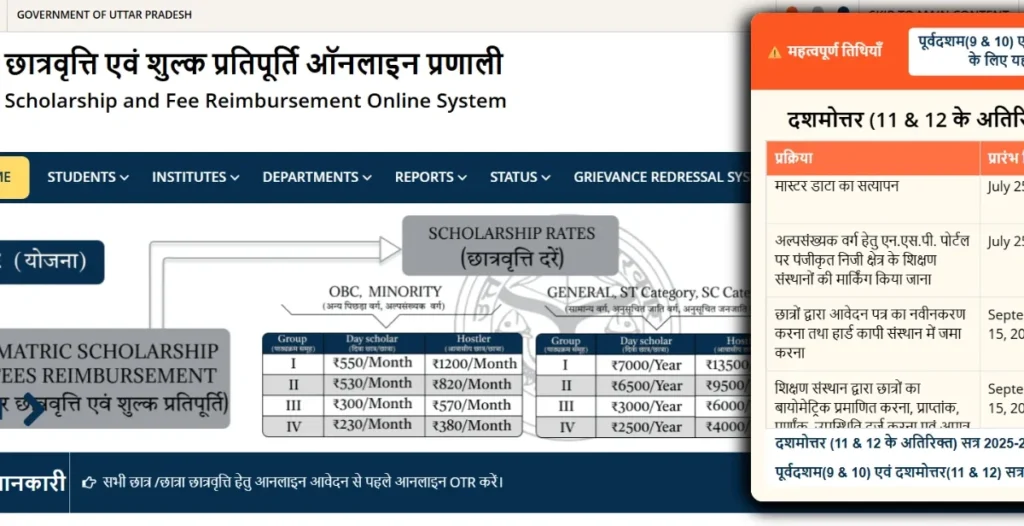
The “2026” in UP Scholarship 2026 refers to the academic session 2026–27. The application windows opened in phases starting August 2026 for school students, and September 2026 for students in higher education . The scheme is administered entirely online through the official portal: scholarship.up.gov.in.

What makes this year slightly different—and more serious—is the One Time Registration (OTR) requirement. Since the 2025–26 session, OTR has become mandatory. You cannot simply fill a form and hope for the best. Your Aadhaar and mobile number must be verified first . This single change has tripped up thousands of applicants who waited until the last day.


The Three Categories: Know Where You Fit

Before you touch the portal, you need to be honest with yourself about which category applies to you. The deadlines are different. The documentation is slightly different. And if you apply under the wrong category, verification will fail.

Pre-Matric Scholarship

This is for students in Classes 9 and 10. It is the foundation level of the scheme, aimed at keeping younger students in school. The application windows for this group closed earlier in the cycle—renewal applications were due by August 25, 2026, and fresh applications by September 21, 2026 . If you are reading this in October 2026, the pre-matric window for this session has already passed. Bookmark the portal for next year.

Post-Matric Intermediate Scholarship

This covers students in Classes 11 and 12. The timeline mirrors the pre-matric schedule: renewal by August 25, fresh by September 21, 2026 . Again, if you missed it, the portal will not reopen for this session. The government does not entertain late submissions for school-level scholarships.

Post-Matric Other Than Intermediate (Dashmottar)

This is the category that is currently active as of October 2026. “Dashmottar” simply means “beyond matriculation.” If you are pursuing graduation, post-graduation, diploma, ITI, or any professional course after Class 12, this is your category .

The deadlines for Dashmottar are the ones you need to tattoo on your memory:

  • Renewal applicants: October 15, 2026

  • Fresh applicants: October 31, 2026

A word of caution: the October 31 date is for online submission. The hard copy of your application, along with documents, must reach your college by November 4, 2026 . Missing the hard copy deadline is the same as not applying at all.


Eligibility: The Quiet Details That Disqualify People

Most articles list the broad eligibility criteria and stop. That is not helpful. The real reasons applications get rejected are often small, avoidable details. Here is what actually matters for UP Scholarship 2026.

Domicile and Institution

You must meet the Uttar Pradesh domicile requirements for your specific category. Generally, this means you are a resident of UP. However, there are provisions for students studying outside UP under certain conditions. The safest approach is to check the specific instructions on the portal for your category before assuming you are eligible .

Your institution must be recognized. If you are studying in a fly-by-night college that is not registered with the appropriate board or university, your application will not move forward. The institution’s master data must be verified by the district authorities. If your college has not updated its master data on the portal, your form will sit stuck regardless of how perfect your own details are .

Family Income

The income limit varies by category. For the post-matric scheme, the commonly applied limits are based on the previous financial year’s income certificate. You cannot use an old income certificate from three years ago. The certificate must be current and issued by the competent authority .

Do not guess your income category. If your family income is borderline, get the certificate first and then apply. The portal will ask for the certificate number, and the verification team will cross-check it.

Aadhaar and Bank Account Linkage

This is where the majority of payment failures happen. The scholarship is disbursed through Direct Benefit Transfer (DBT). The bank account must be in the student’s own name. It must be linked to Aadhaar. And the name on the Aadhaar, the bank account, and the scholarship application must match exactly .

If your name is “Riya Singh” on Aadhaar but “Riya Kumari Singh” on your bank passbook, you will have a problem. Fix these discrepancies before you apply, not after. The portal will not do it for you.


The OTR Process: Your First Real Hurdle

One Time Registration is not a suggestion. It is the gate. Here is how it works, stripped of bureaucratic language.

Go to scholarship.up.gov.in. Look for the OTR section. You will need two things: an active mobile number and your Aadhaar number.

Step 1: Mobile Authentication. You enter your mobile number. An OTP arrives. You verify it. This links the mobile number to your OTR profile. Use a number that will remain active for at least a year. If you lose access to this number, recovering your OTR becomes a nightmare.

Step 2: Aadhaar e-KYC. The portal will redirect you to complete Aadhaar-based verification. This usually involves an OTP sent to your Aadhaar-linked mobile number. If your Aadhaar is not linked to a mobile number, you must visit an Aadhaar center to update it first. There is no workaround .

Step 3: OTR Generation. Once the mobile and Aadhaar steps are complete, the portal generates your unique OTR number. It is displayed on screen and sent to your registered mobile. Save it. Write it down. Screenshot it. You will need it every time you log in .

Students who try to bypass OTR or use someone else’s mobile number end up locked out. The system is designed to ensure one person, one identity, one scholarship record.


Filling the Application: A Step-by-Step Walkthrough

Once your OTR is ready, the actual application is relatively straightforward—if you have your documents ready before you start.

What You Need in Front of You

  • Aadhaar card

  • Aadhaar-linked mobile number (for OTPs)

  • Previous qualifying examination marksheet

  • Current income certificate

  • Caste certificate (if applicable)

  • UP domicile certificate (if applicable)

  • Current admission or enrolment proof

  • Fee receipt for the current academic year

  • Bank passbook (showing account number, IFSC, and student’s name)

  • Passport-size photograph

  • Previous scholarship registration number (for renewal applicants only)

The Filling Process

Log in with your OTR number. Select the correct scholarship category—Dashmottar, in this case. Select Fresh or Renewal. If you received a scholarship last year under the same category, you are a renewal applicant. If this is your first time under this category, you are fresh.

Enter personal details exactly as they appear on your Aadhaar. Do not abbreviate your name. Do not use a different spelling. The system will verify against Aadhaar e-KYC data. Mismatches cause automatic flags.

Enter academic details. Your institution will have a code or will appear in a dropdown. If your college is not listed, stop and contact your college office immediately. They may not have completed their master data submission.

Enter bank details. Double-check the account number and IFSC. One wrong digit and the payment will bounce back. The account must be active. A dormant account will not receive DBT credits.

Upload documents. The portal will specify the format and size limits. Do not upload blurry photographs taken in poor lighting. A rejected document can delay verification by weeks.

Submit and print. After submission, download the confirmation page. Take a printout. Sign it where required. Attach the supporting documents. Submit the hard copy to your college office within three working days of online submission, or by November 4, 2026, whichever is earlier .


What Happens After You Submit? The Verification Chain

This is the part most students do not understand. Submitting the form is not the end. It is the beginning of a chain that involves four different sets of people.

Level 1: Your Institution

Your college or school verifies that you are actually enrolled, that your fee receipt is genuine, and that your academic details match their records. If the institution does not forward your application, nothing else happens. This is why you should stay in touch with your college scholarship coordinator. Do not assume they will process it silently .

Level 2: District School Inspector (or equivalent)

For school-level scholarships, the District School Inspector verifies student numbers. For Dashmottar, the district-level scrutiny is handled by the relevant education office. This is where bulk applications are checked against institutional data .

Level 3: NIC Technical Screening

The National Informatics Centre screens the data for technical errors. Duplicate applications, mismatched Aadhaar details, invalid bank account formats—these are caught here. If your application is flagged, it will not move forward until corrected .

Level 4: District Committee Locking

A district committee finalizes the verified list. Once locked, the list goes to the treasury for payment. After this stage, changes are nearly impossible .

The entire chain can take weeks or months. For renewal students, the process is faster because much of the data is already verified from the previous year. For fresh students, it is slower because every detail is new.


Payment Timelines: When Will the Money Actually Arrive?

This is the question every parent asks. The government releases funds in phases, and the dates are indicative, not guaranteed. Delays happen. But here is the official expected schedule based on recent notifications.

For Dashmottar (Higher Education) Students

Renewal applicants: The expected payment window is between January 16 and January 25, 2027 . Some notifications mention an earlier window in December 2026 for verified renewal cases, with the January window as a secondary phase for cases requiring data correction .

Fresh applicants: The expected window is between January 27 and January 31, 2027 .

For School Students (Classes 9–12) — For Reference

If you are reading this for future planning: renewal students typically receive payment between October 25 and 31 of the current year. Fresh students receive it between January 25 and 31 of the following year .

The money arrives via DBT directly into the student’s Aadhaar-linked bank account. If the account is frozen, dormant, or has a name mismatch, the payment will fail. The government will not call you to ask for a new account number. You have to check your status on the portal and correct the issue yourself.


The Budget Context: Why This Matters Beyond Your Form

In February 2026, the Uttar Pradesh government presented its budget for the 2026–27 fiscal year. The numbers give a sense of how seriously the state is treating scholarship funding.

For Scheduled Caste students, ₹977 crore was proposed for pre-matric and post-matric scholarships. For General category students, ₹950 crore. For minority students, ₹391 crore. And for OBC students, a substantial ₹3,060.50 crore was earmarked for pre-matric and post-matric scholarships under a broader OBC welfare allocation of ₹3,402 crore .

These are not small numbers. They represent real money flowing to real students. But they also explain why verification is strict. The government is distributing thousands of crores. The system is designed to catch fraud, and it sometimes catches genuine students in the net as well. That is why your documents must be perfect.


Common Mistakes That Cost Students Their Scholarship

After reading through the notifications, the same patterns of failure emerge. Here are the ones you can avoid.

Waiting for the last date. The portal slows down dramatically in the final 48 hours. OTPs arrive late. Pages time out. Students who submit on October 30 or 31 often face technical failures and have no time to recover. Submit by the third week of October if you are a Dashmottar fresh applicant.

Using a borrowed mobile number. OTR links your identity to a mobile number. If you use a friend’s or relative’s number, you may not receive critical OTPs later. Use a number that is yours and will stay active.

Ignoring the hard copy. The online submission is only half the application. If your printed form and documents do not reach the college by the deadline, your online submission is meaningless .

Mismatched names. As mentioned earlier, the name on Aadhaar, bank account, and application must be identical. If there is a discrepancy, fix it before applying. A name correction at the bank takes time. A name correction on Aadhaar takes even longer.

Inactive bank account. A zero-balance account that has not been operated for months can become dormant. DBT credits fail on dormant accounts. Make a small transaction (even a ₹10 deposit) before the payment window to keep the account active.

Not checking the portal after submission. The portal is where objections are raised. If your institution or the district office flags an issue, you will see it there. If you do not check, you will not know until the payment window closes.


Frequently Asked Questions (FAQs)

Is the UP Scholarship 2026 application still open?
For Dashmottar (graduation, PG, diploma, ITI) fresh applicants, yes—until October 31, 2026. For school students (Classes 9–12), the windows closed in August and September 2026. Always check scholarship.up.gov.in for the most current status, as dates can be extended in rare cases.

Can I apply without OTR?
No. One Time Registration is mandatory. You need an active mobile number and Aadhaar to complete OTR. Without it, you cannot access the application form .

My college is not listed on the portal. What do I do?
Contact your college office immediately. The institution must complete its master data submission and verification before students can apply. If the college is unresponsive, escalate to the district education office.

How do I check my application status?
Log in to the portal with your OTR/registration number. The dashboard will show your application status—whether it is pending at the institution level, flagged for correction, or approved.

What if my payment is delayed?
Delays are common. Check your status on the portal first. Ensure your bank account is active and Aadhaar-linked. If the status shows “payment failed,” contact your bank and the college scholarship cell. Do not wait for the government to call you.

Can I apply for two scholarships at once?
The UP Scholarship system generally does not allow duplicate applications for the same academic level. If you are eligible for a central scheme (like NSP) and a state scheme, check the rules carefully. Double-dipping is often flagged and can lead to recovery of funds.


A Final Word: Treat This Like a Deadline, Not a Formality

The UP Scholarship 2026 is not a lottery. It is a structured process with clear rules and clear deadlines. The students who succeed are not necessarily the most brilliant. They are the ones who read the instructions, kept their documents ready, submitted early, and followed up.

If you are a Dashmottar fresh applicant reading this in October 2026, you have a narrow window. October 31 is the online deadline. November 4 is the hard copy deadline. After that, the door closes for this session.

Do not rely on rumours from friends. Do not assume your college will handle everything. Do not wait for a reminder that will never come. Go to scholarship.up.gov.in, complete your OTR if you have not already, and fill the form with the same care you would give to an exam you actually want to pass.

The money is real. The support is real. But it only reaches the students who treat the process with the seriousness it demands.


Outer Links (for SEO and reader utility):

  1. National Scholarship Portal (NSP): https://scholarships.gov.in/ — For students who may also be eligible for central government scholarships alongside state schemes.

  2. UIDAI Aadhaar Services: https://uidai.gov.in/ — To check Aadhaar linkage status, update mobile numbers, or correct name discrepancies before applying.

  3. UP Social Welfare Department: https://socialwelfare.up.gov.in/ — For official orders, circulars, and department-level announcements related to scholarship schemes.