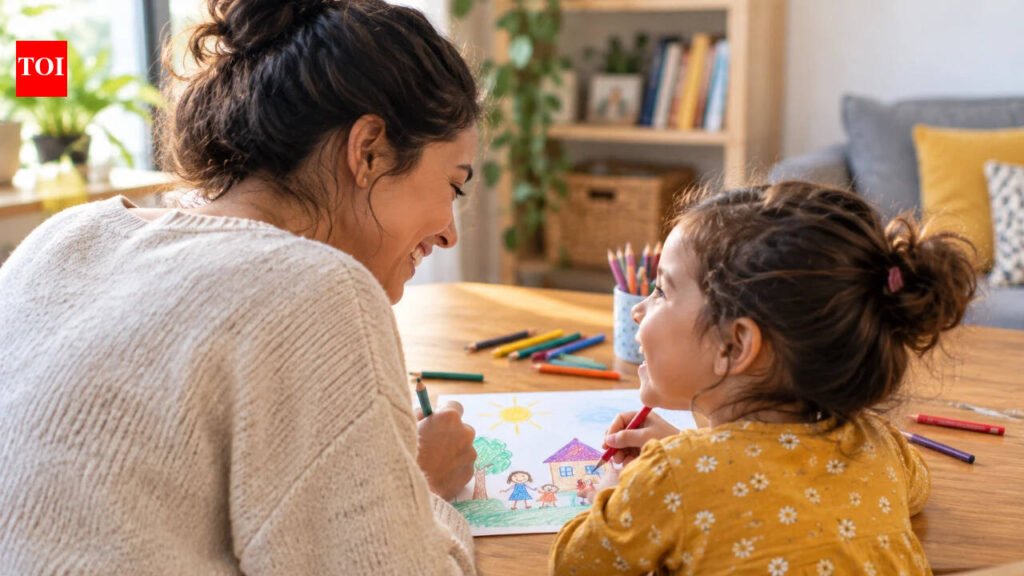

Parents hear it dozens of times a day: “Look at this.” It might be a drawing, a jump, a half-built tower or a pebble. Many adults respond with “good job” and move on, assuming the child wants applause. Developmental research suggests that the request may serve another purpose: sharing attention and interest with someone else. Studies of infants show that pointing and showing can be ways of inviting another person to notice an event together, rather than simply asking for approval. No study cited here has tested the exact phrase “look at this” in older children, so applying these findings to everyday conversations is an interpretation, not a proven rule. Research on responsive interactions between children and caregivers nevertheless offers useful clues about why a child might want an adult to stop, look and respond.
Serve and return: why back-and-forth exchanges matter to children
The Center on the Developing Child at Harvard University describes early caregiver-child interactions through the concept of “serve and return”. When a child makes a sound, gesture or expression, an adult’s responsive reaction creates a back-and-forth exchange. These interactions help support early brain development and the foundations for learning and communication. Harvard identifies the persistent absence of responsive interaction as a concern. This research highlights the importance of responsive exchanges, although it does not directly test how parents should respond when an older child repeatedly says “look at this”.
5 Oct 2026 | 12:06
Parents, when your child refuses to greet relatives, do you make them say hello or respect their choice?
Research on conversation also suggests that the back-and-forth matters. In a study published in Psychological Science titled Beyond the 30-Million-Word Gap: Children’s Conversational Exposure Is Associated With Language-Related Brain Function, researchers analysed home audio recordings from 36 children aged four to six. Children who experienced more conversational turns with adults showed greater activation in the left inferior frontal gyrus, a brain region involved in language processing, during a story-listening task. The association between conversational turns and activation in the left inferior frontal gyrus remained after accounting for socioeconomic status, IQ and the number of adult and child utterances alone. The researchers also found that this brain activation statistically explained part of the relationship between children’s language exposure and their verbal skills. The findings suggest that conversational exchanges may matter beyond the sheer quantity of words children hear. However, the study did not investigate children repeatedly asking adults to look at something.
Joint attention : what infant pointing studies reveal
Some of the clearest evidence about showing and sharing attention comes from research on infant pointing. In a study published in Developmental Science titled Twelve-month-olds point to share attention and interest, researchers observed how 12-month-old infants responded when an adult reacted to their pointing in different ways. When the adult shared attention and interest with the infant, the babies pointed more frequently across trials and tended to prolong their pointing. When the adult’s response did not establish the same shared attention, the infants pointed less frequently across trials and repeated their points more within individual trials, apparently attempting to establish joint attention. The researchers interpreted the findings as evidence that infants can point to share attention and interest, and that the adult’s response influences what happens next. In everyday terms, pointing can be an invitation to notice something together. The research does not establish that every child who says “look at this” has the same intention, especially as the study involved infants communicating through gestures rather than older children using words.Pointing can also serve other purposes, including helping someone else find something. In a separate study titled 12- and 18-Month-Olds Point to Provide Information for Others, researchers examined how infants used pointing to inform another person about the location of an object they were searching for. This illustrates that pointing is not limited to sharing excitement or asking for attention. Its purpose can depend on the situation and what the other person needs to know. A child’s “look at this” may similarly have different meanings: sharing excitement, seeking help, showing progress or simply inviting a parent into an activity.
Praise or attention: how parents can respond when a child says “look at this”
None of this means praise is harmful. Research suggests that the type of praise children receive can matter, but these findings should not be confused with direct evidence about how to respond to the phrase “look at this”. In a study published in Child Development titled Parent Praise to 1- to 3-Year-Olds Predicts Children’s Motivational Frameworks 5 Years Later, researchers followed 53 parent-child pairs. Parents’ use of process praise when their children were between 14 and 38 months old predicted a greater tendency for those children to view abilities as changeable at ages seven to eight. Process praise focuses on a child’s actions, strategies or effort, rather than simply describing the child as inherently talented or intelligent. The researchers did not find a significant association between parents’ early person praise and children’s later fixed-ability beliefs, so the findings do not establish that person praise necessarily produces a fixed mindset. The study was observational, so it did not establish that praise alone caused the later beliefs. It also did not examine whether children wanted attention, reassurance or approval when they showed their parents something.Another study, published in Psychological Science and titled That’s Not Just Beautiful—That’s Incredibly Beautiful!”: The Adverse Impact of Inflated Praise on Children With Low Self-Esteem, found that inflated praise, such as calling a child’s work “incredibly beautiful”, had different effects depending on the child’s self-esteem. Children with low self-esteem who received inflated praise were less likely to choose challenging tasks, while children with high self-esteem who received inflated praise became more likely to choose harder tasks. This does not mean parents should avoid compliments. Rather, it suggests that praise is not a one-size-fits-all response. A practical takeaway is to acknowledge what the child is showing, rather than relying only on a general compliment. A parent can pause, look at the drawing or object, describe what they notice and ask a question. A parent might pause, look at the drawing or object, describe what they notice and ask a question. For example, “You used so many colours here. What made you choose those?” or “You jumped much farther that time. How did you do it?” Such responses acknowledge the child’s effort or interest while also inviting conversation. These studies do not prove that children who repeatedly say “look at this” are seeking connection rather than praise. They do, however, support the value of responsive interaction, shared attention and thoughtful feedback. Sometimes the most useful response is not an elaborate compliment but a moment of genuine attention: looking at what the child wants to show and engaging with them about it.