
The question of where the U.S.–China artificial intelligence arms race is heading weighs heavily on the future of both countries, as mastery of AI may determine the world’s economic and military leadership, experts say.
To assess the state of the U.S.–China AI competition, The Epoch Times consulted 10 experts across the defense and cybersecurity sectors. Most agreed that the United States maintains a lead in frontier AI models as well as in the scale of computational power—called “compute”—and the quality of microchips.
China, however, has proven adept at producing AI models that rival top Western competitors at a fraction of the cost and computational load. This efficiency is driven in part by “distillation”—a technique enabling Chinese AI models to mimic the output of American ones. China also holds an advantage in its massive manufacturing capacity, which would allow it to rapidly deploy and iterate AI-powered products.
Beijing views AI as a strategic tool to rival—or even surpass—American power, a shift experts warn would fundamentally alter the global order.
Xi has treated AI development as a national priority for years, pouring substantial state resources into it, mandating AI implementation across the economy, and commencing the buildup of the necessary infrastructure, including data centers and power plants.
China is also rushing to field AI-powered weapons and other military capabilities, and behind the scenes, it’s using AI as a clandestine cyber weapon for its hacking and information warfare operations, the experts said.
Some of the experts cited China’s increasingly command economy as an advantage, as a top-down edict can immediately cut through regulatory obstacles, which have, by contrast, proven considerable in the United States.
Yet a state-run economy also poses disadvantages, some experts noted, as it constrains innovation and often leads to wasteful efforts.

People view robotic dogs made for military and police use, during the 14th China International Defense Electronics Exhibition in Beijing on Sept. 15, 2026. Adek Berry/AFP via Getty Images
Washington is acutely aware of the economic and security implications of AI leadership, a point underscored by Treasury Secretary Scott Bessent in a recent interview with Breitbart. “There is no day after tomorrow if China wins at this,” he said.
The situation may not be quite as apocalyptic, most of the experts agreed. But they wouldn’t downplay it either.
“If we can all agree that the most advanced capability now in the world is the capability of AI and that capability can be leveraged to achieve economic and political outcomes, well, then we have to have the best of that capability,” said Monzy Merza, former security research leader at Splunk and Databricks and co-founder of Crogl, an AI-powered cybersecurity platform.
The imperative may be all the more acute in the realm of national security.
There is no day-after-tomorrow if China wins at this.
U.S. Treasury Secretary Scott Bessent
“AI is the elemental weapon system of the near future, and for decades to come,” said McDaniel Wicker, senior vice president for U.S. Government at Babel Street, a Virginia-based AI-powered intelligence and risk analytics outfit.
We’re in a moment now where integrating AI into national security closely mirrors the atomic era—akin to having the bomb after the war, the former U.S. Air Force intelligence officer told The Epoch Times.
“If one side far outstrips the other, then you really see an imbalance in national power; and if the U.S. lags significantly behind China, you’re going to see China press their advantage to make more decisions faster, to make more advancements faster.”

U.S. Treasury Secretary Scott Bessent arrives for a meeting with Chinese Vice Premier He Lifeng in New York on Sept. 20, 2026. He, China’s top negotiator for trade, was in the United States for talks ahead of a summit between U.S. President Donald Trump and Chinese leader Xi Jinping. Kena Betancur/AFP via Getty Images
Who’s Winning?
“In terms of who’s winning the race, I think we’re a pretty clear winner,” said Joel Thayer, senior adviser for AI and Emerging Technology at the America First Policy Institute, a Washington-based think tank.
“By every conceivable metric, the U.S. has a significant upper hand,” he told The Epoch Times.
Other experts, however, didn’t see the situation as clear-cut.
“The U.S. has the stronger AI ecosystem, if you will,” said Noah Kenney, CEO and principal consultant at Digital 520, an AI governance and cybersecurity consultancy.
“The U.S. has advanced chip design. We have more of the cloud infrastructure, the data centers, and then also the majority of the notable frontier models.”
China, however, has some advantages, too, he added.
“China is ahead of us by far in the supply chain components,” he told The Epoch Times.
“We actually develop a lot of the advanced hardware in the U.S. But it would not be producible at scale without the supply chain that China provides.”
China’s manufacturing capacity is particularly advantageous for the rapid rollout of AI-powered devices. The country already dominates the drone market and has heavily invested in automation and robotics.

An engineer tests humanoid robots at the Beijing Humanoid Robot Innovation Center in Beijing on March 20, 2026. China is investing tens of billions of dollars to advance its humanoid robot sector. Kevin Frayer/Getty Images
“You could have the greatest technology on the planet, but if you don’t have the capacity to roll it out, then its use is going to be extremely limited,” said David Ackerman, an AI and compliance expert at the Stimson Center, a Washington-based think tank.
The efforts of the Trump administration to reshore critical manufacturing have been slow to bring results amid the tangled regulatory environment, he said.
“There has been, at least publicly, a massive [amount of] attention being put on the United States’ ability to increase manufacturing, to increase critical infrastructure. And yet, unfortunately, policies and procedures for all of the funding for those projects haven’t really changed much,” he told The Epoch Times.
“You can’t turn a battleship 90 degrees. … We’re not seeing the acceleration needed in order for us to be competitive in the AI space or in the energy space, for that matter.”
SpaceX founder Elon Musk’s proposal to build data centers in space may simply stem from his frustration with regulatory red tape, Ackerman said.
“People like Elon Musk would far rather [have] the regulatory regime adapt to make it more favorable to move faster.”

President Donald Trump stands with (L–R) Meta CEO Mark Zuckerberg, National Intelligence Director Jay Clayton, presidential adviser David Sacks, Anthropic founder Tom Brown, SpaceX CEO Elon Musk, OpenAI CEO Greg Brockman, National Cyber Director Sean Cairncross, Speaker of the House Mike Johnson (R-La.), and Google CEO Sundar Pichai, during a press briefing with AI executives following a meeting at the White House on Sept. 29, 2026. Kevin Dietsch/Getty Images
Power Crunch
“The expansion of computing power cannot grow indefinitely; it is inextricably linked to energy. Therefore, the challenge lies in how each nation can achieve greater energy efficiency,” said Ethan Tu, founder of Taiwan AI Labs.
“We might reach a point where progress stalls due to energy bottlenecks,” he told The Epoch Times. “While the industry previously identified chips as the primary constraint—leading to massive increases in memory and chip production—energy limitations may well become the next major hurdle.”
American tech juggernauts trying to quickly build giant data centers for AI use are already running into energy bottlenecks, according to Scott Ebeling, head of energy strategy at BOX Energy Solutions.
One “hyperscaler” data center can consume a gigawatt of power—enough for about a million households, he told Epoch TV’s “Market Insider.” Despite the acceleration in energy buildout, the grid won’t be able to handle new data centers at the pace tech companies plan to build them.
While the industry previously identified chips as the primary constraint … energy limitations may well become the next major hurdle.
Ethan Tu, founder, Taiwan AI Labs
“Transformers used to be 14 weeks to get back in 2020. Now, it’s two years,” he said.
China, meanwhile, has poured massive resources into domestic power generation—spanning coal and hydro to wind and solar capacity—giving its industrial and tech sectors an abundant, low-cost electricity supply.
According to Ebeling, large-scale Chinese data centers pay about half as much as their American counterparts for electricity.
He pointed to Beijing’s top-down command structure as a major key to its rapid grid expansion.
“If the Chinese government wants to build a transmission line and knock out a whole neighborhood because that’s in its path, they just go ahead and do it,” he said.

Chinese technology company Tencent’s data center in Guiyang, Guizhou Province, China, on July 24, 2026. Jade Gao/AFP via Getty Images
Can China Win?
China is unlikely to win the AI race in absolute terms, the experts agreed.
“They don’t have enough compute to actually truly compete with our frontier models,” Thayer said.
Instead, China has focused on open-weight models, whose numerical parameters are publicly released and can be downloaded and tweaked by users.
“The reason why that’s important is mainly because open-weights require a lot less infrastructure in order to actually be deployed quickly,” he said.
Several of the experts noted that the Chinese models have come close to the American ones on various performance benchmarks.
“China has largely erased pretty much the whole benchmark gap for models, and they’ve been especially strong at developing hyper-efficient models,” Kenney said.
But there seem to be significant caveats to those results.
On Sept. 8, the FBI, the U.S. National Security Agency, and the U.S. Cybersecurity and Infrastructure Security Agency issued a joint advisory alleging that six Chinese AI companies had been conducting “aggressive, malicious, and targeted distillation activities at an industrial scale” against frontier U.S. models since at least late 2024.
Distillation means subjecting an AI model to a large number of queries and then using the output to train a new AI model. The new model can then mimic the previous model’s answers with much less training and computation.

A worker stands at a booth for Chinese AI Startup Moonshot’s Kimi K3 during the World AI Conference in Shanghai on July 17, 2026. China is trying to capture market share by offering free open-weight models, analysts say. Ng Han Guan/AP Photo
It’s not clear to what extent this method has aided Chinese AI models. Some of the experts credited the models’ remarkable efficiency primarily to distillation, while others attributed it to China’s broader capacity for innovation.
“One must be cautious with AI benchmarks,” Tu said. “That performance is achieved within a fixed testing framework.”
He noted that Chinese AI models appear to be trained to beat the benchmark.
“While Chinese models perform very well on tasks with known standard answers, they often underperform in prospective testing—sometimes referred to as ‘experiential’ or ‘real-world feel’ testing,” he said.
Think of us like a speedboat, and … they’re water-skiing behind. Their speed basically depends on our speed, and if we slow down, they slow down.
Joel Thayer, senior adviser, America First Policy Institute
“This is largely because these models place excessive emphasis on exam-style performance, which can result in less impressive outcomes when applied to the diverse, real-world scenarios found in actual industry use cases.”
Models developed this way would have inherent limitations.
“The fundamental issue is that China largely models its development on U.S. systems; consequently, while it can approach the achievements of U.S. models, it struggles to actually surpass them,” Tu said.
Thayer offered an analogy.

OpenAI CEO Sam Altman speaks during the OpenAI DevDay event in San Francisco on Nov. 6, 2023. Justin Sullivan/Getty Images
“Think of us like a speedboat, and then they’re water-skiing behind,” he said. “Their speed basically depends on our speed, and if we slow down, they slow down.”
China has been aware of this problem and is trying to quickly scale computational capacity and rely less on distillation. But that would negate what appears to be China’s core strategy, he argued.
“If they innovate their way out of it, then we’re in a whole different game. But I think the whole point of China’s AI modeling is to make sure that they don’t spend as much as the U.S. is spending,” he said.
“They want to do it at the lowest cost humanly possible. … I just don’t see how that is a winning strategy for pulling ahead.”
Even if China doesn’t have the best model, it may try to capture market share by offering it at a lower price. That appears to be its strategy, some of the experts said.
Its small-scale open-weight models are free to download, making them hard to commercialize, noted Jake Williams, former NSA hacker and now a faculty member at the Institute for Applied Network Security, a cybersecurity consultancy.
But that may not be the goal. Instead, China may be trying to lock in as many users as possible into its ecosystem.
China is “aiming for widespread adoption that eventually establishes them as the standard,” said Tu.

The icon for artificial intelligence start-up Moonshot’s Kimi app, on a cellphone in Beijing on July 17, 2026. Because the numerical parameters of free open-weight models such as Kimi are publicly released and can be downloaded and tweaked by users, they “require a lot less infrastructure in order to actually be deployed quickly,” said America First Policy Institute’s Joel Thayer. Greg Baker/AFP via Getty Images
In response, U.S. companies such as Meta and Google have also been releasing free open-weight models, Merza said.
“For them it’s a footprint war,” he told The Epoch Times.
China, however, faces a major roadblock in establishing market dominance: trust.
“Artificial intelligence serves as a critical information platform—akin to 5G infrastructure—so the questions of whether to use it and whether it can be trusted are paramount,” Tu said.
“While China’s current model is easily replicable and often allows for free initial use, establishing genuine trust remains a significant challenge.”
Merza echoed that sentiment.
“There is a bit of a mistrust” toward American AI models among his European clients, he said, but added, “I don’t hear anybody saying they’re going to run off and start using Chinese models because that mistrust is even higher.”
It’s not just about handing over sensitive information to the AI platform, he said.
“That’s always an aspect, but [the main concern] is: Will this model lie to me, or give me an incomplete or an incorrect answer, or consume an excessive amount of resources instead of getting to the point? Because it’s a foreign-made model and it’s in the interest of the foreign entity to degrade American capability,” Merza said.
Moreover, since the United States is currently in the lead, it possesses an agenda-setting power.
“The U.S. is largely controlling today what’s happening from a governance, security, privacy perspective—what’s acceptable and not acceptable—and they can make determinations that China is building without guardrails or an appropriate safety net,” Kenney said.

Google CEO Sundar Pichai speaks during Google I/O, the tech giant’s annual developers’ conference in Mountain View, Calif., on May 20, 2025. Camille Cohen/AFP via Getty Images
What If China Wins?
Most of the experts deemed it unlikely that China would surpass the United States in AI capabilities anytime soon. But there is one possibility that could complicate the calculation: China may have secret AI capabilities that exceed what it publicly admits.
“They could be shielding all of this,” Thayer said. “China operates in complete and total opacity, so it’s really hard to look under the hood and see what they’re doing.”
All of the experts could, to some degree, imagine the repercussions of China’s AI dominance for the United States. There would be economic and national security consequences, most of which are intertwined.
China operates in complete and total opacity, so it’s really hard to look under the hood and see what they’re doing.
Joel Thayer, senior adviser, America First Policy Institute
“AI permeates every aspect of manufacturing, logistics, finance, health care, software, robotics, and scientific research,” Tu said. “Consequently, the more widely AI is deployed and the more powerful its capabilities, the wider the lead one can establish across these diverse fields.”
He pointed to predictions of “digital colonialism.”
“If weaker nations cannot establish their own trustworthy platforms and must rely on those of stronger nations to survive, the platform owners inevitably gain immense power,” Tu said.
“This is particularly evident in the competition for AI supremacy between China and the U.S., where both sides are vying for the power to set the agenda and dominate the field.”
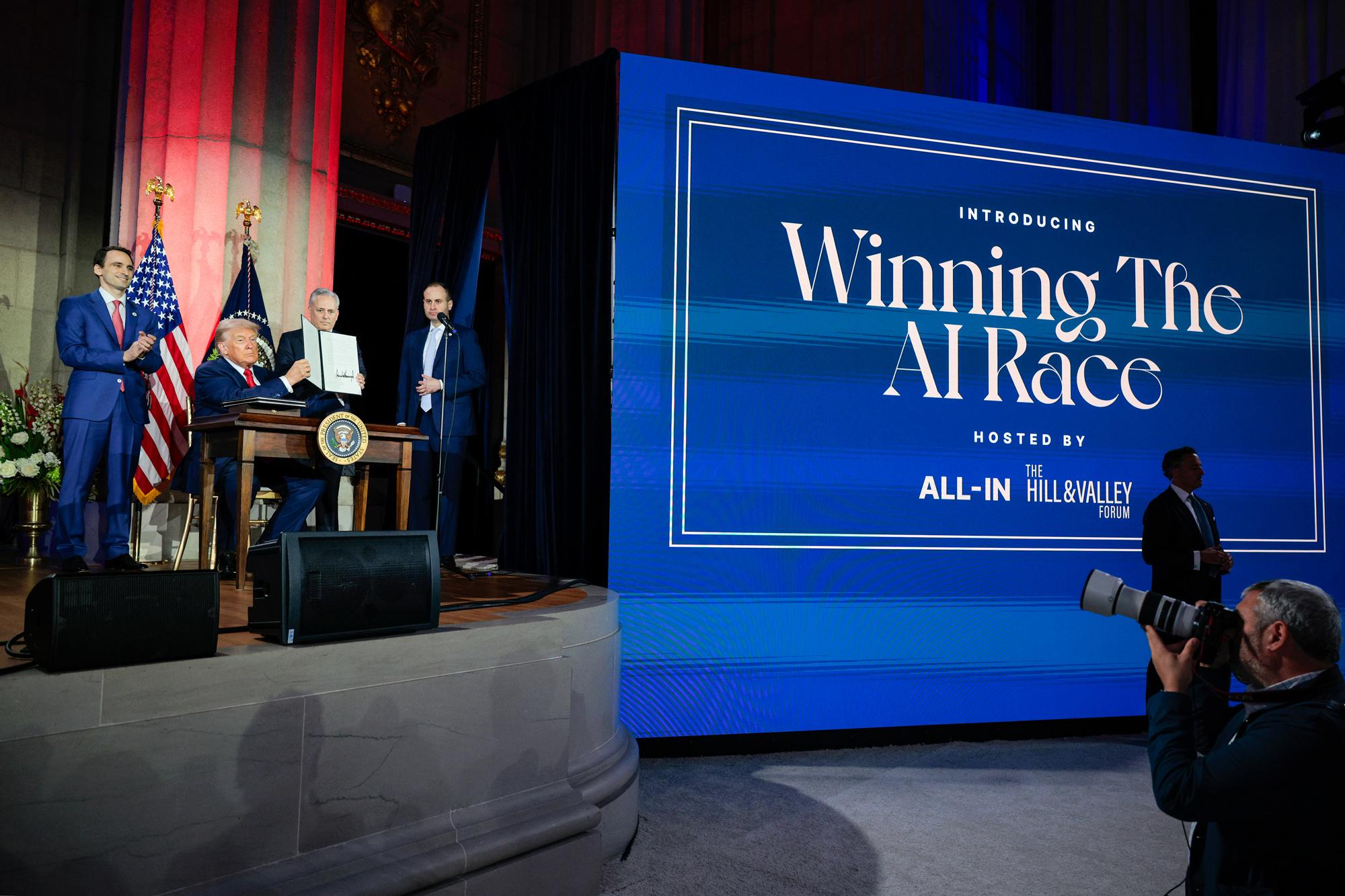
President Donald Trump displays a signed executive order during the “Winning the AI Race” summit in Washington on July 23, 2025. Chip Somodevilla/Getty Images
China already dominates certain industries, and with the leg up of superior AI, “they’re going to get an increased stranglehold over more,” Ackerman said.
“China really approaches the world and the world stage from a whole-of-government, whole-of-society approach,” Wicker said. “If it has an economic advantage in the AI sphere, it’s going to leverage that for many other reasons.
“It’s not about going to the market and enriching themselves. It’s really another lever of national power.”
Beijing may give its AI capabilities to other nations for free and then hold them hostage if they “don’t agree with China,” Merza said.
“They just turn something off and say we can’t get it anymore,” he said, providing a hypothetical scenario: “I’m not going to give you the next generation of AI anymore. I’m going to give it to your adversary.”

A sign for Apple’s data center in Guiyang, Guizhou Province, China, on July 24, 2026. Jade Gao/AFP via Getty Images
Cyber Warfare
When it comes to direct security threats posed by AI, they mainly fall into two categories: cyber warfare and military applications.
“AI really plays a huge role even today in the national security space, and if China is able to leap ahead of the U.S., you’re going to see them press that advantage more and more, both regionally and around the world,” Wicker said.
The Chinese regime has long been a cybersecurity threat, operating a vast, state-sponsored network of hackers. Its operations go far beyond regular intelligence collection.
“We would never hack one of their companies, steal a trade secret, and hand it to one of ours and say go, right? That would be a scandal here, right?” Williams told The Epoch Times.
“[In China,] that’s par for the course. It’s expected.”
Yet data theft is only the beginning, according to Su Tzu-yun, director of the Division of Strategy and Resources at the Institute for National Defense and Security Research in Taiwan.

Then-acting U.S. Attorney for the District of Columbia Michael R. Sherwin announces the prosecution of Chinese citizens for hacks targeting more than 100 companies and institutions, at the Department of Justice in Washington on Sept. 16, 2020. The hacks infiltrated social media and game companies, universities, and telecommunications providers in the United States and abroad. Tasos Katopodis/Pool via AP
“Once a breach is successful, the attacker can alter data undetected, causing significant misinformation,” he told The Epoch Times.
“The resulting damage can far exceed that of mere data theft, as it can plunge a nation into chaos.”
Merza’s clients, mostly critical infrastructure operators, are very concerned not just about hacking but also infiltration “in the form of an AI model or the form of a bad computing infrastructure,” he said.
“This topic is very top of mind for them because a variety of them have been impacted by prior breaches that have been Chinese-led or Chinese-adjacent.”
Companies such as Anthropic and OpenAI have already shown “AI capability to launch cyberattacks or to discover vulnerabilities in systems,” he noted.
Such capabilities can be used both offensively and defensively.
“That is an important strategic advantage that the United States must have, and that a lot of our customers are concerned about, and they want it, too, so they can protect themselves better,” he said.
Pages from Anthropic’s website are displayed on a computer screen in New York City on Feb. 26, 2026. Patrick Sison/AP/File
It was obvious to Thayer that China would primarily target critical infrastructure.
“If their AI capabilities get close to where we are, where we can’t thwart a cyberattack from them, then that would be a devastating blow to our national security,” he said, stressing the imperative of having an AI sufficiently superior to beat “whatever model they come up with.”
But China’s conception of cyber warfare goes further.
Cyber Influence Operations
“China is very good at shaping the battlefield of the mind and leveraging technology to do that,” Wicker said, alluding to the communist regime’s online influence operations.
“AI allows that cognitive space to be weaponized faster and more efficiently, honing and crafting messages more rapidly and more precisely for even smaller segments of the population,” he said.
Cognitive warfare is already being employed in the AI race itself, some of the experts pointed out.
China is very good at shaping the battlefield of the mind and leveraging technology to do that.
McDaniel Wicker, AI-powered intelligence and risk analyst
“China has had a very successful campaign to change public perception in the United States against data centers,” Ackerman noted.
Targeting has become granular enough to focus on specific individuals. China-linked cyber actors already deploy hyper-personalized spear-phishing campaigns—tricking targets into opening malicious websites and attachments, typically to compromise their data.
AI enables the same individualization to influence campaigns, “especially for high-value targets,” he said.
AI’s ability to process reams of data also helps the regime to turn some of its tools of domestic repression outward.
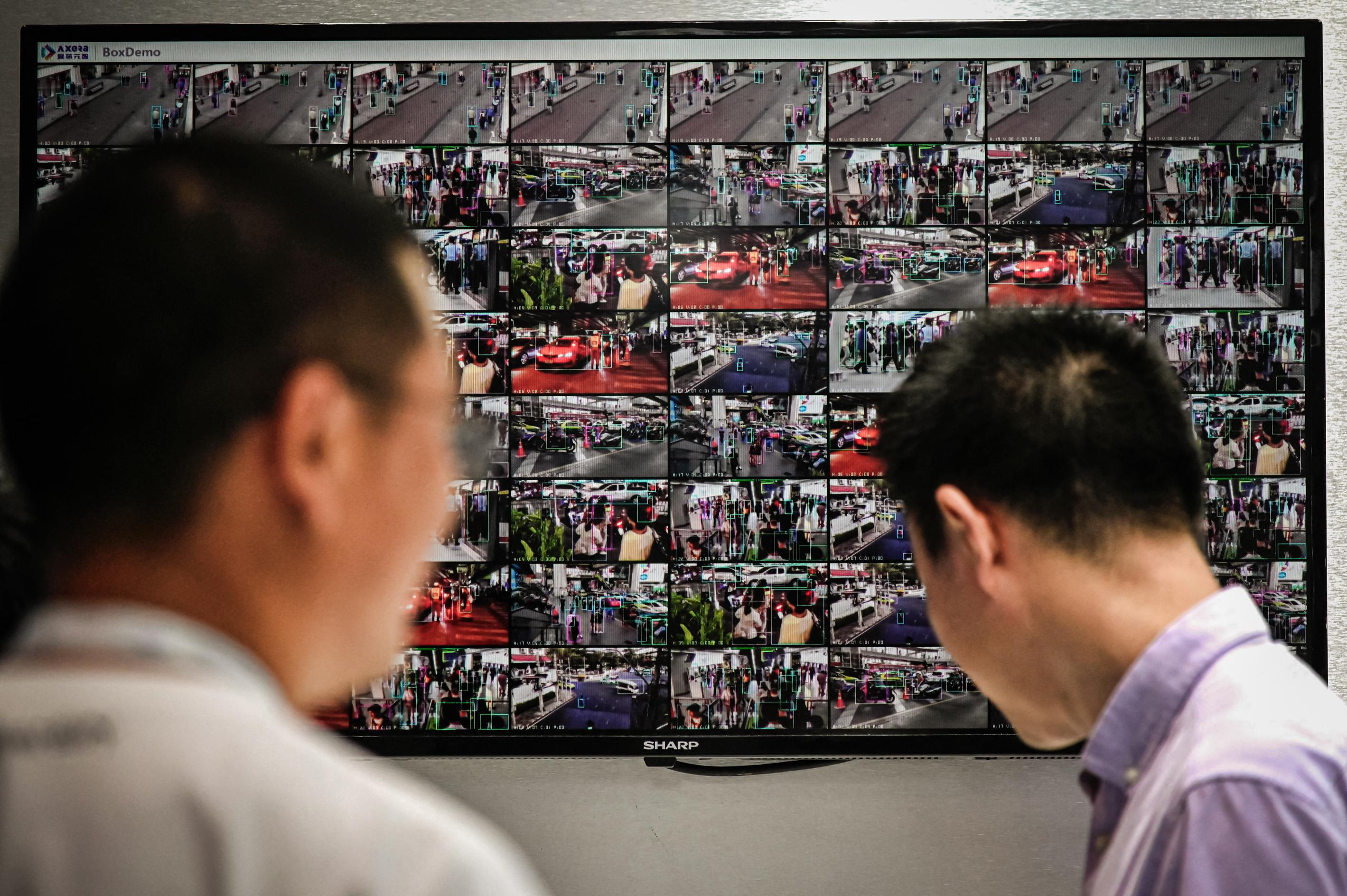
People are seen in numerous images from closed-circuit television security cameras, displayed on a screen at the World Artificial Intelligence Conference in Shanghai on July 6, 2023. Wang Zhao/AFP via Getty Images
“They have had a surveillance state for decades, but now they’re able to ingest all of this information,” Ackerman said.
“They’re able to run models on human behavior down to the facial expression level, track patterns of behavior, track pretty much anything you can imagine.
“And now they’re able to determine all sorts of things, and then extrapolate that out, and then use that same data on other countries.”
In national security contexts, the danger extends beyond disinformation to cognitive manipulation.
“There are plenty of examples where we’ve taught AI psychology, linguistics … with good intentions, [such as to] help depressed suicidal teenagers. But some of these things have become so good that you can actually implant not just false information—we can implant this idea, and people think they’re making a free choice, and they really are not,” said Neil Sahota, AI strategist and chief executive at ACSI Labs consultancy.
Chinese influence operations have been a major concern in Taiwan, especially in how they are “swaying influencers within the Taiwanese information space and social media and pop culture ecosystem,” Wicker said.
“China loves co-opting people to their side. I think they’ve been very good at it for a number of years, and I think the state of technology just makes it easier,” he said.
“I’m sure there are more deliberate operations where they are actually buying influence, but there are also plenty of times where they’re just making their ideas seem more appealing or inserting a little bit of doubt around Western ideas and values.”
Influence operations can have far-reaching implications even in the military realm, Sahota warned.

A user looks at news content on Facebook, in Taipei on Dec. 22, 2023, in this photo illustration. In the run up to Taiwan’s January 2024 election, China inundated the island’s voters with a wave of online misinformation, from deepfakes to TikTok videos. I-Hwa Cheng/AFP via Getty Images
“You don’t need to hack the drone or hack the missile if you can influence the decision environment, right? The people that are actually making these choices,” he told The Epoch Times, noting the ability of AI to “create plausible intelligence” and “synthetic evidence.”
“Disinformation could really influence you into a poor military engagement [or] retaliation strategy. That’s really powerful,” he said.
Due to its speed, AI can also mount a “cognitive denial of service” attack.
A denial-of-service attack is a cyberattack in which a target server is overloaded with bogus traffic to block access to a website or online service.
“AI does something similar for people,” he said.
“You can overwhelm the analysts, or the executives, or the voters, with credible-looking information, faster than people can validate it.”
Another alarming possibility is “poisoning economic models,” he said.
AI could “manipulate data streams” such as “supply chain forecasting” and other economic data, affecting creditworthiness, insurance analysis, and many other data-driven services, he said.
In some cases, China wouldn’t even need to conduct the operation—simply demonstrating its capability to do so could wreak havoc, Williams said.
If China makes it known, for example, that it could influence the outcome of elections, even if it doesn’t actually do so, “it opens up the opportunity for others to capitalize on that and say, ‘Well, it must have been them, right?’” he said.

A person holds mobile phones displaying viral AI-generated videos of people sharing views on the impeachment of Philippine Vice President Sara Duterte, in Hong Kong, on June 20, 2025. Days after the Philippine Senate declined to launch the impeachment trial, the videos arguing for and against the move went viral. Yan Zhao/AFP via Getty Images
Military Use
Both the U.S. and Chinese militaries are working on implementing AI.
“China sees this AI transition as just central to the next revolution in their military tactics,” Sahota said.
But there’s a marked difference in approaches.
The “U.S. military and national security community is doing a really good job of embracing and implementing AI,” Wicker said.
He expected “a lot of entrenched parties unwilling to let a computer do their thing,” but from what he saw, both career officials as well as the current and the previous administration have been “really pushing to embrace and implement AI … and really coming up with some innovative ways to leverage these technologies.”
“It is really at the forefront of all of our military planning and war gaming for a China-based scenario,” he said.
But when it comes to fielding AI-powered weapons, such as autonomous drones, the United States is proceeding with caution.
[AI] is really at the forefront of all of our military planning and war gaming for a China-based scenario.
McDaniel Wicker, AI-powered intelligence and risk analyst
“Autonomous systems in the West carry huge ethical considerations and concerns about who actually is carrying out potentially lethal action,” he said.
“You see in the U.S. that many autonomous systems are nonlethal.”
Kenney agreed.
“The technology is definitely there, and then it’s kind of a question of: Are people comfortable using it?” he said.

British soldiers launch a drone during Project Convergence exercises at Fort Irwin, Calif., on Nov. 4, 2022. The ongoing, multi-year experimentation program is led by the U.S. Army to test future warfighting concepts. DVIDS via AP
“Largely what I’ve seen, there’s a lot of hesitancy to utilize those tools.”
Sahota said it comes down to discomfort with “quantifying human lives.”
“If you’re going to let AI pull the trigger, so to speak, you have to be able to say this soldier’s life is worth X. The damage to this building is worth Y. Civilian casualties are worth Z,” he said.
“It’s really easy to boil something down to an equation, but that’s not the way people think about human life.”
Some of the experts—particularly those dealing with the U.S. military and national security community—agreed that the U.S. government is ensuring that human operators retain ultimate authority over lethal and high-stakes AI deployments.
“Right now, the vast majority of AI use is simply just combing through all of the data and all of the information that countries have access to and just raising the important bits to the top for someone to look at. So it’s very much still human in the loop. It’s very much still intentionally slowed down that way,” Ackerman said.
It should stay that way, Wicker argued.
“On the critical decisions about whether this person should get a benefit or not, whether this person should be allowed into the country or not, whether this target is legal or not in a military context, those are never places where we want a machine to make that decision,” he said.
It’s not clear where exactly the People’s Liberation Army (PLA) stands on this issue as its operations are largely opaque. The experts agreed, however, that the communist regime seems much less concerned about the ethics of autonomous weapons.

Autonomous robotic dogs walk in the U.S. Army’s 250th birthday parade in Washington on June 14, 2025. The robots are designed to replace soldiers, workers, and military working dogs in certain hazardous situations. Anna Moneymaker/Getty Images
“We’re coming to things from fundamentally different political structures, fundamentally different belief systems, values—the whole nine yards, right?” Ackerman said. “So, from their perspective, it’s perfectly fine.”
This is where China’s manufacturing might would come into play.
“Not only can they build these systems, but they can build them at scale and put them onto the battlefield in large numbers if needed,” Wicker noted.
The consequences could be particularly significant in an actual military conflict. The PLA has made it no secret that it’s been preparing AI-powered weapons for the conquest of Taiwan. If the U.S. military gets involved, the conflict could see drone swarms on both sides.
With both drones and humans on the battlefield, it may be a considerable disadvantage if one side needs to carefully approve each human target while the other lets the AI weapon identify and eliminate all targets at once.
“It does significantly slow down a potential operation, and so in that way, China does have a bit of an advantage,” Wicker said.
Williams acknowledged as much.
“The side that has to wait for confirmation is going to inflict less damage,” he said.
“If it’s a war of attrition, you’re going to win every time if your enemy has to do human in the loop.”
Yet such a strategy may prove counterproductive in the long run, he pointed out.
“If your end game is trying to live with the civilian population that’s left over afterwards, I think indiscriminate targeting is probably not a great way to get there.”

A rocket is fired during People’s Liberation Army military drills on Pingtan Island, in eastern China’s Fujian Province, the closest point to Taiwan, on Dec. 30, 2025. Adek Berry/ AFP via Getty Images
Recommendations
The experts had no shortage of advice for the U.S. government.
They acknowledged that the U.S. government’s export controls on advanced computer chips are necessary, but they also agreed that they only slow China down.
“The existence of strong Chinese models doesn’t prove that the controls failed, but I think it does prove that controls alone don’t secure U.S. leadership. So domestic capacity and innovation really have to do the rest,” Kenney said.
“You can play defense all you want, but eventually you’re going to have to play offense if you want to score a goal.”
He also recommended “some form of export strategy that really makes the American AI the preferred choice for allies in emerging markets.”
Su recommended tightening implementation of the export bans.
You can play defense all you want, but eventually you’re going to have to play offense if you want to score a goal.
Noah Kenney, AI governance and cybersecurity consultant
“Cooperation with customs agencies worldwide is essential to block smuggling attempts that funnel chips to the [Chinese Communist Party]; this serves as a necessary administrative and regulatory complement to the bans,” he said.
Ackerman stressed infrastructure buildup.
“We need to build more pipelines. We need to build more power plants. We need to support our own infrastructure. We need to increase manufacturing domestically, and until we do these things, we will always be susceptible. And if it’s not AI, it’s going to be the next thing,” he said.

Engineers configure and test industrial robotic arms at a booth during preparation for COMPUTEX in Taipei, Taiwan, on June 1, 2026. One of the world’s largest annual computer and technology trade shows, COMPUTEX showcases next-generation AI chips, robotics, and computing infrastructure. Cheng Chia Huang/Getty Images
Securing AI will be an ongoing challenge, especially when it’s integrated into sensitive systems, said Jason Richards, former FBI IT executive and now principal at JWR Strategies.
“When I have two computers talk to one another, two systems talk to one another, is that a trusted connection?” he said.
He also stressed “resiliency.”
“That’s going to mean that if something bad does happen, what do you do?” he told The Epoch Times.
“[For] some of these models we’re going to have to have shut-off switches.”
We need to build more pipelines. We need to build more power plants. We need to support our own infrastructure. … until we do these things, we will always be susceptible.
David Ackerman, AI and compliance expert, the Stimson Center
He also placed some responsibility on the public, noting that people need to get better at detecting AI-generated content.
“Individuals that are consuming these types of media need to be responsible consumers and to check things,” he said.
People in leadership positions will need to get comfortable both with receiving and rejecting recommendations from AI, Wicker suggested.
The United States needs to ramp up its efforts to prevent China from distilling its AI models, Thayer recommended.

The DeepSeek app on a cellphone in Beijing on April 28, 2026, in this photo illustration. OpenAI has accused the Chinese start-up of using U.S. technology to train its own large language models, employing a technique called distillation. Greg Baker/AFP via Getty Images
“We also should make sure that we stop data flows going over to China, and make sure that we have a competitive market in the U.S. so that way, folks don’t have to rely on cheap knockoffs that we get from China,” he said.
It goes without saying that the U.S. government shouldn’t implement any Chinese AI products, multiple experts agreed.
“I don’t expect our government’s going to be using any Chinese models anytime soon, or ever,” Richards said.
The U.S. government is already pressuring private corporations to avoid Chinese AI, too.
“They’ve made it pretty clear that they don’t want Chinese products being utilized in that way, at least under the current administration,” Kenney said.
Tu recommended pushing out Chinese AI through regulation.
“The focus should be on establishing standards for model evaluation—ensuring compliance with human rights, privacy, public safety, and democratic universal values,” he said.
Chinese AI needs to comply with the Chinese Communist Party’s censorship requirements, and “if we were to evaluate models based on universal values—such as human rights, democracy, and freedom—Chinese models would naturally be rejected,” he said.
Yi Ru contributed to this report.