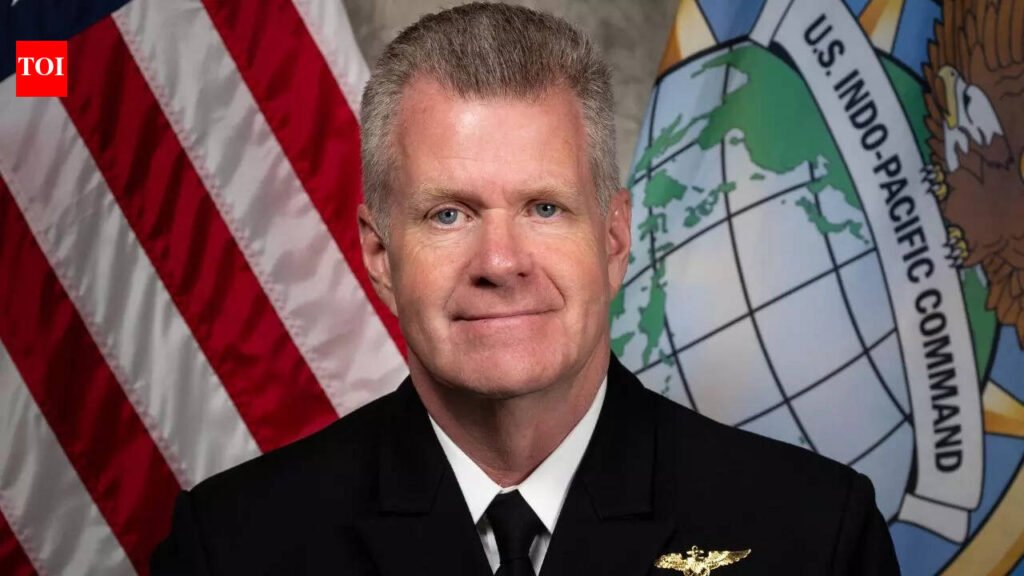
NEW DELHI: American admiral Samuel J. Paparo, who leads US Indo-Pacific Command, is in India from 3 to 8 October. It is his second visit this year.The US Embassy said the trip is meant to push forward the “major defense partnership” and deepen cooperation between the two militaries.Its list of topics includes digital transformation, emerging technologies and regional strategic stability. It also names “defense energy resilience” and an “increasingly competitive technology landscape”, though it does not spell out what either would involve.
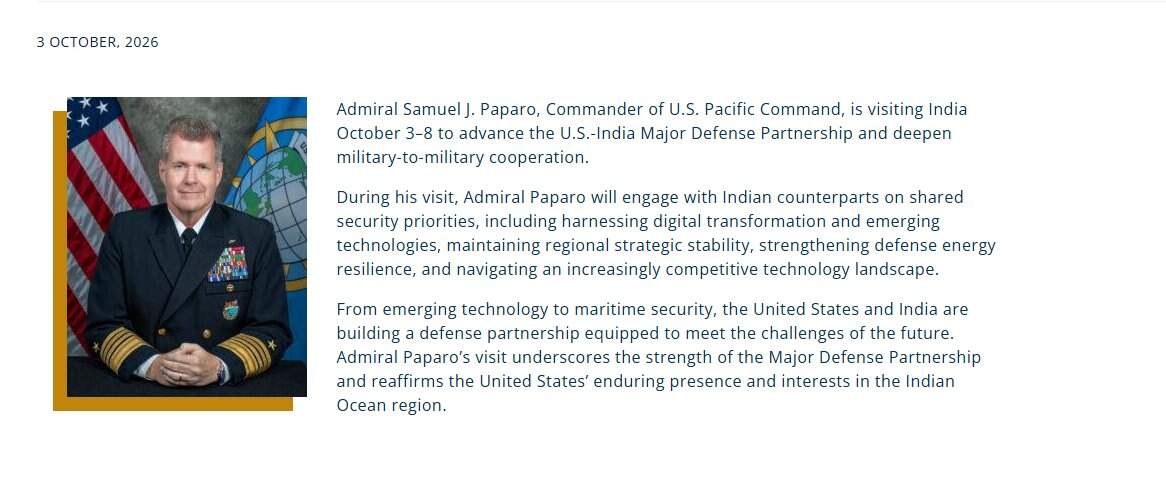
Press release by the US Embassy in India.
On his earlier trip, Paparo visited Delhi, Chandimandir and Bengaluru. He met the Chief of Defence Staff and the Navy chief, and discussed security along India’s western and northern borders.Last month, Paparo conducted a series of key bilateral and multilateral meetings on the sidelines of the 28th Indo-Pacific Chiefs of defence conference in Victoria, Canada, held from August 31 to September 2.According to the US Pacific Command (US PACOM), Paparo highlighted “the importance of strong bilateral and multilateral relationships in advancing regional security and deterrence”.Throughout the conference, the US commander engaged in discussions with the Defence Cooperation Council and the Quadrilateral Security Dialogue (Quad), and joined military leadership from Asean nations. Paparo also connected with defence counterparts from Australia and the United Kingdom for an Aukus dialogue, and conferred with Adm. Giuseppe Cavo Dragone, chair of the Nato Military Committee.US Pacific Command noted that Paparo carried out bilateral discussions focused on “strengthening operational cooperation, information-sharing, maritime security and readiness across the Indo-Pacific” with senior representatives from numerous partner nations.The participating countries included Bangladesh, Brunei, Cambodia, Canada, France, India, Indonesia, Japan, Malaysia, Mexico, Mongolia, New Zealand, the Republic of Korea, Singapore, Thailand, and Vietnam.
What Washington has put on record
Paparo’s visit comes after a run of statements in Washington. An update on how the 2026 National Defense Strategy is being carried out, sent to the Senate Armed Services Committee, places India under the heading of burden-sharing, the idea that allies and partners should take on more of the load.“Finally, and crucially given its regional standing and power, we are also building on our strong defence relationship with India, with the recent signature of a 10-year bilateral defence framework and a separate framework to strengthen undersea cooperation,” the update said.Testifying before lawmakers in April, Paparo said the relationship with India had seen “transformative growth through increasingly complex military exercises, defence sales, and strategic dialogue”.However, the recent Trump tariffs and the punitive measures against India for buying Russian oil, and a stuck trade deal has undoubetly strained the ties between both nations.Paparo had also pointed to cooperation on maritime security and underwater awareness, including India’s planned purchase of MQ-9B drones through US foreign military sales. He also described India as one of the partners he visits and coordinates with most often.He said India “continues to be a source of stability within South Asia”, and cited its investments in Sri Lanka and its agreements with Mauritius, which he said help keep strategic infrastructure “free of adversarial influences”. On Pakistan, he noted that recent military exchanges had extended beyond traditionally disputed areas, but said India’s main focus remained “maintaining deterrence and credible warfighting capability within the region writ large.“
The China question in the background
None of this is discussed in isolation from China as Paparo himself has said Beijing’s actions, along with its deepening ties to Russia and North Korea, make for a complex challenge to regional stability. He calls alliances and partnerships Washington’s “greatest asymmetric advantage”, and the Quad, which brings together the US, India, Japan and Australia, is part of that picture. Though Quad his been pushed to a back burner under the Tump 2.0.
Share your thoughts in the comments
Be respectful · TOI community guidelines
At a regional security conference in Malaysia, Paparo said some actors were using “false claims of legitimacy” to justify coercion. “That’s not the rule of law. That’s the rule by law. That distinction between law as a tool of order versus law as a weapon of raw power, is the defining fault line of our time,” he said. He added that the US was deterring China “through strength, not through confrontation”.In the South China Sea, Manila has accused Beijing of dangerous manoeuvres, water cannon attacks and attempts to block resupply missions around a disputed shoal. China denies this. Philippine defence secretary Gilberto Teodoro said, “China is everywhere … this is a matter of concern,” and pointed to a recent Chinese ballistic missile launch into the Pacific.At the congressional hearing, Representative Adam Smith said partners needed reassurance. “We need to maintain those relationships. We need to let those folks know that we are there and they can depend on us,” he said.