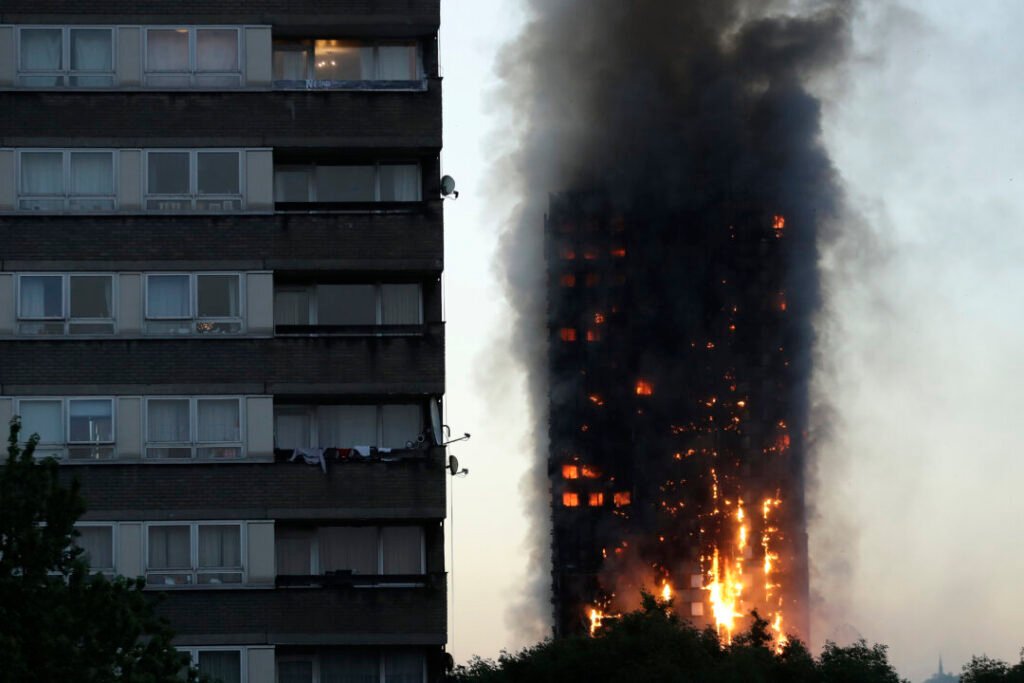

The Grenfell Tower building in London engulfed in flames and smoke on June 14, 2017. Matt Dunham/AP
London’s Metropolitan Police said they asked prosecutors to consider bringing criminal charges over the Grenfell Tower fire, which killed 72 people.
The UK’s deadliest residential fire since World War II started on the fourth floor of the 24-story residential block in West London on June 14, 2017, and rapidly spread up the side of the building. Victims included retirees and 18 children.
A 2024 public inquiry concluded the disaster resulted from decades of failures by government, regulators, and companies involved in the building’s refurbishment.
The Met on Wednesday said it passed 20 files to the Crown Prosecution Service (CPS) involving 54 individuals and 20 entities and asked it to consider charges including corporate manslaughter, gross negligence manslaughter, fraud, misconduct in public office, and health and safety offenses.
Police said prosecutors have committed to deciding on criminal charges before the fire’s 10th anniversary.
The government’s housing secretary, Angela Rayner, confirmed that her Ministry of Housing, Communities and Local Government was among the entities police referred to prosecutors.
Related Stories


“The government failed in its fundamental duty to keep the residents of Grenfell Tower safe,” Rayner said in a statement.
“Lives were lost as a result of the profound failures within the building safety system, and on behalf of the British state, I am sorry.”
The Royal Borough of Kensington and Chelsea Council, the local government authority, also confirmed on Wednesday that it was one of the 20 entities reported to prosecutors for consideration of corporate manslaughter charges.
“We have accepted the Council’s failings, and our commitment to candour, openness, and accountability has not changed,” council leader Elizabeth Campbell said in a statement.
Police said they had gathered 165 million electronic files, taken 14,700 statements and collected more than 27,000 exhibits during what they described as one of the most complex criminal investigations ever undertaken in Britain.
Flammable cladding was found on thousands of buildings across England after the disaster. Government data from August 2026 show 1,849 residential buildings out of 4,724 have had it completely removed.

The Grenfell Tower block, destroyed in a disastrous fire in North Kensington, West London, on June 16, 2017. Hannah McKay/Reuters
Between 1920 and 1980, millions of properties were built for social housing, but in 1979 former Prime Minister Margaret Thatcher introduced the Right-to-Buy policy, which allowed tenants to buy their homes from the council at a discount.
Reuters contributed to this report.