MURRIETA, Calif.—The Trump administration’s One Big Beautiful Bill Act will fund a much-needed facility to maintain U.S. Border Patrol vehicles in Southern California and inspect impounded vehicles for narcotics.
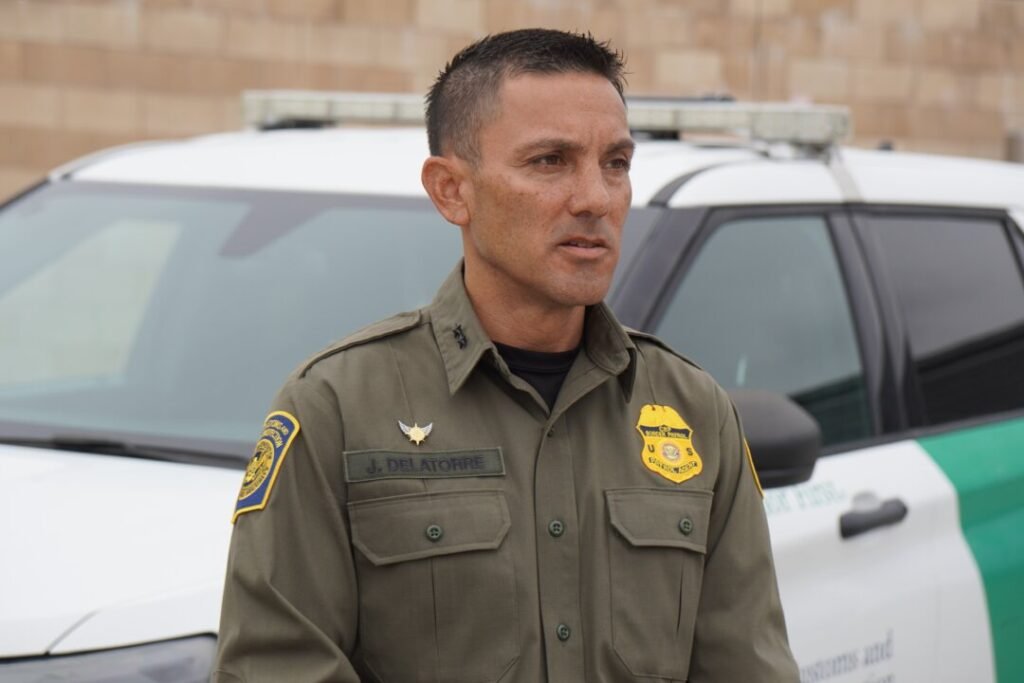
Fleet readiness is “absolutely critical” to mission success, said Justin De La Torre, San Diego Sector Border Patrol chief, as he unveiled plans to build a $28.7 million vehicle maintenance facility at a Sept. 18 press conference at the Newton-Azrak Border Patrol Station in Murrieta.
The federal funding is a “generational investment in border security” for decades to come, he said.
De La Torre told reporters the new project in southwest Riverside County will improve fleet maintenance, overnight storage and secure parking for vehicles and replace an outdated, rented off-site commercial garage used for nearly 30 years.
The current “subpar” system means staff must drive away from the operational environment, “taking us off task and requiring additional resources,” he said.
The new facility will include a fueling station, vehicle washes, an impound lot, overnight storage and secure parking. The project also includes essential upgrades to the station’s electrical grid and a reinforced emergency power system.
Related Stories


CBP’s Office of Facilities and Asset Management has awarded a $23 million contract to the Haskell Company to design and build the facility, with completion expected by Sept. 30, 2028, the end of the fiscal year.
About 70 agents currently work out of the station, and 30 more will be hired, De La Torre said.
De La Torre said he expects more modernization projects and upgrades at other border stations.
The Murrieta station is in a critical corridor leading away from the border, he said.
“The agents out here are some of the best highway interdiction agents in the country. They are very good at identifying vehicles that are laden with narcotics or smuggling people who have illegally entered the country and are furthering their entrance into the United States,” he said. “They patrol on all egress routes leading away from the immediate border environment in San Diego County.
Because drug cartels have become so “crafty” at hiding narcotics in vehicles—including inside engine components—the site will also be used to search those vehicles for illicit drugs, De La Torre said.
“Once we pull a vehicle over on the side of the road. We may know that there’s narcotics inside the vehicle. However, getting to those narcotics requires disassembling difficult components within that vehicle,” he said. “Our agents can bring those vehicles back to this new facility, have the mechanics support that process of inspecting the vehicle, disassembling them, and finding where those narcotics are hidden.”
Drug cartels that smuggle people into the country for about $10,000 per person profit off human suffering, he said.
“Those people don’t have $10,000 at their disposal,” and are forced to pay back that debt “while working illegally in the country and undermining legitimate businesses,” De La Torre said.
“These are the same organizations that bring narcotics into our communities and generate violence in Mexico. These organizations are a threat to our national security,” he said.
The White House has touted the One Big Beautiful Bill Act as an historic pro-growth spending package to keep campaign promises, boost the economy, and secure the borders.
“I’ve been with the U.S. Border Patrol for over 26 years. I joined in 2000, and what I have experienced, along with my fellow agents, is that we have never had the resources to fully succeed in our mission, until now,” he said.