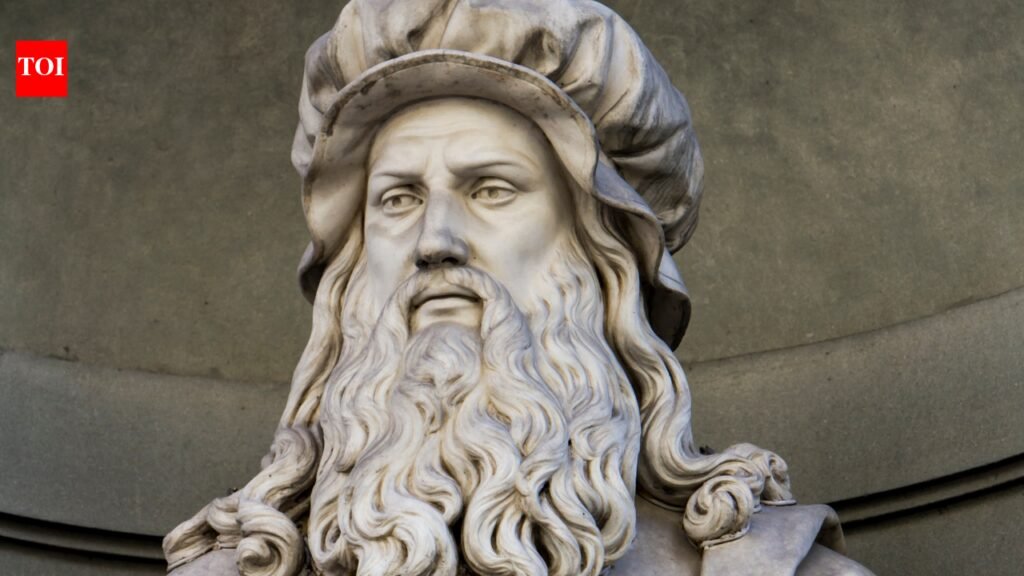
Leonardo da Vinci was the polymath of the Renaissance, a painter, sculptor, architect, engineer, and scientist all in one. He created the “Mona Lisa” and “The Last Supper,” but he also had interests in anatomy, mechanics, botany, and hydraulics.Much of what is known is that his scientific thinking comes not from published books but from his personal notebooks, thousands of handwritten pages filled with sketches, mirror-writing, and observations, including research on nature like this one.Leonardo da Vinci was a person who had knowledge about nature, phenomena, and how things functioned in nature, talking about the human body, water currents, bird flight, and the growth behaviour of plants. He didn’t separate “art” from “science” the way we do today; to him, understanding how something worked and being able to render it beautifully were the same pursuit.
Quote of the day
“Nature is the source of all true knowledge. She has her own logic, her own laws, she has no effect without cause nor invention without necessity.”
Leonardo da Vinci
What does the quote mean?
Leonardo says that nature doesn’t do anything without a reason. Every effect has a cause, and every invention, or smart mechanism, whether built by nature or by a human, is present because it was necessary. Nothing in the natural world is just there as a decoration for its own sake. A bird’s wing has a particular shape, exactly as it needs to be for flying; a river carves its path based on the landscape and the water’s behaviour; it is not what it is for no reason.In Leonardo’s view, since nature “has her own logic, her own laws,” you must study the thing itself to understand it clearly, not just what people say about it.This was quite an idea for his era. In the 15th and 16th centuries, a huge amount of accepted “knowledge” came from ancient texts, religious doctrine, or scholarly tradition that was passed down, and its authenticity was never really tested against reality.Leonardo, instead, spent his life dissecting cadavers, studying water flow, sketching muscles mid-motion, and observing plants growing toward light. He trusted what he could see and verify over what he was told, and that is the core idea of the quote.
How are his words relevant today?
Our lives today are surrounded by immense information online in this digitally driven world and we hardly know how to differentiate between facts and fiction.It’s someone’s opinion portrayed as fact, or a real fact cut off from the context that made it make sense. And it all spreads so quickly that nobody has time to check if it’s even true.Similarly, search algorithms also keep showing what gets clicks and keeps people scrolling, and it is not necessary that all of it is true.Here, Leonardo’s approach to go look at the real thing yourself instead of just believing whatever’s loudest or most shared actually matters more today than it did in his own time.