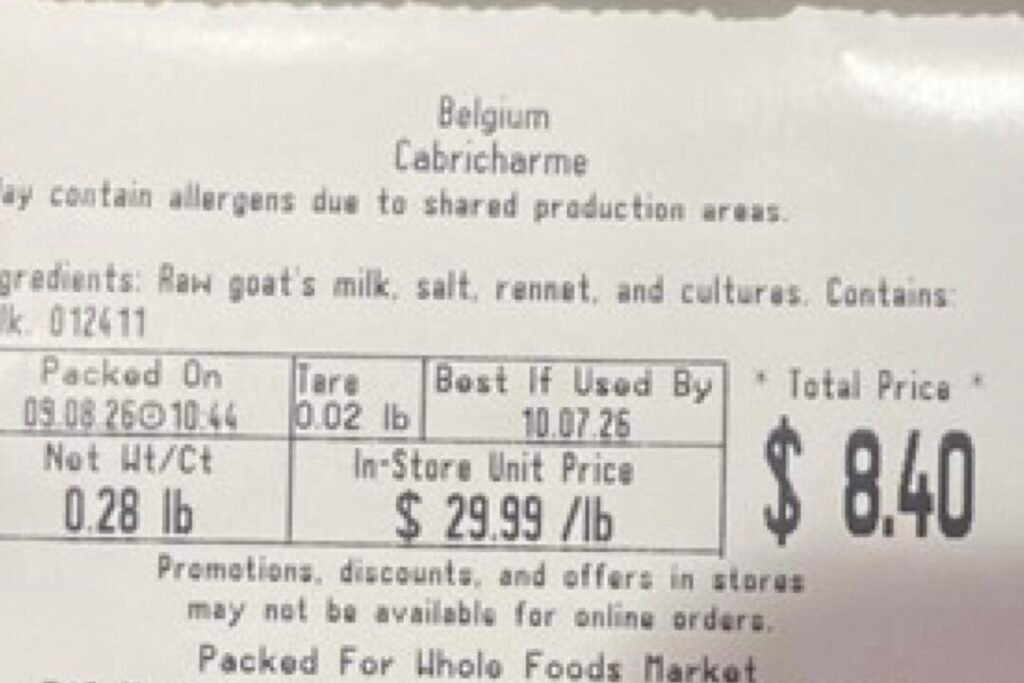
Whole Foods Market has announced the recall of its “Fromagerie Coop de Mean Cabricharme” cheese products due to the presence of egg lysozyme, which was not declared on product labels, according to a company announcement.
Egg lysozyme is an egg white protein. Food products containing the protein may cause people with allergies or severe sensitivity to eggs to suffer a serious or life-threatening reaction upon consuming the items.
The cheese was sold in the specialty cheese department at 18 Whole Foods Market stores in Arizona, California, Connecticut, Massachusetts, New Jersey, New York, and Rhode Island, the company said in a Sept. 11 announcement shared by the Food and Drug Administration.
Fromagerie Coop de Mean Cabricharme Raw Milk–Aged 60 days, with PLU number 57953, was sold in California, Connecticut, Massachusetts, New Jersey, New York, and Rhode Island. Belgian Cabricharme, with PLU number 54670, was sold in California and Arizona. Both products have “Best By” dates up to and including Oct. 7, 2026, the company said.
According to the announcement, the impacted products have all been removed from shelves across stores. The company asked people who have bought the items to destroy them. Impacted customers may get a full refund on the product if they submit a valid receipt.
Whole Foods Market clarified that no illnesses have so far been reported in connection with the recalled items. Customers with queries can contact the company at 1-844-936-8255.
Related Stories


Owned by Amazon, Whole Foods Market has more than 500 locations in the United States, Canada, and the United Kingdom combined, according to the company website.
The Epoch Times reached out to Amazon for comment but did not receive a response by publication time.
According to the agency, it is legally obligatory that food labels identify sources of these allergens used as ingredients.
The specific component at issue in the recall, lysozyme or Gal d 4, is present in egg whites and is considered a “major allergenic protein molecule” for children allergic to eggs, according to testing company Thermo Fisher Scientific Inc.
Roughly 30–40 percent of patients allergic to eggs are sensitized to lysozyme. The protein makes up roughly 3 to 3.4 percent of an egg white’s total protein content. It is used in the food industry in products such as wine and cheese. Due to its antibacterial properties, the protein is also used in the pharmaceutical industry as a preservative.
According to advocacy organization Food Allergy Research & Education (FARE), as many as 2 percent of children are estimated to be allergic to eggs.
“Symptoms of an egg allergy reaction can range from mild, such as hives, to severe, such as anaphylaxis. Allergic reactions can be unpredictable, and even very small amounts of egg can cause one,” FARE said.
Anaphylaxis refers to a potentially fatal allergic reaction.
People with egg allergy should avoid food products containing eggs. Such items can include pancakes, waffles, cake decorations or fillings, breads coated with egg wash, marshmallows, hollandaise, crackers, salad dressings, tortillas, pretzels, and pasta, according to FARE.