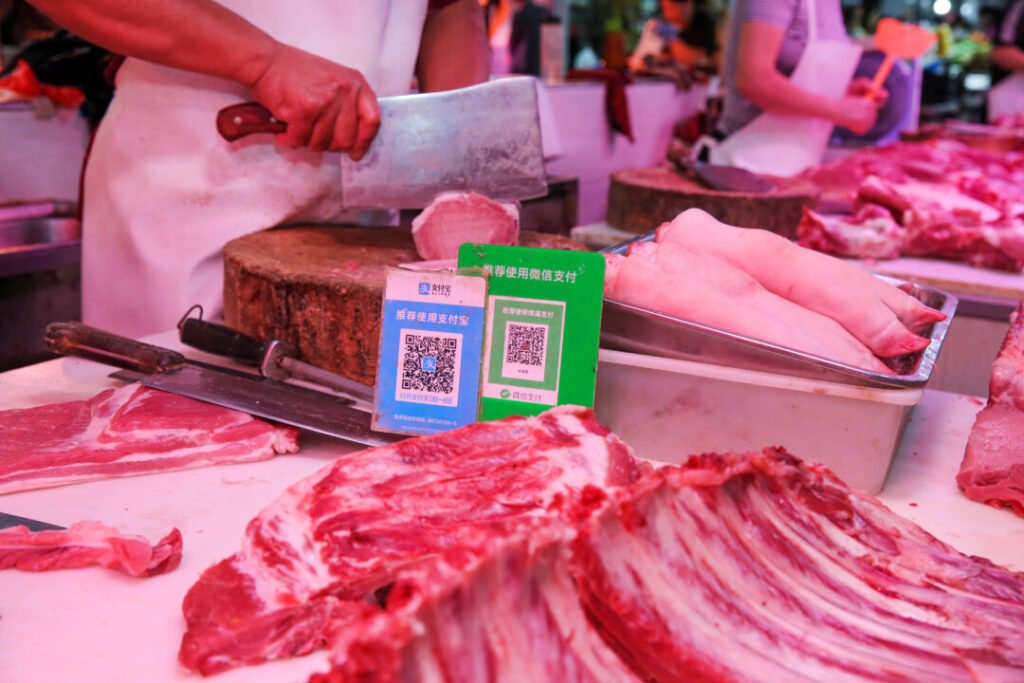

A meat stall at a market in Nantong city, Jiangsu Province, China, on Sept. 10, 2018. STR/AFP via Getty Images
The video warned other fellow meat sellers in Shanghai that “Now all knives have to be locked.”
Images circulating on Chinese social media show cleavers, kitchen knives, and other cutting tools attached to metal chains, with the chains secured to the meat counter or other fixtures at the stalls. The situation mirrors the Chinese regime’s strict control of knives in the Xinjiang region, where stringent measures have been imposed to prevent any forms of dissent or rebellion from ethnic minority Uighurs who may seek independence from China.
Text accompanying another video suggested that the measure was being implemented in response to a call for greater security. The apparent expansion of such controls into a major Chinese city prompted some netizens to ask whether the “Xinjiang model” was being extended to Shanghai.
The Epoch Times interviewed a motorcycle repair store owner in Shanghai who confirmed that reports of knives being chained to the stall are accurate. The owner does not want to be identified out of fear of reprisal.
Related Stories


“The government [sent] people to come and chain up the knives to prevent people from coming in and taking the knives to hurt people,” the owner said. “It just started to be implemented.”
A China current affairs commentator, also speaking on condition of anonymity, told The Epoch Times that Shanghai’s measure is similar to security practices in Xinjiang, where knife purchases have been subject to extensive identification and registration requirements.
“I saw that in Xinjiang, people who sell meat are locked in iron cages. If you want to buy meat, you have to go into the cage to buy it. Such things only exist in China,” he said.
Xinjiang’s Knife Controls
Knife purchases in Xinjiang have for years been subject to heightened controls, and recent videos posted online have renewed attention to the restrictions.
A man said in a video, reposted on X by @whyyoutouzhele on Sept. 18, that he visited more than 10 locations in Xinjiang before he was able to purchase a kitchen knife using his identification card.
The footage showed a knife sales counter enclosed behind glass doors covered with metal mesh and secured by three locks. The resident said buyers had to complete real-name registration and that his identification number was then laser-engraved onto the blade.
In another video reposted July 18 by the same account, a woman described searching five or six stores in Xinjiang before finding one that would sell her a kitchen knife. She said buyers had to present identification, undergo facial recognition, and provide personal information, while the transaction was recorded on surveillance cameras.
Some Chinese netizens have mocked such restrictions as “stability maintenance with Chinese characteristics,” a satirical reference to the Chinese Communist Party’s official slogan of “socialism with Chinese characteristics” in the 1980s.
The Shanghai incident has now brought renewed attention to whether security measures associated with Xinjiang are appearing in more ordinary commercial settings in other parts of China.
Xiao Bin contributed to this report.