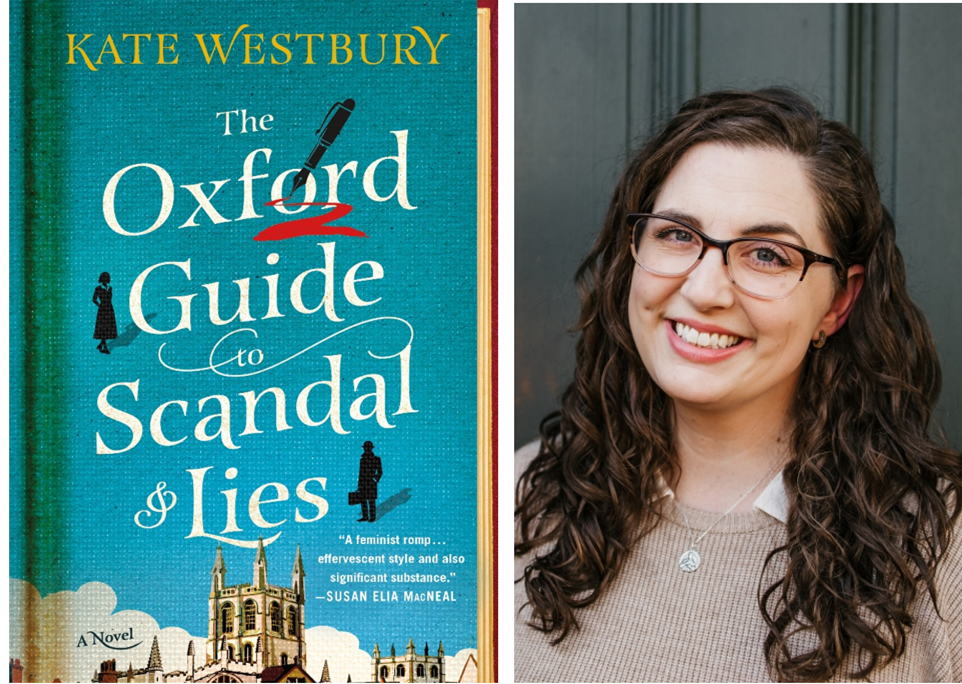
Author Kate Westbury has been a fan of the detective novel since childhood. One of her favorite books, she says, was Dorothy Sayers’s “Gaudy Nights,” a story set in 1950s Oxford University.
It’s hardly surprising, then, that her first foray into mystery writing features the same setting. To paraphrase the old writing maxim, “Write what you love.” The result, just released this month, is the richly textured and impressive debut, a whodunnit with an espionage chaser titled “The Oxford Guide to Scandal and Lies.”
Library Connection
The story features two heroes: Ginevra “Gin” Bishop, a first-year student studying Modern Languages (German) at St. Mildred’s College, and 26-year-old Sidney Braithwaite, a former soldier turned student, whose wartime experiences have left him shaken.
Finding a quiet corner of Bodleian Library to study isn’t an easy task for Bishop. It’s the beginning of the first or “autumn” term (coined Michaelmas for you UK culture nerds out there). The place, as usual, is packed. Female students are not given the same consideration as their male counterparts; they are often looked upon as novelties rather than true academics.

One of the librarians—a kind, elderly gentleman named Mr. Tolliver—directs her to a table he knows was just vacated. Bishop claims the spot, but when she returns to the table with her books, she finds a somewhat disheveled second-year student there: Braithwaite.
Bishop notices that his suit looks new but his shirt cuff is worn and his tie outdated, suggesting he’s experiencing some financial strain. The two argue over the seating before they agree to share the table.
Frenemies
The two share an affection for Mr. Tolliver (the librarian once helped Braithwaite find a vital lost book), but that doesn’t mean they have to get along. Braithwaite’s opinion of Bishop sours even further when she appears to be chummy with the flashy, charming, full-of-himself Professor Michael Leland, an acquaintance of her viscount father.
Later, Braithwaite finds himself staring at Bishop’s auburn hair: “it was too subtle for [just red]. … It was the rich, warm red-brown of cream sherry.”
Related Stories


He shakes it off. Besides, she seems romantically connected with Don Craddock, the arrogant leader of the Damocles club, an elitist society group known for their questionable ethics.
A couple of months later, the two students cross paths again when they meet on a garden terrace at a debate hall. Almost immediately, they begin sniping at one another.
The argument is interrupted when a scream cuts through the night. Searching together, they discover poor Mr. Tolliver in great distress. He collapses, whispers something in German to Bishop, and dies.
Secret Rendezvous
At the beginning of third term (called Trinity), Braithwaite gets an anonymous note instructing him to meet someone at Bodleian Library and is shocked to find Bishop there. She denies sending the note, which happens to be true.
Before he can leave, a stranger arrives, a slight, sallow-faced man in a dark suit with an air of quiet authority. He identifies himself only as “the Rook.” He explains that he works for British counterintelligence and knew that Braithwaite served as an intelligence asset during the war. He has questions for both of them regarding the death of Mr. Tolliver. He tells them the death was not a heart attack, but a murder.
From here, Braithwaite and Bishop quickly find themselves caught up in a critical Soviet spy case at Oxford, one that they could be integral to solving.

Westbury offers an honage to the late great British writers of mysteries.
Genre Tribute
The initial premise and plot points of “Oxford Guide” are nothing new. The frenemies have a meet-cute, and the mysterious stranger heralds the call to adventure. Of course, you don’t have to be original to do something well—which is the case here.
Westbury was obviously inspired by the great UK crime and spy novelists of the 20th century: Agatha Christie, Dorothy L. Sayers, and John le Carré, to name a few. Many of the classic themes, elements, and characteristics of their works are present, yet they aren’t clumsily or garishly shoehorned in. They appear natural, organic.
Christie and Sayers especially understood that a thoroughly enjoyable mystery is often composed of many different story types, powered by the engine of uncovering the murderer.
In the case of “The Oxford Guide to Scandal and Lies,” the mystery is indeed well-plotted, but it also has romantic angles, historical explorations, soap opera moments, cathartic backstory resolutions, and espionage thrills that never fail to enrich the experience.
Notwithstanding Westbury’s status as an admitted “Not a British,” her choice of setting would be a hard road for any author. Early 1950s Oxford University culture featured a rigid class hierarchy, heavy social conservatism, and fairly unique nomenclature—a serious challenge to encapsulate.
But Westbury’s obvious passion has resulted in an atmosphere that feels thoroughly authentic and absorbing, the kind of literary time-travel that is hard to come by.
“The Oxford Guide to Scandal and Lies” is an impressive debut, and the author is definitely one to watch.
‘The Oxford Guide to Scandal and Lies’
By Kate Westbury
Minotaur Books: Sept. 1, 2026
Hardcover, 352 pages