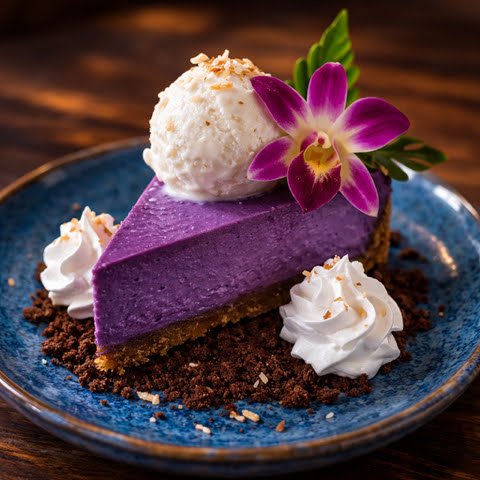
Ube is a purple-colored variety of yams. Yams are not to be confused with purple sweet potatoes, which have thin, smooth skin that is edible, as opposed to the skin of ube, which is thicker, rough, and inedible. The sweet potato is sweeter and denser, while ube brings an earthy, nutty flavor, and the sweetness is milder. You will find people, and even grocery stores, that are using the names interchangeably. But botanists would be esoterically horrified; yams are monocots, not dicots like the potatoes! Cooks will understand the difference in recipes. And the Hawaiians know. I ordered the cheesecake, and it was every bit as delicious as it was beautiful.
Ube Origins
Once I knew what ube was, I started seeing it everywhere in Hawaii: cookies, pancakes, specialty coffees, breads, purple ube foam topping tropical cocktails, and even ube-flavored mochi. Ube is not indigenous to the islands, but it is definitely a local flavor. Many things we think of as Hawaiian arrived with the islands’ immigrants, from the first Polynesian voyagers 1,000 years ago to workers from Portugal, Japan, Korea, and Puerto Rico who began arriving in the 1800s. Ube originated in Southeast Asia and is a common ingredient for Filipinos, who moved here for contract labor in the early 20th century. The name itself is from Tagalog. Traditionally, it could be boiled, steamed, mashed, or sweetened. One of its best-known preparations is ube halaya, a Filipino purple yam jam made with cooked ube, sugar, and milk or coconut milk. It can also flavor halo-halo, a Filipino dessert of shaved ice and evaporated milk, with fruits, beans, and jellies.
Ube fits naturally into the story of “outside ingredient adopted by locals.” Many Hawaiians have childhood memories of it in cakes, pastries, and ice cream at family gatherings. Current trends incorporate it in creative new ways. Tiki’s works it into purplish ube tortillas, an Ube Colada, and some mocktails, such as the Ube Sour, with ube syrup, vanilla, coconut, lemon juice, and frothy foam.
Social media has helped introduce ube to a wider audience. I recently found a baker making ube cheesecake in southern Wisconsin. No surprise: She had spent years living in Hawaii.
Related Stories


Finding Ube
Cultivating ube requires a tropical climate, and while some of it is grown in small amounts on farms in Hawaii, it isn’t available in sufficient quantities for mass-market products and its scarcity can pose a problem for a restaurant aiming to keep it on the regular menu. For this reason, the bulk of it is imported, typically as frozen puree, powder, syrups, and extracts.
Sous Chef Mikey Vong developed the ube cheesecake recipe at Tiki’s. He’s worked there for more than 23 years, starting as a dishwasher and then working his way through every station in the kitchen before becoming second-in-command to Executive Chef Ronnie Nasuti. For Vong, the violet cheesecake is familiar to local guests while also offering a familiar dish with a memorable, exotic twist for travelers. Ube works especially well in cheesecake thanks to its mild sweetness and a touch of earthy flavor, which balance the rich, slightly tangy cream cheese. And as I can testify, its unusual, colorful appearance turns tourists’ heads in the restaurant.