Barnard, who would become arguably the era’s greatest astronomical observer, and the observatory, which would house the world’s largest telescope, were destined to meet. In due course, Barnard, using the 57-foot long, 25,000-pound telescope with its 36-inch refractor lens, would make a discovery that was nearly 300 years in the making.

The Great Lick 91-centimeter (36-inch) refractor, in an 1889 engraving. Library of Congress. Public Domain
Humble Beginnings
Barnard’s life (1857–1923) began in impoverished obscurity. His father, Reuben, died shortly before his birth, leaving his mother, Elizabeth, in dire straits with two boys to raise and feed. Barnard received his early education from his mother but financial necessity for the family’s survival forced him to enter the workforce at the age of 9.
Barnard became an apprentice for John Van Stavoren, a local photographer. He retained his position as photographer assistant for 17 years, learning the science of photography, and saving up as much money as he could.
Early on, one of his co-workers introduced him to astronomy. He was also loaned Thomas Dick’s “The Practical Astronomer,” which provided insight on how to observe celestial bodies. After saving $400 (about eight months’ salary) in 1876, he purchased a telescope with a five-inch lens. His interest in the stars, his frugality, and his skill for keen observation would, in time, establish his name in astronomy.
New Comets and a Galaxy
The year 1881 proved to be a pivotal one for the young assistant photographer and amateur astronomer. That year, he married Rhoda Calvert. He also observed a comet that he believed to have previously been undiscovered. He contacted Lewis Swift, a renowned (and self-educated) astronomer in Rochester, New York, about the comet. The two tried to find it again but were never able to. The elusive comet—if it actually was one—inspired Barnard to keep his eyes on the sky in search of comets.

Comet Barnard–Denning as sketched by William F. Denning on April 4, 1891, alongside a passing meteor. Edward Emerson Barnard co-discovered many comets alongside other astronomers. Public Domain
Fortuitously, Swift’s patron, Hulbert H. Warner, a wealthy medicine manufacturer, began offering $200 rewards for anyone who discovered new comets. In a relatively short period of time, Barnard had won $1,000. The speed with which he made these comet discoveries forced Warner to stop offering the reward due to depletion of the funds set aside.
Related Stories
Barnard had cashed in just in time and, with his awarded money, bought a new house.
The Nashville astronomer continued observing the night sky and discovered many more comets (numerous sources differ on the total, somewhere between 14 and 20). These observations afforded him another opportunity.
In 1883, he was given a scholarship to attend Vanderbilt University as an astronomy student and was soon made an instructor. He remained at Vanderbilt until 1887, which afforded him use of the school’s six-inch telescope.
While searching for comets, he observed the far reaches of the observable cosmos. In 1884, he noticed objects that he thought might be comets. What he saw were nebulae—massive clouds of dust and gas. This particular nebula was about 2 million light years away. A neighbor of the Milky Way, it is now known as Barnard’s Galaxy.

Barnard’s Galaxy, taken with a six-inch refractor telescope. Public Domain
Joining Lick
About four years before Barnard’s galactic observation, construction began on the Lick Observatory thanks to the $700,000 donation (about $23 million today) from the late-real estate baron James Lick. Construction took eight years to complete, just enough time for Barnard to make a number of major observations and finish his education, receiving an honorary bachelors degree, at Vanderbilt.
As completion neared for both the observatory and Barnard’s education, Edward Holden, who was a member of the American National Academy of Sciences, president of the University of California, and designated to be the first director of the soon-to-open observatory, offered Barnard a position as photographer and observer, specifically for the observatory’s 12-inch and four-inch telescopes.
Barnard accepted, sold his home, and moved with his wife to California. One of his job descriptions was to discover comets, which was the primary purpose of the much smaller four-inch telescope, appropriately known as a comet-seeker.
During his time at Lick, he discovered seven comets and became the first astronomer to do so by use of photographic plates. As the staff photographer, he made major contributions to the study of the Milky Way Galaxy. His portrait-lens photography of the galaxy was groundbreaking.
In 1895, he published a book called “Astronomical Photography,” discussing the science of his methods. His landmark “A Photographic Atlas of Selected Regions of the Milky Way,” however, was not published until a few years after his death. Most of the images were taken while observing from the Mount Wilson Observatory near Pasadena, using a specially designed telescope.
During those early comet discoveries, he became the first astronomer to witness the eclipse of Saturn’s third-largest moon Iapetus.
Finding Amalthea

Schematic of Jupiter’s ring system and four inner moons. Amalthea is the third outermost moon inner, orbiting within the gossamer rings. NASA/JPL/Cornell University. Public Domain
After about four years at Lick, he was finally given one night per week with the 36-inch telescope. It was only a few months later, on Sept. 9, that he made arguably the biggest discovery of his career and one that had eluded astronomers for nearly three centuries.
In 1610, Galileo Galilei discovered four moons orbiting around Jupiter and published his account, naming the four moons after the Medici family: Cosimo, Francesco, Carlo, and Lorenzo (Galilei identified the moons as I, II, III, and IV in his notes). Four years later, Simon Marius, a German astronomer, published his observations of the moons, claiming to have discovered them in 1609. Marius chose to name them Io, Europa, Ganymede, and Callisto. Galilei refused to call them by such names, and those names never gained traction until the 20th century.
Three years after his Amalthea discovery, Barnard accepted an astronomy professorship at the University of Chicago, as well as a position as astronomer for the soon-to-open Yerkes Observatory in Wisconsin (it opened in 1897). Yerkes is still home to the world’s largest refracting telescope with its 40-inch refractor lens.
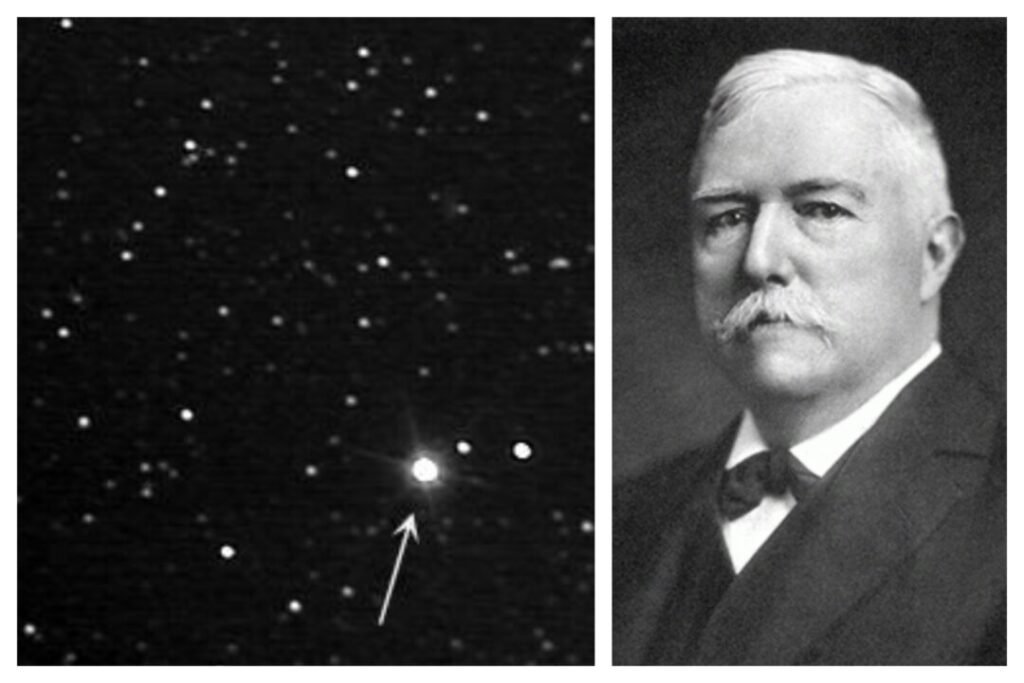
In 1916, Barnard made another major discovery, which would come to bear his name. Known for constantly observing the cosmos via telescope or sifting through photographs, he found a star that had been photographed more than two decades before.
By studying photographic plates and thanks to his sharp eyes, he discovered the closest single star to our solar system. It is understandable, though, that it had long been missed. It is about six light years away and moves at approximately 320,000 miles per hour. This red dwarf is known as Barnard’s star, and, recently, it was discovered there was an exoplanet, now called Barnard b, rotating around the star, about a third the size of Earth.