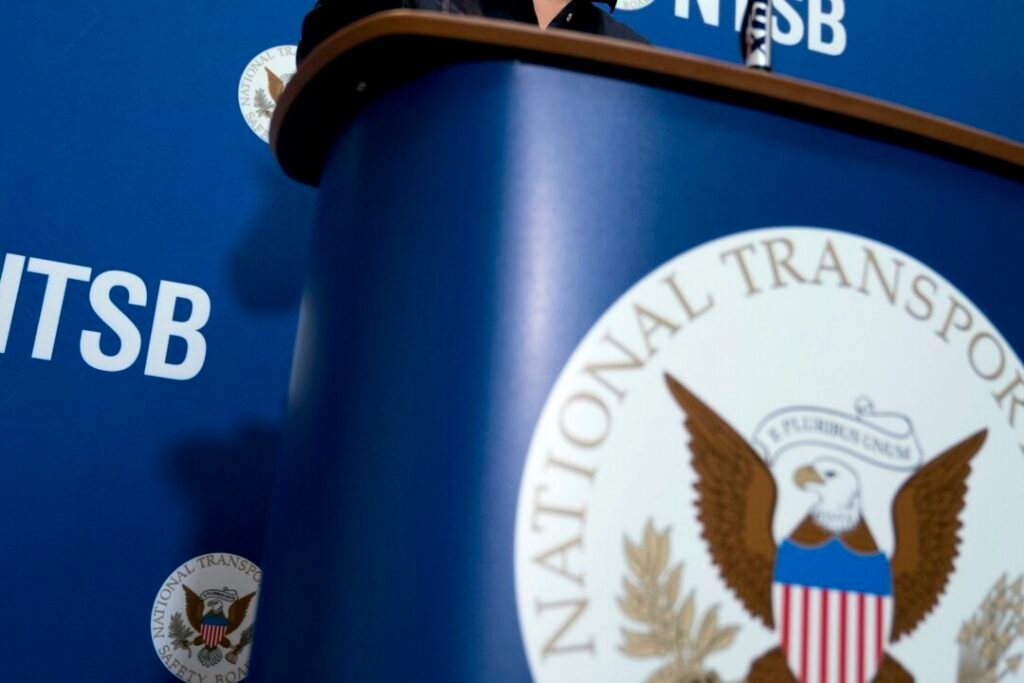

The National Transportation Safety Board logo and signage are seen at a news conference at NTSB headquarters in Washington on Dec. 18, 2017. Andrew Harnik/AP Photo
A charter plane that crashed at a remote military site in western Alaska was making a second approach to a runway amid heavy fog, the National Transportation Safety Board (NTSB) said on Aug. 21.
The crash that occurred on Aug. 20 near Cape Newenham Long Range Radar Site Airport killed all eight people onboard the flight.
NTSB Alaska region chief Clint Johnson said the plane was a Cessna Conquest 441 operated by Security Aviation based in Anchorage.
The plane was carrying two Security Aviation pilots, two members of the Army Corps of Engineers, and four contractors who were being transported to Cape Newenham. Their identities have not been released.
The plane departed Anchorage at 9.15 a.m. and crashed near the radar site’s airport at 11:45 a.m.
Johnson said the accident happened after “one missed approach,” in which the pilots had to navigate solely by instruments because the weather conditions prevented them from seeing the ground.
Related Stories


That military site is about 450 miles west of Anchorage, surrounded by mountains on three sides.
Visibility remained poor as the pilots lost contact with Anchorage controllers on the second try. The plane crashed on this second attempt, about one-third of a mile from the gravel runway.
An NTSB investigation is underway. Teams were heading to the remote location on Friday.
U.S. Air Force Lt. Gen. Robert Davis, who heads Alaskan Command along with the Alaskan NORAD Region and Eleventh Air Force, described the loss.
“This is a devastating loss for our military family and the communities we serve,” Davis said.
“Our absolute priority right now is providing unwavering support to their families, friends and teammates during this devastating time. We are profoundly grateful for the swift and tireless response of our search and recovery professionals.”
The Army Corps of Engineers contracted the aircraft. Its two employees were part of a project delivery team sent to support Air Force work at the site. The four contractors joined them.
The Federal Aviation Administration confirmed the Cessna left Ted Stevens Anchorage International Airport and traveled west of the Cape Newenham field around midday local time.
Sen. Lisa Murkowski (R-Alaska) knew the operator, having flown with Security Aviation crews across the state.
“I’ve traveled extensively with Security Aviation throughout Alaska, and have met many of their experienced pilots,” Murkowski posted.
“I appreciate the U.S. Coast Guard, NTSB, Alaska State Troopers, and the Rescue Coordination Center for responding to the site. Alaska is praying for those on board, their loved ones, and the team at Security Aviation.”
The radar site was built in the 1950s as part of a network designed to provide early warning of a missile attack by the Soviet Union. Today, it monitors the skies off the coast in the direction of Russia, North Korea, and China.
The airstrip is at a private military site managed by the Pacific Air Forces Regional Support Center. It’s part of a network of remote radar sites that tracks aircraft operating in Alaska’s airspace and along its borders, a statement from Alaskan Command said.
The Associated Press contributed to this report.