

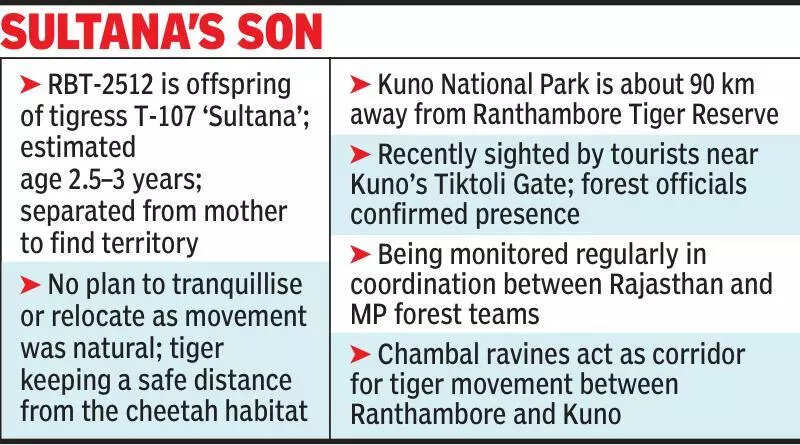
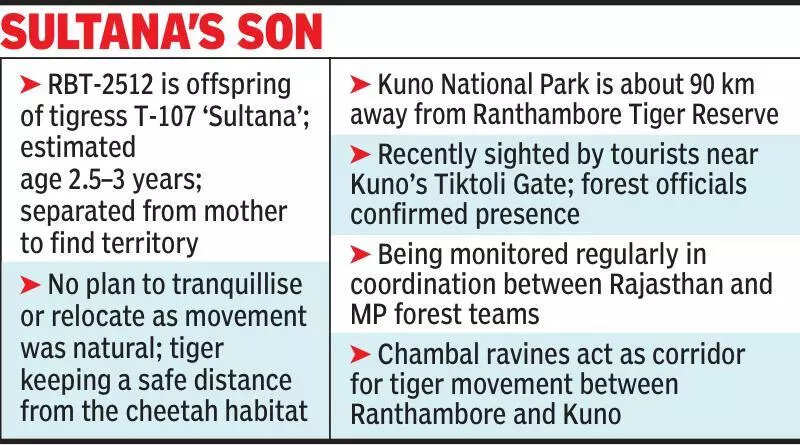
“There is continuous coordination between both forest departments, and the animal is being tracked on a regular basis. Since the dispersal occurred naturally, there is no plan for tranquillisation or relocation. The tiger is presently maintaining a safe distance from the cheetah habitat,” a senior official said.Forest department records show RBT-2512 is the offspring of Ranthambore tigress T-107, popularly known as Sultana, and is estimated to be between two-and-a-half and three years old. The tiger moved out of the reserve after separating from its mother while searching for a new territory.The Chambal River ravines form a natural ecological corridor between Rajasthan and Madhya Pradesh and have long facilitated the movement of big cats. Tigers from Ranthambore regularly traverse this route to reach Kuno, while cheetahs from Kuno were also recorded in parts of the Ranthambore landscape.The corridor has seen several notable movements over the past decade. Male tiger T-38, which shifted to Kuno Palpur nearly 10 years ago, returned to Ranthambore in 2020. Earlier movements of T-71 in 2012 and T-56, which later travelled further into Datia district of Madhya Pradesh, were also documented.Wildlife officials said sustained tiger movement along the corridor has added complexity to conservation management after the reintroduction of cheetahs in Kuno.“With annual dispersal of tigers from Ranthambore, the proximity of a cheetah landscape presents new challenges in managing large carnivore interactions,” a senior forest officer said.