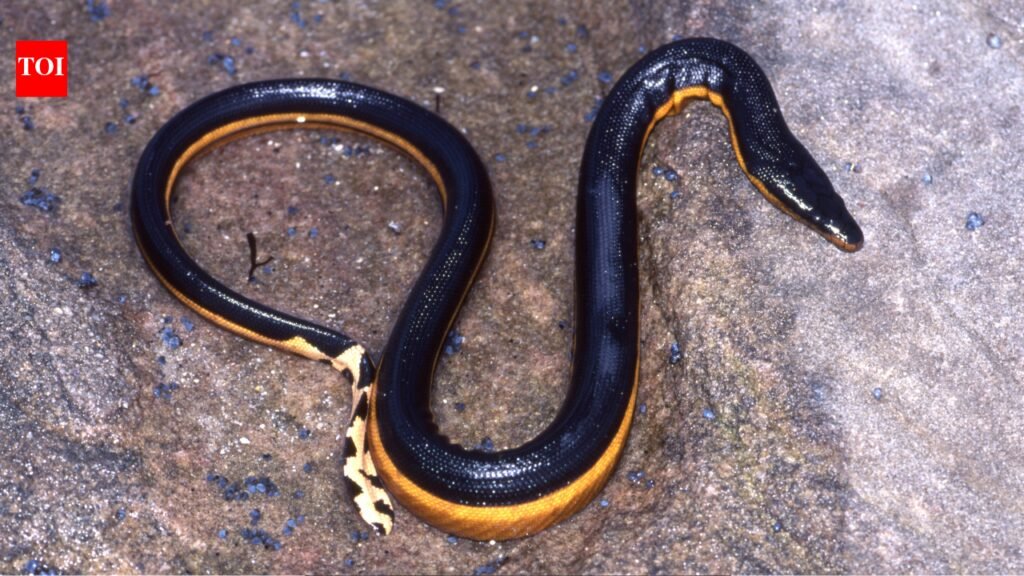
Snakes are scary slitherers with potent venom in their fangs, and one would rarely want to encounter these deadly reptiles, especially with a raised hood and a forked tongue flicking back and forth.While these scenarios are common in sultry places like rainforests, one would likely not expect an encounter with the venomous creature predator during an evening stroll on the beach, but that’s exactly what happened to one Orange County family earlier this month.What started as a curious find with a palm frond turned into a lesson in just how much our landscapes are changing.Family encounters a rare yellow-bellied predator on Southern California beachA family outing at Crystal Cove State Beach turned into an unexpected wildlife encounter on the night of September 11, when Jackie Aguilar came across a snake unlike anything she’d seen on a Southern California shoreline. Video from the encounter shows her calmly scooping it up with a palm frond, unaware at the time that she was handling one of the most venomous sea snakes in the world.It was only later, after doing some research, that Aguilar realised how serious the situation could have been. “What? A venomous sea snake on the beach!” she said, according to CBS LA. She went on to explain that after people around her mentioned how dangerous the species could be, she looked into it herself and confirmed it was a yellow-bellied sea snake, which is a species that hasn’t been spotted in the area in nearly ten years.Certified marine naturalist Capt. Chad Steffen later confirmed the identification to CBS LA, explaining that while the snake is capable of injecting venom potent enough to be fatal to humans, its behaviour on land works in people’s favour. According to Steffen, the snakes tend to be clumsy and slow once out of the water, and they’re not the type to strike unprompted. “They’re not inclined to bite at all. They’re not aggressive,” he said.How to identify a yellow-bellied snake?Physically, the species is easy to identify. It has a dark brown or black back along with a bright yellow underside, and a flattened, paddle-like tail built for swimming rather than crawling. That tail is exactly why the snake looked so out of place and awkward once it washed up on sand, as its body is adapted entirely for life at sea, not land.Yellow-bellied sea snakes are normally found much farther south, in the warmer tropical waters of the Pacific and Indian Oceans. Their unexpected appearance in Southern California is associated with changing weather patterns, including El Niño, which impact ocean surface temperatures. Species that typically stay in tropical zones start drifting into cooler regions they’d normally avoid. Steffen pointed to this year’s water temperatures as a likely factor, saying there’s been no shortage of unusual marine activity lately.