Chinese leader Xi Jinping’s remarks during his September state visit to Washington on the U.S.–China alliance during World War II demonstrated the Chinese communist regime’s ongoing effort to target Taiwan and Japan through distorted historical narratives amid regional tensions, analysts say.
The experts who spoke with The Epoch Times said it was misleading for Xi, as the Chinese Communist Party (CCP) leader, to reference the wartime alliance while leaving out key historical facts.
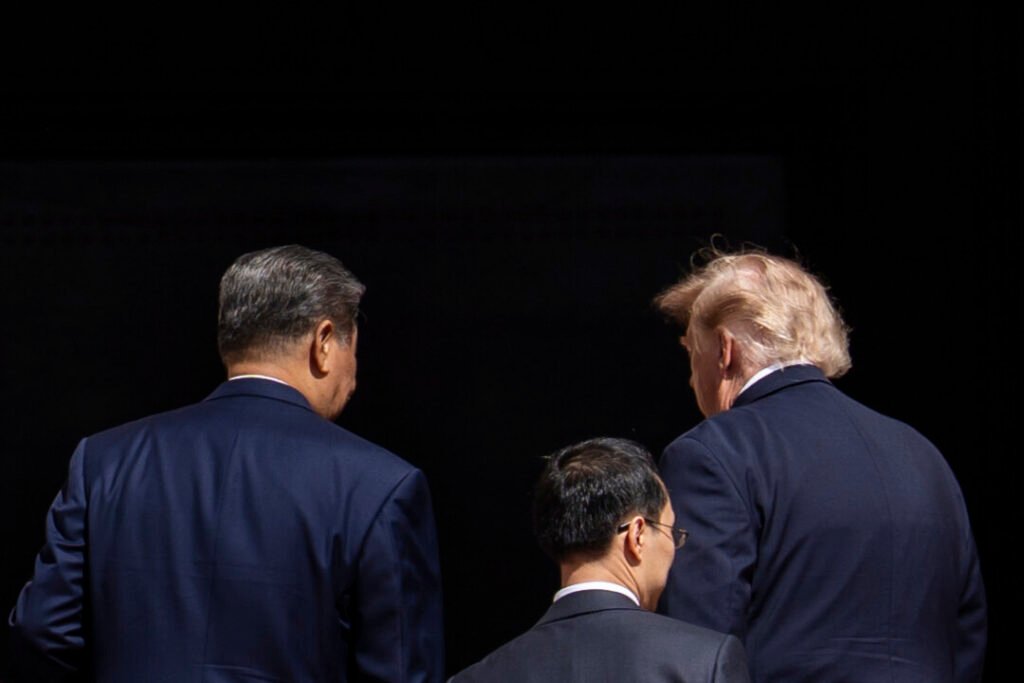
During the White House state dinner hosted by U.S. President Donald Trump on Sept. 24, Xi said in his toast that during WWII, “the Chinese and American people stood shoulder to shoulder in a fight against Japanese militarist aggressors.” Xi then described at length other more recent U.S.–China diplomatic exchanges before saying that “reviewing the past gives us new perspectives” and calling for the two countries to “write a new chapter in our friendly relations.”
While China did fight alongside the United States against Japan in the Pacific during World War II, it was the Republic of China (ROC) under the nationalist government led by Chiang Kai-shek, not the later Chinese communist regime, the People’s Republic of China (PRC).
After World War II ended in 1945, the decades-long hostilities between the nationalist forces and the Chinese communists escalated into a full-blown civil war. The war ended after four years with the CCP seizing the mainland and establishing the PRC. The defeated ROC government retreated to Taiwan, and the Republic of China has remained the island nation’s official name ever since.
Related Stories


Shen Ming-shih, research fellow at the Division of National Security Research at Taiwan’s Institute for National Defense and Security Research, said that Xi’s WWII comments distort history by obscuring the ROC.
“The aim is to claim the legitimacy and orthodoxy of the Republic of China for its own regime, and to extinguish the sovereign status of the Republic of China in Taiwan,” Shen told The Epoch Times.
The CCP “intends to imply that the People’s Republic of China has inherited the legitimacy and historical standing associated with that era—whether as a permanent member of the UN Security Council or as an ally of the United States,” he said.

Territories in China and surrounding countries occupied by Japan are shown in orange and pink on the map in 1940. Public domain
Shen noted that Chiang officially served as the supreme commander of the China Theater during WWII and represented China in the United Nations Declaration, the Cairo Declaration, and various major conferences at the time. The China Theater encompassed the campaigns in Yunnan and Burma, as well as those in Vietnam and the Indochina Peninsula.
Another expert, Su Tzu-yun, researcher and director of Division of Defense Strategy and Resources at Taiwan’s Institute for National Defense and Security Research, noted that the Republic of China’s armed forces were invited to participate in the London Victory Parade following the Allied victory in 1945.
“It was the Republic of China—not the CCP—that was listed among the ‘Big Five’ powers of World War II,” Su told The Epoch Times.
“The CCP cannot erase these facts and the historical reality that the Republic of China was a staunch ally of the United States during World War II.”
And today, Su said, it is an international reality that the ROC still exists in Taiwan.
“When they are emphasizing the cooperation between the United States and China, it only further highlights the legitimacy of the Republic of China,” he said.
Taiwan’s Reaction
Taiwanese officials have accused Xi of intentionally blurring the line between ROC and PRC.
“China is trying to replace the Republic of China’s role during World War Two,” Taiwan Deputy Foreign Minister Francois Wu said, adding that Beijing wanted to overwrite the “true history.”
Taiwanese representative to the U.S. Alexander Yui on Sept. 27 told CBS’s “Face the Nation” that Xi’s comments demonstrate how Beijing is “twisting the facts” and trying to “drive a wedge” between the United States and its allies, including Japan and Taiwan.
Although Trump also invoked the WWII U.S.–China alliance during the summit, Yui said the U.S. president “was correct in saying that the Chinese and the Americans fought valiantly in the war, but that was in the context that it was the Republic of China government,” not the Chinese communist regime, which was nonexistent at the time.
Japan’s Response
Japan’s Prime Minister Sanae Takaichi on Sept. 26 appeared to respond to Trump and Xi’s WWII-related comments at the summit.
“Despite the war, Japan and the United States have reconciled and deepened our relations. Now, we can trust each other as allies with very strong bonds,” she told reporters in Tokyo, according to Japanese media.
Trump and Takaichi also reaffirmed strong ties between the two countries in a phone call after Xi’s state visit.
The analysts said the prime minister’s statement suggests that Tokyo is concerned that the notion of a U.S.-China alliance could reinforce the CCP regime’s narrative of Japan as a shared enemy.
Su noted that today’s Japan, with its fully democratically elected government, is no longer the military regime it was during WWII.
Tokyo is also concerned that Washington might be swayed by the prospect of securing Chinese rare earths or related benefits, Shen said.
“It also fears that … the Trump administration might reach a major trade deal with China, strike a compromise on economic or geopolitical matters, or even move closer to Beijing—scenarios that would have a significant impact on Japan,” he said.
Meanwhile, Fang Wei, a U.S.-based senior journalist, suggested that Tokyo doesn’t need to worry too much about Trump’s friendly diplomatic gestures toward Xi.
“The U.S.–Japan alliance to contain the CCP is unlikely to change for the time being. As long as Japan stands firmly with the United States, it will be fine,” he told The Epoch Times.
Luo Ya and Reuters contributed to this report.