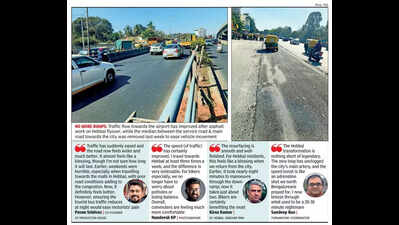
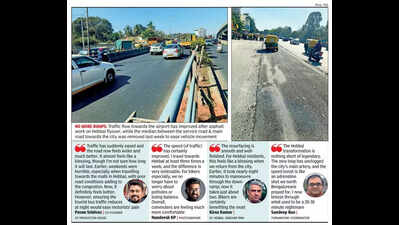
Bengaluru: In a major relief for people heading to Kempegowda International Airport (KIA), vehicular movement on the Hebbal flyover main carriageway towards the airport has become significantly faster following the completion of asphalt resurfacing work, traffic police said.Officials noted that the stretch, long considered one of the city’s biggest traffic bottlenecks, witnessed a sharp improvement in traffic flow over the past week. Before the resurfacing, average vehicle speeds on the flyover ranged between 20kmph and 25kmph because of poor road conditions and congestion. After the asphalt work, the speed is now in the range of 40-50kmph.An officer from Hebbal traffic police station said the improvement has reduced travel time for airport-bound commuters, especially during peak hours when delays at Hebbal junction often caused stress for people trying to catch flights. The officer also observed that not even one ambulance was stuck in slow-moving traffic or jams since the repairs, which is seen as very encouraging news.Officials said the carriageway earlier had several small potholes, severe asphalt damage, alligator cracks, and sudden bumps near bridge expansion joints. Though asphalt work was carried out earlier, the road surface deteriorated within a short period. This prompted traffic police to formally write to the Greater Bengaluru Authority (GBA) to undertake fresh asphalt work on the carriageways in both directions, another senior officer said.Another major reason for slow traffic movement was lane mismatch. There were three lanes on the main road before the flyover and two lanes on the service road — meaning vehicles from five lanes had to merge into three lanes on the flyover. Because of the poor road surface, vehicles moved slowly, worsening congestion, the officer added.Two-wheeler riders were among the most vulnerable. They faced the risk of accidents when four-wheelers or heavy vehicles applied sudden brake because of potholes or bumps near expansion joints. Many motorists also complained of back pain or spinal discomfort caused by the rough stretch, an officer from Hebbal traffic police station said.Explaining the scope of the project, Pommala Sunil Kumar, commissioner of Bengaluru North city corporation (BNCC), said that milling and stone matrix asphalting were carried out on the flyover surface. “We carried out milling and laid stone matrix asphalt to repair the road and provide a smooth riding surface.”He added that the flyover earlier had multiple alligator cracks due to issues with the bituminous surface. “The main carriageway has two lanes, and there were alligator cracks on both the up-ramp and down-ramp. These cracks caused waterlogging during monsoon and worsened traffic congestion,” he said. The existing damaged tar layer was removed, and the expansion joints were properly filled to ensure durability and smoother traffic movement. The work commenced on Jan 24 and was completed by Jan 28. According to police, another major reason for traffic congestion and slow movement on the flyover was frequent vehicle breakdowns. To address this, traffic police personnel and home guards continue to be deployed on the stretch. They respond to such incidents, clear stalled vehicles, and ensure smooth movement for other motorists. Where traffic slows downHowever, traffic slows down soon after the flyover, particularly near the Dairy Farm bus stop — popularly known as Kempapura bus stop — opposite Esteem Mall, especially during evening peak hours, despite the presence of a designated bus bay. While most BMTC buses use the bay, private buses are the main concern. They frequently halt on the main road instead of using the bus bay or service road, disrupting traffic flow.In Jan, a two-lane loop was inaugurated for vehicles coming from KR Pura towards the city. However, vehicles moving from the down-ramp had to criss-cross between lanes near Baptist Hospital, which slowed down traffic. To address this, the median separating the main road and the service road was removed on Wednesday. From the down-ramp to the Baptist Hospital BMTC bus stop — a stretch of over 100 metres — the median was removed. Vehicles no longer need to criss-cross, and vehicular movement has consequently become significantly faster, a senior officer said.