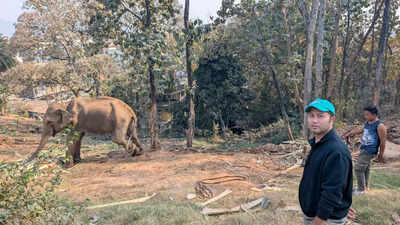
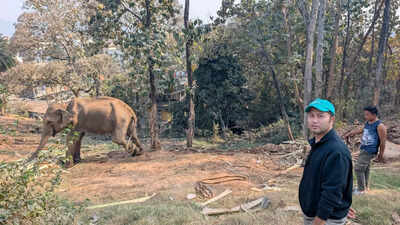
Guwahati: In the dense forests and expanding human settlements of Assam, distress calls about injured or displaced wild animals have become increasingly frequent.Responding to these emergencies is Debabrata Phukan, a wildlife veterinarian who has quietly spent years on the frontlines of wildlife rescue. Navigating difficult terrain and high-risk situations, he dedicated himself to save animals in distress.
From an early age, Phukan was intrigued by wildlife. He spent his childhood observing insects and small animals. However, as he recalled, he often felt clueless about how to turn that curiosity into action, even as his desire to do something for wild animals steadily grew within him.He pursued his studies in wildlife science in Dehradun’s Wildlife Institute of India. After completing his degree, he returned to Assam and spent two years working with an NGO, focusing on immunising livestock in fringe villages within the protected wildlife range.“When domestic animals enter park premises or when wild animals come into contact with them, the risk of disease transmission increases significantly. Disease, in turn, plays a crucial role in shaping the demography of wild populations, as outbreaks can directly affect survival rates, reproduction and overall population size. This happens because infectious diseases can spread rapidly through wildlife populations that have little or no immunity to pathogens carried by domestic animals,” he said.Following this, Phukan got the opportunity to pursue a PhD in molecular biology and biotechnology from Tezpur University, where his research focused on diseases transmitted between domestic and wild animals. During that period, he also got a job in Kaziranga National Park as a forest veterinary officer.In a region where human-animal conflict has been rising due to habitat loss and encroachment, wildlife emergencies have become more frequent. Phukan’s work spans from tranquilising distressed elephants and treating injured wild cats to rescuing birds caught in fishing lines. His approach combines medical precision with a deep sensitivity to animal behaviour, which is critical in volatile rescue environments.However, beyond individual rescues, Phukan has focused on a larger concern — the lack of structured knowledge and training in handling wild animals at the grassroots level. Many first responders in rural areas, including forest guards and local volunteers, are often forced to act with limited guidance and equipment when animals stray into human settlements.Drawing from his experience abroad, he said, “During my time in Kenya, I observed that animal handling is carried out with utmost care and detailed planning. Here in the state, however, it remains a challenge, as teams are often not well coordinated and responsibilities are not clearly divided”To bridge this gap, Phukan has been actively conducting hands-on training sessions and awareness programmes for forest staff, rescue teams and community volunteers. These sessions focus on safe restraint techniques, humane rescue practices, basic veterinary first aid, and understanding animal stress and behaviour.