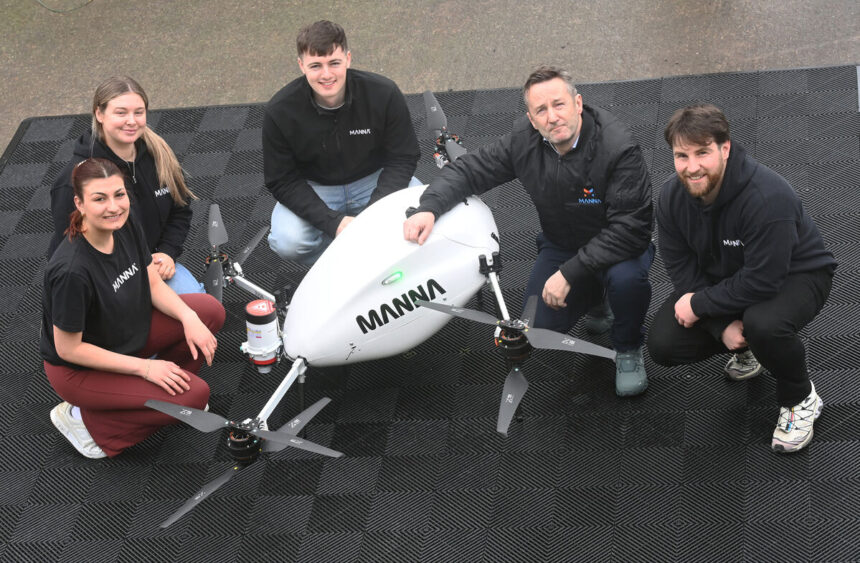
TO drive growth, it would be better for Irish drone-delivery firm Manna to “drop everything” and go “all in on the US”, but its founder and chief executive, Bobby Healy, has “firmly got a green jersey on” and wants Ireland to be a leader in this tech.
Independent retailers at Marina Market and elsewhere, including the likes of La Cantina, Frankie’s, as well as Burritos & Blues, have all said they will participate in this exploration phase with Manna.
Manna already has operations in Moneygall, Oranmore, Balbriggan, Texas, Finland, and Dublin. The company has been gradually rolling out its services over the past seven years.
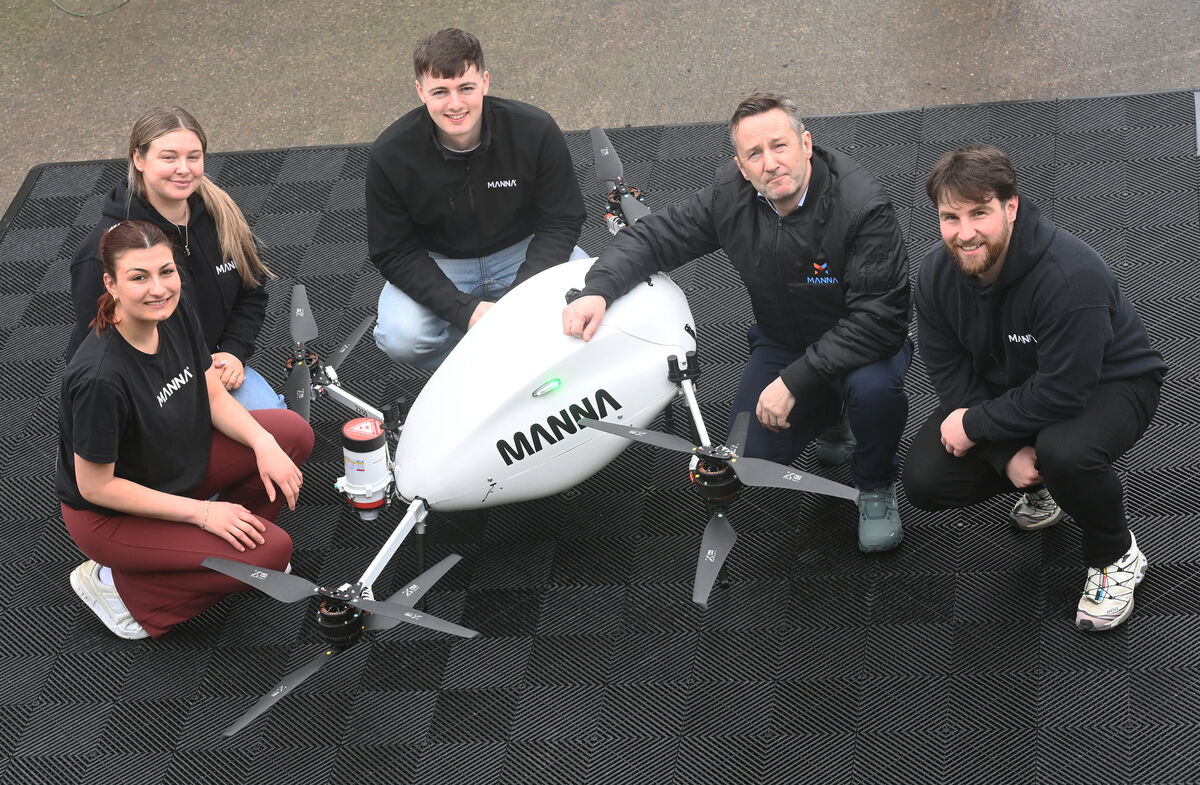
Speaking to the Irish Examiner, Mr Healy said the gradual approach is because people need to get used to drone technology, and it takes a long time to scale production and manufacturing in a way “that you’re coming out with aircraft to just work every time”.
However, he said the company is transitioning from being a “linear R&D company” that was spending millions per month on development to one that, over the next two to three years, will be raising, “hopefully, hundreds of millions” to just “pour capital into growth”.
Mr Healy said: “A good comparison is autonomous driving. So look at Waymo or Wave AI in the UK, or Tesla’s autonomous driving. Look how long it takes those great companies to be ready to scale, and we’re no different. It just takes so long.
“We will now start to drive material growth, and that will require a lot of capital,” he said.
Mr Healy said that, unlike other companies operating in this space, Manna is making money on each delivery, but is still investing a lot back into the business.
“We already make money on every delivery,” Mr Healy said. “We don’t make money. As a company, we invest a tonne, we have 175 people — but when we fly, we make money.”
“The reason we’ve been so successful at raising capital investment for the business is that we’re the only company in the world that makes money in delivery; not Amazon, not Google, not Zipline,” he said.
“There’s only American companies and us competing in this space; we’re the only ones with margin-positive unit economics.”
The drones are autonomous and overseen by one of the company’s remote pilots, who can manage 10 aircraft at a time.
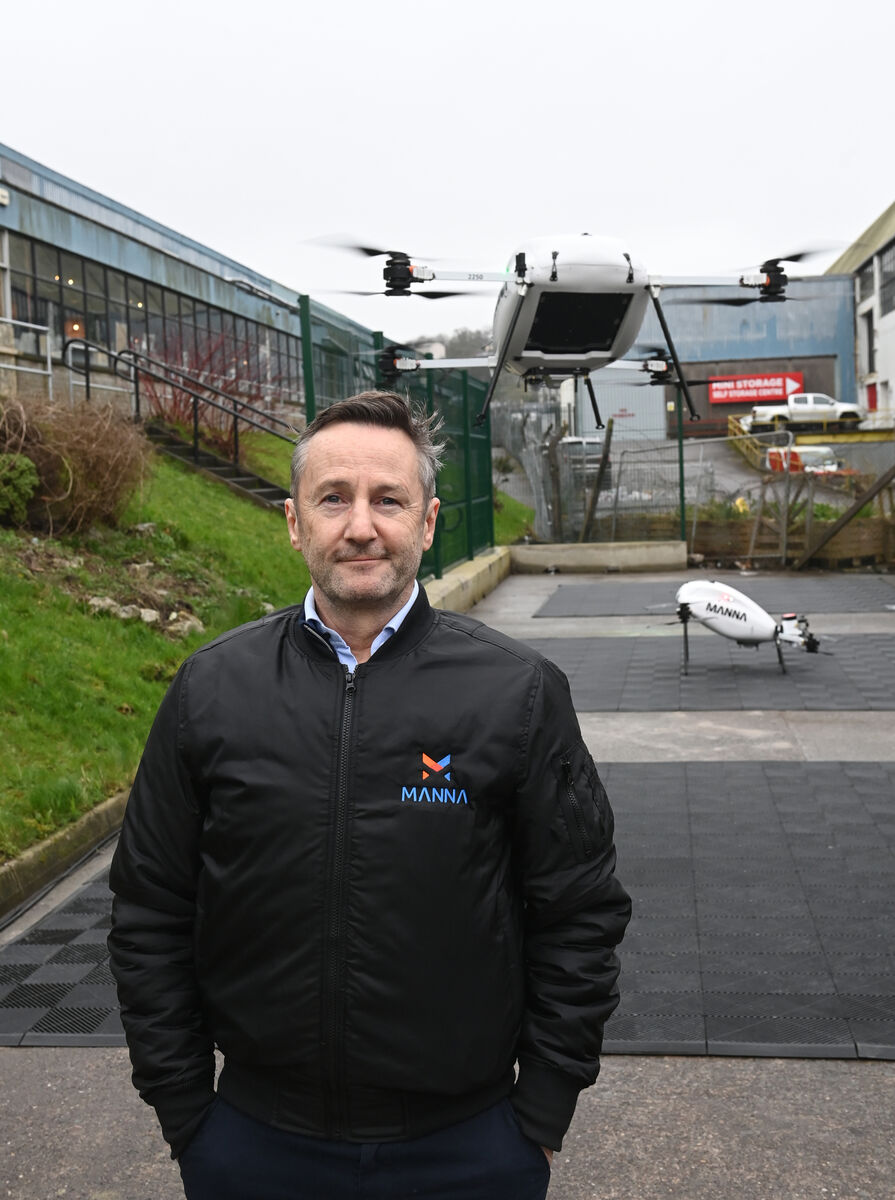
Mr Healy said: “So 10 aircraft can do 80 deliveries an hour, if you have them fully active. So that’s one person doing 80 deliveries an hour. So the labour costs are very low.”
The aircraft are a large cost, but they are able to do between 70,000 and 80,000 flights each before they are depreciated out.
“Our cost of a delivery is depreciation on aircraft, motor batteries, which is quite low,” he said.
It has chosen a strategy of being profitable from the start and being disciplined about cost.
Mr Healy said: “This isn’t SpaceX. This is flying hamburgers. You have to be like Ryanair, not like Concord. We talk about cost, we talk about turnaround time, operational efficiency, all those disciplines that you wouldn’t expect to hear about a tech company, but it is literally our whole operational focus.”
Manna has a blend of items it delivers, including medicines, books, and meat, among other things.
Smaller businesses want to work with them, because “we bring them customers that they never would have gotten before, in a way that’s very creative and viral”.
In terms of bigger companies, he said it has already signed on to work with Deliveroo, DoorDash, and that one of their investors is Coca-Cola. He said;
Regulations, particularly around airspace, are a big issue facing companies such as Manna, which can differ depending on the country.
The US is a large focus, and Manna expects to bring its operations to Oklahoma soon. Manna’s licence to operate in the US covers the whole country, while in Ireland, “for every location we roll out, we have to go through this huge engagement process, public support, and different councils”.
Mr Healy said: “Local government in Europe is hugely fragmented, and we don’t have that issue at all in the US.”
The US has a much higher concentration of consumers with more suburban homes, which are ideal for drone delivery.
“So in terms of value, it’s significantly more valuable for us than Europe would be, but in terms of natural habitat, I think Europe is probably better,” he said.
“While I could drop everything and say we’re all-in on the US, and that’s all we’re doing, I have firmly got a green jersey on.
“We want to be the leader in Europe. We already are the leader in Europe, but we want to be the leader with material growth in Europe over the next five years. Similarly, we want to be in first or second place in the United States doing the same thing.”
Manna has four other countries in Europe, which it has yet to name, where it is working towards a rollout, but has limited means to do so.
“We’re working right now on exactly where and how many sites in the US to do this year, and the outcome of that will determine whether we do one additional European market or not,” Mr Healy said.
When it comes to deploying their drones in an area, Mr Healy said there are often two concerns from locals: Noise and privacy.
However, he said there are systems to address both of those. In Cork, their aircraft will be flying at 80m; in Dublin, when the company first started operating, it was limited to 45m.
“We also introduced a brand-new propulsion system, motors and propellers, and I can tell you, noise is not an issue now,” Mr Healy said. “When we deliver to your house, we’re at 14m. You’ll definitely hear us there, but we’re there for 25 seconds.” The company has been operating in Dublin 15 for two years, and since it introduced the new propellers to its drones in October, the company says it has received 10 complaints.
The drones are autonomous and have a camera for safety, but nothing is recorded.
“Right as we get down to 20m, we switch the camera on to make sure there’s nobody underneath the aircraft: No recording, no images, no video, no sound, very low resolution,” he said.