

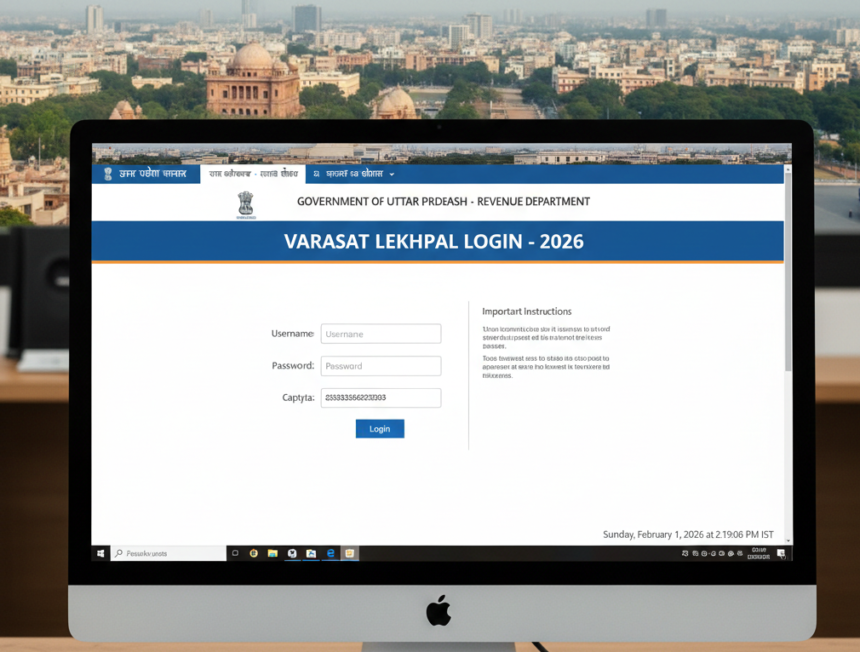
Varasat Lekhpal Login 2026 : In the heart of Uttar Pradesh’s land administration system lies the Varasat Lekhpal portal, a digital gateway that has transformed how millions of citizens interact with their land records. This comprehensive platform represents a significant step toward transparent governance and efficient land management in India’s most populous state. With over 23 million rural landholding records and thousands of urban property documents, the need for a streamlined system was imperative—and the Varasat Lekhpal login portal has answered that call.
For farmers, landowners, and citizens across Uttar Pradesh, the ability to access Khasra-Khatauni records, check land ownership details, and verify revenue records from the comfort of home represents a monumental shift from the days of endless queues at government offices. The system, officially integrated with the Uttar Pradesh Revenue Council’s computerization initiative, brings centuries-old land administration into the digital age while preserving the critical role of the Lekhpal—the village-level revenue official who has traditionally maintained these records.
This guide provides you with everything you need to master the Varasat Lekhpal login process, troubleshoot common issues, and utilize all features of this powerful land records management system. Whether you’re checking inheritance documents (Varasat), verifying land titles, or accessing crucial property records, this article will serve as your definitive digital handbook.
The Evolution of Land Records in Uttar Pradesh
From Paper Records to Digital Transformation
The journey from fragmented paper records to integrated digital systems in Uttar Pradesh’s land administration represents one of India’s most ambitious governance technology projects. For decades, land records in UP were maintained in physical ledgers by Lekhpals, vulnerable to damage, loss, and manipulation. The digitization initiative, accelerated under the Digital India campaign, has fundamentally redefined citizen-government interaction in the property domain.
The current Varasat Lekhpal portal represents the culmination of multiple phases of computerization beginning in the 1990s with isolated district-level projects, evolving into the state-wide integrated system we see today. This transformation aligns with the National Land Records Modernization Programme (NLRMP), which aims to establish a conclusive, transparent land titling system across India by replacing the current presumptive system.
Key milestones in this transformation include:
-
Initial Computerization (1990s-2000s): Scattered digitization efforts with limited integration between districts
-
Bhulekh Portal Launch (2010s): First statewide online access to land records with basic search functionality
-
Varasat Integration (2015-2018): Inheritance records digitized and linked with existing land databases
-
Mobile Accessibility (2019-present): Optimization for smartphones and development of mobile applications
-
Real-time Updation (2022 onward): Continuous synchronization between field-level changes and central database
The Uttar Pradesh Revenue Council has played a pivotal role in this evolution through its Revenue Court Computerized Management System, creating an integrated ecosystem where land records, court cases, and administrative processes converge on a unified technological platform.
Understanding the Institutional Framework
To effectively navigate the Varasat Lekhpal portal, it’s essential to understand the administrative hierarchy governing land records in Uttar Pradesh:
State Level: The Revenue Department, Government of Uttar Pradesh sets policy and oversees implementation through the UP Revenue Council, which has spearheaded the technological transformation of revenue courts and land records.
District Level: Each district has a District Magistrate/Collector responsible for land administration, supported by Additional District Magistrates (Revenue) who specifically oversee land records.
Tehsil/Sub-district Level: The Tehsildar operates as the key administrative officer for land matters within their jurisdiction, with Naib Tehsildars providing support.
Village Level: The Lekhpal remains the foundational officer maintaining land records at the village level, with responsibilities now extending to updating digital records through the Varasat portal.
This multi-tiered structure ensures both local accountability through the Lekhpal’s grassroots presence and technological integration through the state-level portal infrastructure. The Varasat Lekhpal login system effectively bridges these levels, allowing citizens to interact directly with this administrative hierarchy from anywhere with internet access.
What is Varasat? Understanding Inheritance Records in UP
The Legal Foundation of Varasat
In the context of Uttar Pradesh land administration, Varasat refers specifically to inheritance records that document the transfer of property rights following the death of a landowner. These records form a crucial component of property succession documentation and are legally recognized for establishing ownership claims. The term originates from the Urdu word for “inheritance,” reflecting the historical administrative language of the region.
Varasat records contain several critical components:
-
Genealogical Information: Family tree showing relationships between deceased and successors
-
Property Details: Comprehensive listing of inherited properties with identification numbers
-
Succession Documentation: Legal description of how property devolves to heirs
-
Mutation Records: Documentation of changes in revenue records reflecting new ownership
-
Supporting Documents: References to wills, succession certificates, or court orders when applicable
The importance of Varasat records extends beyond family property transfers—they serve as primary evidence in property disputes, support loan applications by establishing clear title, and facilitate accurate tax assessments by maintaining current ownership information. In Uttar Pradesh’s legal framework, an updated Varasat record can significantly strengthen ownership claims in both revenue courts and civil litigation.
Types of Varasat Records and Their Significance
Understanding the variations in inheritance records helps citizens identify which documents they need for specific purposes:
Regular Varasat: Standard inheritance documentation following natural succession patterns, typically processed through the Lekhpal’s office with verification from the Tehsildar.
Court-Ordered Varasat: Inheritance records established through judicial proceedings, often involving disputed successions or complex family situations requiring court intervention.
Will-Based Varasat: Succession following testamentary disposition, requiring verification of the will’s validity alongside standard inheritance documentation.
Joint Family Property Varasat: Documentation of coparcenary property division, particularly relevant for Hindu Undivided Family properties governed by specific succession laws.
Agricultural vs. Non-Agricultural Varasat: Differentiation based on land use, with agricultural land inheritance potentially involving additional considerations under tenancy laws.
Each Varasat type follows specific documentation requirements and approval pathways within the administrative system. The digitization of these records through the Varasat Lekhpal portal has standardized processes while maintaining necessary legal distinctions between inheritance types.
The Role of Lekhpals in Varasat Maintenance
The Lekhpal serves as the cornerstone of Varasat record integrity at the village level. Traditionally responsible for maintaining physical Khasra (plot-wise record) and Khatauni (holder-wise record) registers, their role has evolved to include:
Field Verification: Physical inspection of properties to verify boundaries, possession, and cultivation details during succession changes.
Documentation Collection: Gathering necessary supporting documents from inheritors, including death certificates, identity proofs, and relationship evidence.
Record Updation: Entering verified succession details into both physical registers and the digital portal through their authorized login.
Dispute Mediation: Initial intervention in inheritance disputes at the local level before escalation to revenue courts.
Public Awareness: Educating villagers about inheritance procedures, documentation requirements, and digital access methods.
The dual responsibility of maintaining both physical and digital records creates a crucial verification mechanism, with the Lekhpal’s firsthand knowledge of local land situations providing an essential reality check against purely digital transactions. This hybrid approach balances technological efficiency with local accountability—a distinctive feature of Uttar Pradesh’s land records modernization.
Complete Guide to Varasat Lekhpal Login Process
Prerequisites for Successful Login
Before attempting to access the Varasat Lekhpal portal, ensure you have the following essential requirements:
Official Credentials: Valid username and password provided by the Uttar Pradesh Revenue Department. Lekhpals receive these credentials through official channels, while citizens may need to register or use public access points.
Device Compatibility: The portal is optimized for access through:
-
Desktop computers running Windows 7 or above with browsers like Chrome (version 80+), Firefox (75+), or Edge
-
Android smartphones (version 8.0+) with Chrome or Firefox browsers
-
iOS devices (version 12+) with Safari or Chrome browsers
Internet Connectivity: Stable connection with minimum 1 Mbps speed for optimal performance. Slower connections may work with reduced functionality.
Documentation: Depending on your access type, you may need:
-
For Lekhpals: Official ID, authorization documents, and station information
-
For Citizens: Property details (Khasra number, Khata number), location information (village, tehsil, district), or registered mobile number
Browser Settings: Enable JavaScript, allow cookies, and disable pop-up blockers for the portal domain to ensure all features function correctly.
Step-by-Step Login Procedure
Follow this comprehensive login protocol to access the Varasat Lekhpal portal:
Step 1: Portal Access
Navigate to the official Uttar Pradesh Revenue Department portal. While the specific URL may vary, the primary access point is typically through the UP Bhulekh website or directly through the Revenue Department’s official portal.
Step 2: User Selection
Identify your user category on the homepage:
-
Lekhpal/Revenue Official Login: Authorized access with editing rights
-
Citizen/Public Login: View-only access to land records
-
Departmental Login: For other revenue department officials
Step 3: Credential Entry
Enter your assigned username and password in the designated fields. The system is case-sensitive, so ensure correct capitalization. First-time users may need to complete additional verification steps.
Step 4: Security Authentication
Complete the CAPTCHA verification to confirm human access. Some user categories may require additional two-factor authentication through registered mobile numbers.
Step 5: Dashboard Navigation
Upon successful login, you’ll be directed to your personalized dashboard with options based on user privileges:
-
For Lekhpals: Record updation, application processing, report generation
-
For Citizens: Record viewing, application status checking, document requests
Step 6: Session Management
Maintain awareness of session timeout policies (typically 15-30 minutes of inactivity). Regularly save your work to prevent data loss.
Troubleshooting Common Login Issues
Even with proper preparation, users may encounter technical challenges. Here are solutions for frequent login problems:
Incorrect Credentials Error
-
Verify username/password accuracy, noting case sensitivity
-
Use “Forgot Password” feature if available
-
Contact designated technical support or your superior officer for credential reset
Browser Compatibility Issues
-
Clear cache and cookies for the portal domain
-
Update browser to latest stable version
-
Try alternative recommended browser
-
Disable conflicting extensions temporarily
Connectivity Problems
-
Check internet stability through other websites
-
Switch between WiFi and mobile data
-
Access during off-peak hours if connection is slow but functional
CAPTCHA Difficulties
-
Ensure proper rendering of CAPTCHA images
-
Request audio CAPTCHA if visual impairment exists
-
Refresh for clearer CAPTCHA if unreadable
Account Lockout
-
Wait 15-30 minutes for temporary lockouts to expire
-
Contact administrator for manual unlock if persistently locked
-
Verify no unauthorized access attempts have occurred
Portal Unavailability
-
Check official social media or notification channels for maintenance announcements
-
Try alternate access portals if provided
-
Contact the UP Revenue Department helpline for status updates
For persistent issues beyond these solutions, the Uttar Pradesh Revenue Department has established district-level technical support cells specifically for land records portal assistance. These cells typically operate during office hours and can be reached through designated helpline numbers published on the department’s official website.
Key Features and Functionalities of the Portal
For Citizens: Public Access Capabilities
The Varasat Lekhpal portal offers citizens comprehensive access to land records without requiring official credentials for basic viewing:
Land Record Search
-
Khasra Number Search: Retrieve records using the unique plot identification number
-
Khata Number Search: Access holder-wise records showing all plots owned
-
Owner Name Search: Find records using owner or ancestor names
-
Location-Based Search: Filter by village, tehsil, and district
Document Viewing and Download
-
View digitized copies of original land records
-
Download certified extracts for official use
-
Print hard copies with authenticating watermarks
-
Access historical versions to trace record evolution
Application Tracking
-
Submit online applications for record corrections, mutations, or partitions
-
Track application status in real-time with milestone updates
-
Receive SMS alerts on application progress
-
Download approval documents once processed
Information Services
-
Access land-related circulars and government orders
-
View schedule of rates for property valuation
-
Check land use regulations and zoning information
-
Find contact details for local revenue officials
The portal’s citizen-centric design reflects the “Digital India” philosophy of making government services accessible, transparent, and efficient. By reducing physical visits to government offices, the system saves citizens time and resources while minimizing opportunities for discretionary delays or rent-seeking behavior.
For Lekhpals: Administrative Functions
Authorized officials enjoy enhanced capabilities through their privileged logins:
Record Management
-
Data Entry: Input new land records or update existing information
-
Mutation Processing: Officially record ownership transfers including inheritance
-
Correction Authority: Rectify errors in land records with appropriate documentation
-
Map Integration: Link textual records with spatial data including digitized maps
Case Management
-
Track revenue court cases related to land disputes
-
Update case status as proceedings advance
-
Generate hearing notices and other legal documents
-
Maintain digital case files with all related documentation
Reporting and Analytics
-
Generate standard reports on land holdings, transactions, and revenue
-
Create custom analyses using built-in query tools
-
Produce statutory returns for higher administration
-
Monitor performance metrics for administrative efficiency
Communication Features
-
Internal messaging with other revenue officials
-
Public notification system for announcements
-
Document sharing with secure access controls
-
Task assignment and progress tracking
These administrative functions transform the Lekhpal’s role from manual record-keeper to digital land administrator, enhancing both efficiency and accuracy while creating comprehensive digital trails for accountability.
Integration with Other Government Systems
The Varasat Lekhpal portal doesn’t operate in isolation—it forms part of Uttar Pradesh’s integrated governance ecosystem:
Bhulekh Integration: Seamless connection with the main UP land records portal ensures consistency between different access points and eliminates duplication of records.
Revenue Court Management System: Direct linkage with the computerization system for revenue courts allows synchronized updates between administrative records and judicial proceedings.
Aadhaar Verification: Optional integration with India’s biometric identity system for enhanced verification of identity in sensitive transactions.
Property Registration Linkage: Coordination with the Registration Department’s database to ensure consistency between sale deeds and subsequent mutations.
National Generic Document Registry: Compatibility with India’s document registry system for enhanced security and interoperability.
This systemic integration represents a significant advancement over earlier fragmented approaches to e-governance, creating what technology experts call a “whole-of-government” approach to land administration.
Security Protocols and Data Protection
Multi-Layered Security Architecture
The Varasat Lekhpal portal employs comprehensive security measures to protect sensitive land records and prevent unauthorized access:
User Authentication
-
Role-Based Access Control: Different permission levels for citizens, officials, and administrators
-
Two-Factor Authentication: For privileged accounts accessing sensitive functions
-
Session Management: Automatic logout after periods of inactivity
-
IP Tracking: Monitoring access locations for unusual patterns
Data Protection
-
End-to-End Encryption: SSL/TLS protocols for all data transmissions
-
Secure Database Architecture: Protected storage with regular security audits
-
Data Integrity Checks: Mechanisms to detect unauthorized alterations
-
Backup and Recovery: Regular backups with disaster recovery protocols
Infrastructure Security
-
Firewall Protection: Network-level security against external threats
-
Intrusion Detection Systems: Monitoring for suspicious access patterns
-
Regular Vulnerability Assessments: Proactive identification of security gaps
-
DDoS Mitigation: Protection against coordinated access attacks
These security measures align with India’s Digital Personal Data Protection Act requirements for government systems handling sensitive citizen information. Regular security audits by certified agencies ensure ongoing compliance with evolving cybersecurity standards.
Privacy Safeguards and Citizen Rights
While promoting transparency in land records, the portal balances public access with individual privacy:
Information Gradation: Different access levels for different data types—basic land details may be publicly accessible while personal identification information requires authentication.
Consent Mechanisms: Procedures for citizens to control certain data sharing aspects, particularly with third parties.
Access Logs: Comprehensive tracking of who accesses which records, creating accountability for official record views.
Redaction Capabilities: Ability to mask sensitive personal information in publicly accessible versions of documents.
Grievance Mechanism: Process for citizens to report privacy concerns or unauthorized access suspicions.
This privacy-conscious design reflects evolving norms around digital governance, recognizing that land records contain both public information (property details) and private information (personal identifiers) requiring different handling protocols.
Common Challenges and Solutions
Technical Difficulties and Resolutions
Despite continuous improvements, users may encounter system limitations:
Slow Performance During Peak Hours
-
Cause: High user load on central servers, particularly during daytime working hours
-
Solution: Schedule critical tasks during off-peak hours (early morning, late evening)
-
Workaround: Use district-level mirror servers when available
-
Long-term: Infrastructure upgrades by the Revenue Department
Mobile Interface Limitations
-
Cause: Legacy system elements not fully optimized for mobile devices
-
Solution: Use desktop mode on mobile browsers for full functionality
-
Workaround: Access through officially designated mobile applications
-
Long-term: Progressive enhancement of responsive design
Document Upload Issues
-
Cause: File size restrictions, format limitations, or connectivity interruptions
-
Solution: Compress documents before upload, ensure correct file formats
-
Workaround: Use designated e-Document submission portals as alternative
-
Long-term: Enhanced file handling capabilities
Browser-Specific Glitches
-
Cause: Variations in how different browsers render complex web applications
-
Solution: Stick to recommended browser versions
-
Workaround: Clear cache regularly, disable conflicting extensions
-
Long-term: Standardized testing across browser ecosystem
Administrative Hurdles and Navigation Strategies
Beyond technical issues, users sometimes face procedural challenges:
Verification Delays
-
Challenge: Manual verification requirements causing processing bottlenecks
-
Strategy: Submit complete documentation with self-attestation to minimize back-and-forth
-
Advocacy: Utilize escalation mechanisms after reasonable waiting periods
-
Documentation: Maintain records of submission dates and follow-up communications
Inter-Departmental Coordination
-
Challenge: Need for synchronization between Lekhpal records and other departments
-
Strategy: Initiate parallel processes where possible rather than sequential approaches
-
Advocacy: Request integrated status tracking for cross-departmental applications
-
Documentation: Obtain reference numbers from all involved departments
Legacy Data Issues
-
Challenge: Discrepancies between digitized records and historical physical documents
-
Strategy: Request certified copies of original documents to identify specific discrepancies
-
Advocacy: Utilize grievance mechanisms for systematic correction of digitization errors
-
Documentation: Build case files with evidence supporting correction requests
Digital Literacy Barriers
-
Challenge: Limited comfort with digital systems among some stakeholders
-
Strategy: Utilize facilitation centers at Common Service Centers or Tehsil offices
-
Advocacy: Request training programs for citizens and officials
-
Documentation: Access user guides and video tutorials provided by the department
Recognizing these challenges, the Uttar Pradesh Revenue Department has established multi-channel support systems including helplines, facilitation centers, and dedicated grievance cells. Persistent issues can be escalated through these official channels with proper documentation of the problem and previous resolution attempts.
Future Developments and Roadmap
Upcoming Enhancements to the System
The Varasat Lekhpal portal continues evolving with planned upgrades:
Blockchain Integration (Pilot Phase): Exploring distributed ledger technology for enhanced security and transparency in land transactions, potentially creating immutable record chains resistant to unauthorized modifications.
Artificial Intelligence Applications: Developing AI tools for anomaly detection in land records, predictive analytics for dispute resolution, and automated verification of document consistency.
Enhanced Mobile Experience: Developing dedicated mobile applications with offline capabilities for areas with intermittent connectivity, potentially utilizing Progressive Web App (PWA) technology.
Vernacular Interface Expansion: Extending language support beyond Hindi and English to include regional dialects and improving accessibility for diverse linguistic communities across Uttar Pradesh.
Real-time Synchronization: Moving toward instantaneous updates across all access points, eliminating current delays between field-level changes and system-wide visibility.
API Ecosystem Development: Creating secure application programming interfaces for authorized third-party services, potentially enabling integration with banking, legal, and real estate platforms while maintaining data security.
These developments align with India’s broader Digital Governance Roadmap and specifically the National e-Governance Plan in Land Records which aims to create conclusive land titling systems across all states.
Long-Term Vision for Land Records Management
The ultimate vision extends beyond the current portal to a comprehensive land governance ecosystem:
Spatial Data Integration: Complete convergence of textual records with spatial data through the National Generic Document Registry system, enabling visualization of land parcels with precise geographical coordinates.
Inter-State Interoperability: Seamless exchange of land records across state boundaries, crucial for border regions and multi-state landholdings, potentially through the National Land Records Modernization Programme framework.
Automated Dispute Resolution: Integration with online dispute resolution mechanisms, potentially reducing the burden on revenue courts through technology-mediated settlements for straightforward cases.
Citizen-Led Updates: Exploring controlled mechanisms for citizens to propose record updates with automated verification workflows, creating more responsive systems while maintaining integrity.
Predictive Governance: Using aggregated, anonymized land data for policy planning, infrastructure development, and agricultural optimization at regional and state levels.
This evolutionary path reflects a shift from digitization of existing processes to reimagining land governance through technology—a journey from efficiency gains to transformational change in how citizens and government interact around property rights.
Best Practices for Optimal Portal Usage
For Citizens: Maximizing Benefit from the System
To extract maximum value from the Varasat Lekhpal portal, citizens should adopt these strategic approaches:
Regular Record Monitoring
-
Schedule quarterly checks of your land records even without specific transactions
-
Verify automatic updates after any government notifications or scheme implementations
-
Maintain personal archives of downloaded documents with date stamps
-
Cross-reference portal information with physical documents periodically
Proactive Discrepancy Management
-
Immediately document discrepancies between portal records and physical documents
-
Utilize official grievance mechanisms rather than informal corrections
-
Maintain communication records with officials regarding discrepancy resolutions
-
Escalate unresolved issues through proper channels with documentation
Efficient Transaction Preparation
-
Pre-download required document formats before initiating applications
-
Complete offline information gathering to minimize online session time
-
Verify document checklists for specific transaction types before starting
-
Use off-peak hours for complex transactions requiring extended sessions
Digital Literacy Enhancement
-
Attend free workshops offered at Common Service Centers on land records access
-
Utilize tutorial resources on the Revenue Department’s YouTube channel
-
Practice with test transactions before actual need arises
-
Share knowledge within communities to build collective capability
For Officials: Effective Portal Management
Lekhpals and other authorized officials can enhance their effectiveness through these professional practices:
Data Quality Maintenance
-
Implement regular verification cycles for records under your jurisdiction
-
Establish cross-referencing protocols between digital and physical records
-
Document update rationales within the system for future reference
-
Participate in quality improvement feedback to system administrators
Citizen Facilitation
-
Develop standard responses for common citizen queries about the portal
-
Create localized guidance materials addressing area-specific issues
-
Establish regular assistance hours for citizens needing help with digital access
-
Document frequent citizen challenges for systemic improvement suggestions
Security Vigilance
-
Practice regular password updates following security guidelines
-
Maintain access log awareness to detect unusual patterns
-
Implement physical security for devices used to access the portal
-
Participate in security training programs offered by the department
Efficiency Optimization
-
Develop personal workflows that leverage portal capabilities fully
-
Utilize bulk operations where available instead of individual transactions
-
Master keyboard shortcuts and system features that reduce processing time
-
Provide constructive feedback on interface improvements to development teams
Comparative Analysis: Varasat Lekhpal Portal vs. Other State Systems
Technological Sophistication Comparison
When evaluated against similar systems in other Indian states, Uttar Pradesh’s Varasat Lekhpal portal demonstrates distinctive characteristics:
Maharashtra’s Bhulekh System
-
Strength: More advanced spatial integration with digitized maps
-
Weakness: Less comprehensive inheritance record integration
-
Differentiator: UP’s stronger focus on Varasat (inheritance) as core component
Rajasthan’s Apna Katha Portal
-
Strength: Superior mobile application with offline capabilities
-
Weakness: Less detailed historical record archives
-
Differentiator: UP’s deeper integration with revenue court management
Karnataka’s Bhoomi System
-
Strength: Earlier implementation with more stabilized processes
-
Weakness: Less frequent feature updates and modernization
-
Differentiator: UP’s more aggressive roadmap for future enhancements
Madhya Pradesh’s Bhulekh Portal
-
Strength: Simpler user interface with lower digital literacy requirements
-
Weakness: Limited functionality beyond basic record viewing
-
Differentiator: UP’s balance between sophistication and accessibility
This comparative analysis suggests that while no system is perfect across all dimensions, Uttar Pradesh’s portal represents a middle path—more functional than minimalist systems but more accessible than overly complex platforms. This balance likely contributes to its widespread adoption across diverse user groups within the state.
Integration Depth with Legal Processes
Where Uttar Pradesh’s system particularly excels is in its embeddedness within legal and administrative processes:
Revenue Court Connectivity: Unlike systems that treat land records as isolated databases, UP’s portal maintains live connections with revenue court cases, allowing synchronized updates as cases progress.
Mutation Workflows: The system doesn’t merely display records but facilitates complete mutation processes from application to approval with integrated verification steps.
Documentary Evidence Integration: Legal documents like wills, succession certificates, and court orders can be referentially linked to land records rather than existing as separate entities.
Multi-generational Tracking: The emphasis on Varasat (inheritance) enables lineage-based tracking of property transfers across generations—a crucial feature for establishing clear titles in India’s complex succession landscape.
This process-oriented design reflects an understanding that land records gain value through their connection to legal and administrative actions, not merely as static information repositories.
Conclusion: The Transformative Impact of Digital Land Records
The Varasat Lekhpal portal represents more than technological convenience—it embodies a fundamental shift in citizen-state relations around property rights in Uttar Pradesh. By making land records transparently accessible, the system addresses historical power imbalances in land information management. Farmers no longer depend entirely on intermediaries to understand their property rights. Women heirs can more readily assert succession claims with documentary evidence. Marginalized communities gain clearer pathways to establish legitimate land ownership.
The true measure of the system’s success lies not in technical specifications but in lived citizen experiences—the inheritance smoothly transferred during difficult times, the property dispute resolved with clear documentation, the loan obtained for agricultural improvement based on verifiable land title. These individual stories collectively represent a quiet revolution in rural and urban governance.
As the system evolves with emerging technologies like blockchain and artificial intelligence, the core principle remains constant: land records as public goods that should serve citizen needs rather than administrative convenience. The Varasat Lekhpal login—that simple authentication step—opens a portal not just to digital documents but to empowered citizenship in one of India’s most crucial governance domains.
For citizens of Uttar Pradesh, mastering this digital gateway has become an essential skill for property ownership in the 21st century. For the state administration, it represents a commitment to governance that is simultaneously more efficient and more equitable. And for India’s digital transformation narrative, it offers a compelling case study in how technology can strengthen foundational institutions of democracy and development when implemented with citizen-centric design and continuous improvement.