

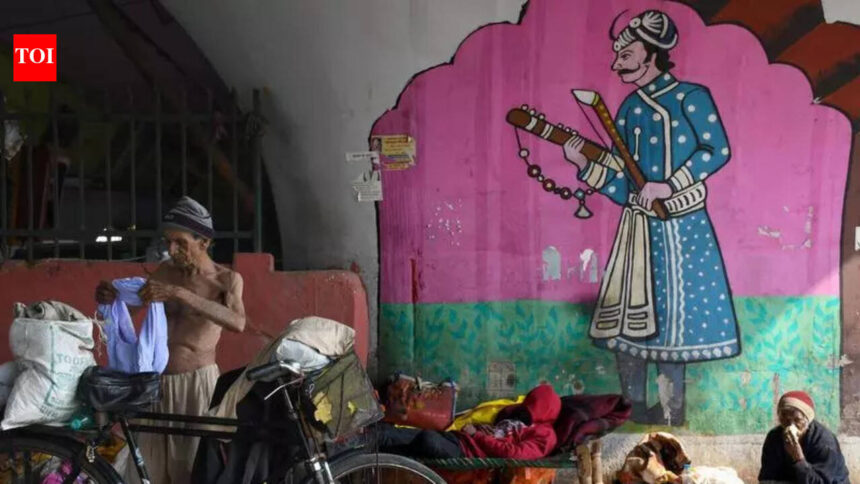
New Delhi: As Delhi gears up to host high-profile dignitaries for the upcoming AI summit, those who spend their lives beneath its flyovers, on footpaths and central verges say they are accustomed to being asked to temporarily “move aside” whenever the city prepares to present a polished face.Authorities have already told Delhi Urban Shelter Improvement Board to start shifting the homeless as part of measures to ensure smooth traffic movement, security and general preparedness during the next week’s high-profile international event.On Wednesday afternoon, TOI visited some stretches near Lodhi Road, Red Fort railway bridge, M G Road, Bahadur Shah Zafar Marg and Bhairon Marg, and found several people resting, eating, playing cards, shaving and changing their clothes in the open.Most of them, migrants from Bihar, UP, West Bengal and Nepal, are daily-wage labourers, ragpickers and, in some cases, beggars.Many said thefts and overcrowding deter them from moving into shelter homes and that they would rather shift to other roadside locations. “The shelters are crammed. Also, money and personal belongings are often stolen from there,” claimed a man who stays on a footpath on M G Road.Others said they would prefer putting up in the shelters instead of sleeping in the open, but can’t do soas they lack identification documents. Though none has so far been asked to shift because of the AI summit, they said temporary displacement during VVIP movement is common.“Whenever dignitaries pass from this stretch, police ask us to clear it for some time. We cooperate. After all, this is not our personal land,” said Krishna, 43, who stays near the Red Fort railway bridge and is part of a team that pitches tents at weddings and events.Ashok Ram (40) from Bihar, who sleeps on a footpath on MG Road, said, “We stay here, so in a way it feels like home. We work here and there, and we sleep wherever we find space. However, when I was first asked to shift to another place ahead of the visit of a dignitary, it felt disturbing. Now, we are used to it. If they ask us to cooperate, we do.”An elderly couple TOI spoke to near Hanuman Mandir close to the Red Fort flyover said police usually ask them to vacate the area for a few hours or days when a major event is scheduled nearby. “Sometimes they drop us off at shelter homes, but we don’t stay there for long,” Pooja (50) said, alleging lack of space and safety. Her belongings had gone missing during previous stints at such shelters, she claimed.Abdul, 60, originally from Kolkata, has been living intermittently near Bhairon Marg for nearly a year. Paralysed in both legs following a stroke in 1981, he depends entirely on his wheelchair. “I have been staying outside a temple,” he said. “If I am asked, I will shift somewhere else. We already live on the road without a roof. What more discomfort can there be?”However, he is wary of shifting to a shelter. “This wheelchair is my everything. If it is stolen, I can’t even move around to get food,” he said. “In shelters, there are so many people. I am scared I won’t be able to keep it safe.” Despite his concern, he doesn’t oppose the potential relocation. “If guests visit the city, it must look good. We only want our things to be safe. Whatever little we have is everything for us,” he said.Some of the homeless people TOI spoke to said lack of ID cards prevents them from accessing the shelters. “I recently came from Nepal and don’t have proper documents. Without proper papers, they don’t let us in,” said Ram, 37, who calls a slice of space beneath the Lodhi Road flyover home and survives on daily labour and seasonal work at weddings.Responding to these concerns, a senior govt official associated with shelter management in the city said permanent shelter homes have locker facilities where people can store their belongings safely. “There are caretakers at the centres. In large facilities, isolated incidents can happen, but security arrangements are in place,” the official said.