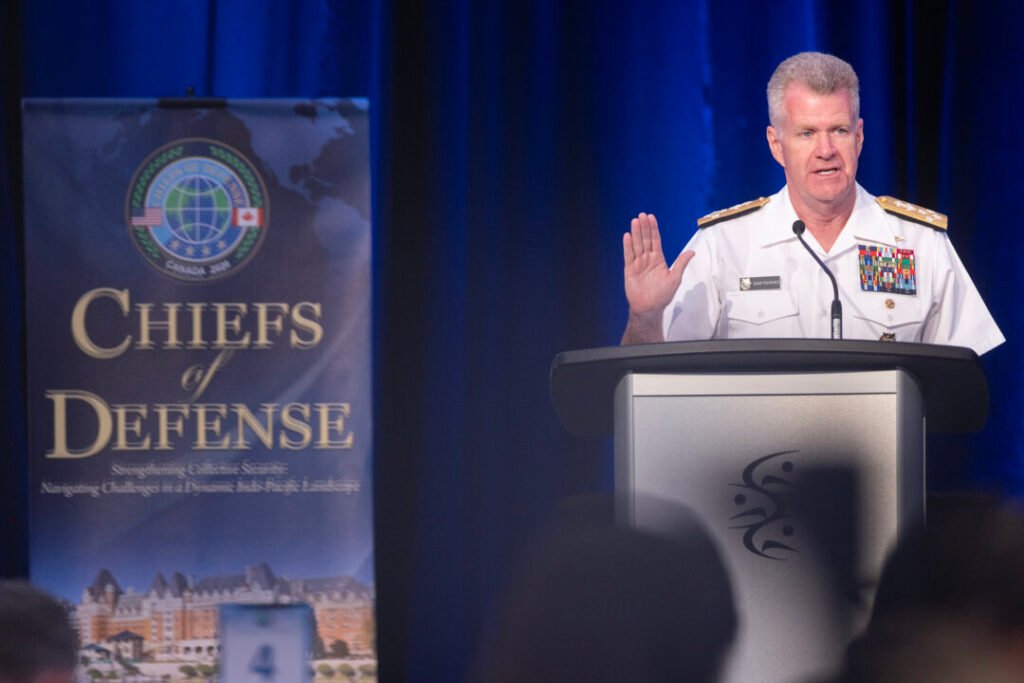

U.S. Admiral Samuel Paparo delivers opening remarks during the opening ceremony at the 28th annual Indo-Pacific Chiefs of Defence Conference in Victoria on Sept. 1, 2026. The Canadian Press/Chad Hipolito
U.S. Pacific Commander Admiral Samuel Paparo says Canada continues to be a “close” and “indispensable” partner for the United States and that both nations are committed to common defence regardless of any ongoing political discussions.
Paparo made the remarks while in Victoria, B.C., for the annual Indo-Pacific Chiefs of Defence Conference co-hosted by Canada and the United States, delivering opening remarks Sept. 1 and speaking separately to reporters on Sept. 2. He later addressed a press conference jointly with Canada’s Chief of the Defence Staff is General Jennie Carignan.
Paparo emphasized the apolitical status of military ties between allies when speaking to media Sept. 2.
“Military-to-military relationships are such a serious foundation, they’re executed without emotion, they’re executed on the facts on the ground of a requirement to defend our spaces together.”
Related Stories
Paparo said any ongoing political discussions doesn’t impact military cooperation between the two nations.
“This professional ethos of [an] apolitical military is really so common throughout the Indo-Pacific and throughout the world, and that’s how we deal with the ups and downs of political discourse,” he told reporters Sept. 2.
Asked repeatedly by a reporter under what circumstances he would obey an order to undertake military action against Canada, Paparo called the suggestion ridiculous.
“I find that scenario to be absolutely and utterly preposterous,” Paparo said, laughing. “I follow the orders of the commander-in-chief but that is a needlessly emotional question.”
“Would you ask me please also what my attack plans are for the Martians?” he added.
As head of U.S. Pacific Command, Paparo is responsible for U.S. military operations and activities across the Indo-Pacific region, encompassing 36 nations and more than 400,000 U.S. military and civilian personnel.
This year’s Indo-Pacific Chiefs of Defence conference was held Aug. 31 to Sept. 2 in Victoria and brought together top military brass from 29 nations.
The Indo-Pacific Chiefs of Defence conference is a regional military forum intended to bring together top military leaders to discuss security challenges and potential military coordination and cooperation.
More broadly in his Sept. 1 remarks, Paparo said that allied militaries should boost their deterrence capabilities, although he did not reference any specific global conflicts or military tensions.
“We must adapt before crisis forces us to. Not every crisis turns into a conflict, but every conflict begins with a crisis,” Paparo said. “Would-be aggressors must see that the cost of aggression outweighs any perceived benefits.”