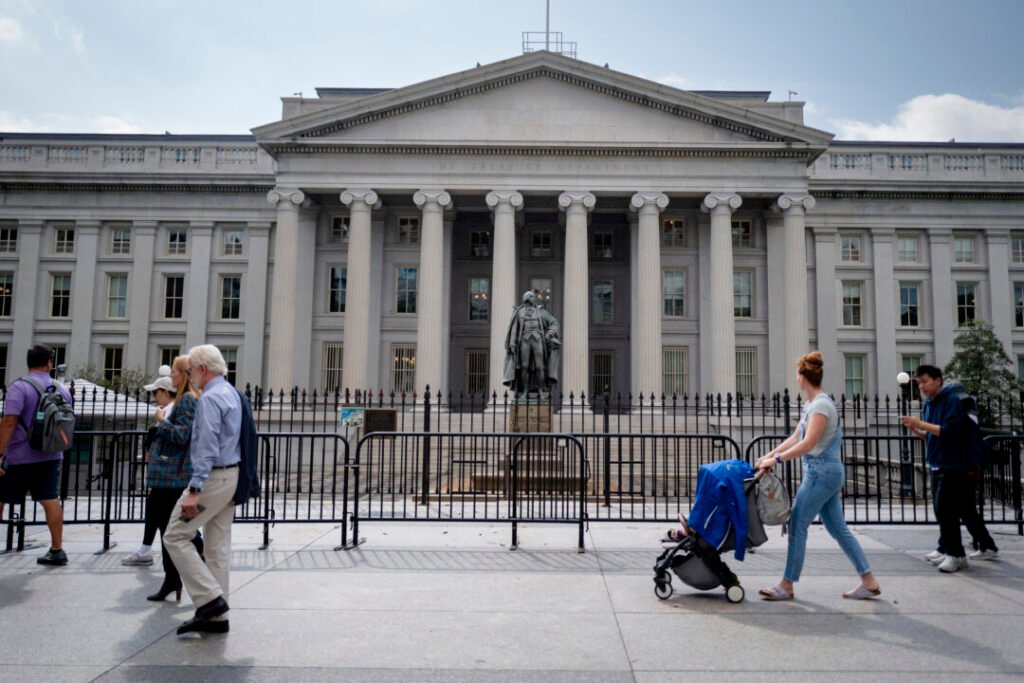
The U.S. Treasury Department has fined Amidi LLC $200,000 for failing to report an investment in a Chinese tech startup—the first penalty under U.S. restrictions on investments in sensitive Chinese technologies.
Amidi is the parent company of Plug and Play Tech Center, a California-based venture investment and startup accelerator organization. The Treasury imposed the penalty in July and disclosed it on Oct. 7.
According to Treasury, a Chinese investment fund controlled by Amidi invested $92,478 on April 19, 2025, in Shanghai Qiongche Intelligent Technology, known as Noematrix, a Shanghai-based developer of AI technology that helps robots interact with and perform tasks in the physical world.
The Treasury identified the transaction through regular compliance and market monitoring. The violation was a failure to report the investment, not a finding that the investment itself was prohibited.
1st Penalty Under US Investment Restrictions
The Outbound Investment Security Program, which took effect on Jan. 2, 2025, prohibits certain U.S. investments in Chinese companies developing advanced artificial intelligence, semiconductors, and quantum technologies. Other transactions involving these sectors are permitted but require notification to the Treasury.
Related Stories

The rules also cover certain investments made through foreign subsidiaries controlled by American companies.
The restrictions are intended to prevent American capital and investment-related benefits from supporting the development of sensitive technologies that could threaten U.S. national security.
Christopher Pilkerton, the Treasury’s assistant secretary for investment security, said in the Oct. 7 announcement that the program addresses the development of sensitive technologies by countries of concern that could pose national security risks.
Plug and Play’s China Investment Network
Amidi’s investment in Noematrix followed several earlier financing rounds involving Plug and Play China, the China-based investment and startup development operation of the Silicon Valley network.
Noematrix identified Plug and Play China as an investor in its September 2024 financing, several months before the U.S. restrictions took effect.
In December 2024, Noematrix announced another financing round led by Sequoia China, a Chinese venture capital firm, and said Plug and Play China had increased its investment.
On April 10, 2025, Noematrix announced another financing round, again naming Plug and Play China as a participating investor.
Nine days later, the Amidi-controlled Chinese fund made the investment identified in the Treasury’s enforcement action. It remains unclear whether the two transactions were connected or whether the fund was the investment vehicle used by Plug and Play China.
The Epoch Times contacted the Treasury, Amidi, Noematrix, and Plug and Play China to seek clarification on the Chinese fund, its relationship with the Silicon Valley investment network, and the failure to notify U.S. authorities. None responded by publication time.
Chinese University and State-Linked Investment
Noematrix has since received financing from Chinese university-linked and state-owned investors.
In June 2026, the company announced another financing round involving Shanghai Jiao Tong University’s AI Future Fund, a university-linked technology investment fund; Shanghai Chuangzhi Technology, a subsidiary of the Shanghai Chuangzhi Academy research institution; and Wuxi Data Group, a state-owned data industry company.
Noematrix said it had worked with Shanghai Jiao Tong University and Shanghai Chuangzhi Academy on joint laboratories and research projects. Its co-founder Lu Cewu is a professor and vice dean of Shanghai Jiao Tong University’s School of Artificial Intelligence.
The company also said it had joined Wuxi Data Group and other partners in launching a citywide initiative to collect high-quality data from real-world activities to train robotic AI systems.
The initiative targets data from 1,000 businesses and 1 million hours of real-world activity, according to Noematrix. The company said the partners had released the project’s first phase results and planned to expand industrial datasets to support the use of AI-powered robots on production lines.