

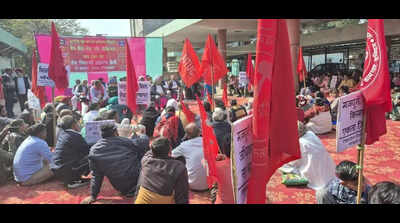
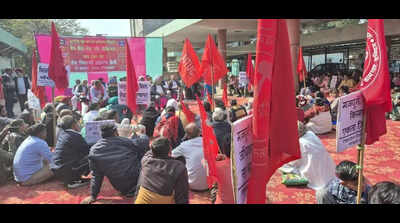
TNNLudhiana: Various trade unions, farmer groups and workers’ organisations on Thursday held a joint protest at the Inter State Bus Terminal (ISBT) in Ludhiana as part of the nationwide Bharat Bandh call, raising strong objections to several central govt policies. The demonstrators voiced opposition to the proposed Indo-US trade deal, the labour codes, the draft Seed Bill, amendments to the MGNREGA Act, and the proposed Electricity (Amendment) Bill.
A large number of protesters gathered at the site, raising slogans against what they termed as “anti-farmer” and “anti-worker” measures. Union leaders said that the combined impact of these policy decisions would negatively affect farmers, labourers and economically vulnerable communities.Chamkaur Singh, district secretary, All India Kisan Sabha, said farmers were already facing severe economic stress. Referring to the year-long agitation against the now-repealed farm laws, he said fresh policy changes were once again generating uncertainty within the agriculture sector. On the proposed Indo-US trade arrangements, he said increased imports of processed foods, edible oils and fruits from the United States could push Indian farmers into intense global competition. He argued that many Indian farmers already struggle without adequate MSP cover and face insufficient institutional support. Allowing heavily subsidised agricultural products from abroad, he said, would depress domestic prices further and hit farmers’ incomes.Surinder Kaur, president of Aurat Mukti Morcha Punjab, also cautioned that marginal and small farmers would bear the maximum burden if cheaper imported agricultural goods flood Indian markets. She pointed out that farmers in developed countries receive significant subsidies that lower their production costs. Without stronger MSP coverage and amid rising input costs such as seeds and fertilisers, she said, survival would become increasingly difficult for small cultivators.Protesters also objected to the draft Seed Bill, saying that although the government claims it aims to improve seed quality, it could increase the influence of private and multinational corporations in the seed market. Leaders argued that this would raise input costs and create dependency on proprietary seeds, affecting farmers’ autonomy.Trade union representatives criticised the four labour codes, which merge 29 labour laws into four categories—wages, industrial relations, social security and occupational safety. While the govt has maintained that the codes simplify compliance and extend social security, unions argued that the changes dilute worker protections by weakening collective bargaining, making hiring and firing easier for companies and raising thresholds for layoffs and strikes.Mangat Ram Parsla, state vice-president of a central trade union, also criticised the proposed Electricity (Amendment) Bill, saying that allowing multiple service providers in the same distribution area could lead to increased privatisation, higher tariffs and reduced accountability. He said such changes would particularly affect rural consumers and small farmers who depend on subsidised power.Anganwadi workers, Karkhana Mazdoor Union, Punbus PRTC Contract Workers Unions, and several other organisations also participated in the demonstration.